Get Full Government Meeting Transcripts, Videos, & Alerts Forever!
Get email alerts on the Higher Education Budget topic
No spam. Unsubscribe anytime.
Higher education budget overview sets FY26-27 base; committee warned one-time funding lowers tails
Summary
Nonpartisan fiscal staff told the House Higher Education Finance and Policy Committee that the committee will draft its FY26-27 base from current forecasts, emphasizing that prior one-time spending raised FY24-25 totals and that ‘‘tails’’ (FY28-29) depend on how the session law defines bases.
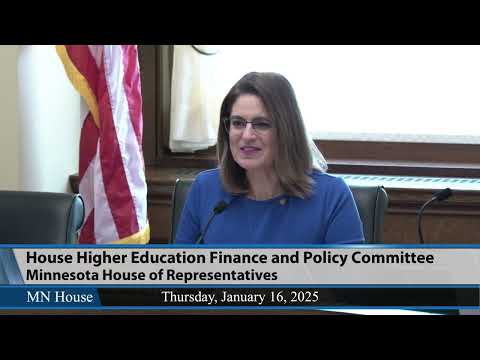
The House Higher Education Finance and Policy Committee received a fiscal briefing that laid out how the committee will set base funding for the FY26-27 biennium and how ‘‘tails’’ could affect FY28-29 obligations.
Ken Savory, the committee's nonpartisan fiscal analyst, told members the state fiscal year runs July 1 to June 30 and that the committee’s omnibus higher education appropriations will be almost entirely general fund direct appropriations. He said direct appropriations are typically written into session law and that ‘‘tails’’ (out-year obligations) follow the base set by the committee unless the session law specifies otherwise.
The briefing emphasized that FY24-25 included substantial one-time funding that raised the apparent recent funding level. ‘‘So the spending is lower than it was in 24 and 25,’’ Savory said, adding that base amounts for FY26-27 shown in the November forecast will be the starting point for drafting. He walked members through budget concepts including one-time appropriations, statutory (open) appropriations, and the difference between operations & maintenance (O&M) appropriations and state special appropriations.
Savory displayed pie charts showing higher education’s share of the general fund over time and noted higher education’s relative share declined from earlier decades even as nominal funding rose. He described the typical finance article ordering: Office of Higher Education first, then Minnesota State, then the University of Minnesota, followed by state special appropriations and Mayo Foundation riders. He also summarized the composition of the most recent enacted budget for FY24-25, in which Minnesota State accounted for roughly 45 percent, the University of Minnesota about 36 percent, and the Office of Higher Education about 19 percent of higher ed general fund spending.
Chair Rehrig opened the meeting by noting invited Office of Higher Education (OHE) staff were not present. She said, on the record, that OHE staff said they were ‘‘under orders from the governor to not show until what they said was, that the legislature is legitimate and there is bipartisanship.’’ Nonpartisan staff filled in for OHE for the fiscal overview.
Savory also described the calendar and constraints that flow from the February economic forecast and the House rules that limit how budget resolution targets are used during drafting. He repeated that the committee’s starting numbers are the November forecast base amounts for FY26-27 and that the committee will track tails (FY28-29) on spreadsheet tools if the committee sets ongoing bases that create out-year obligations.
The presentation closed with a summary of state special appropriations (several tied to research and partnerships) that the committee will review when agencies appear to describe how they use those funds.
For committee members, the briefing provided a technical foundation for drafting the finance article and a reminder that previous one-time spending can make the current base appear higher than the ongoing base the committee must fund.
Looking ahead, staff said they expect to update numbers after the February forecast and to use the November base as the working starting point for the committee’s FY26-27 omnibus finance bill.