Get Full Government Meeting Transcripts, Videos, & Alerts Forever!
Get email alerts on the Student Cell Phone Policy topic
No spam. Unsubscribe anytime.
District officials, principals and students report early gains and consistency challenges in cell‑phone policy
Summary
Assistant superintendent and school leaders presented a mid‑year review of the district’s student cell‑phone procedures, citing reduced classroom phone use, fewer referrals at some schools and student concerns about inconsistent enforcement and downtime during long block periods.
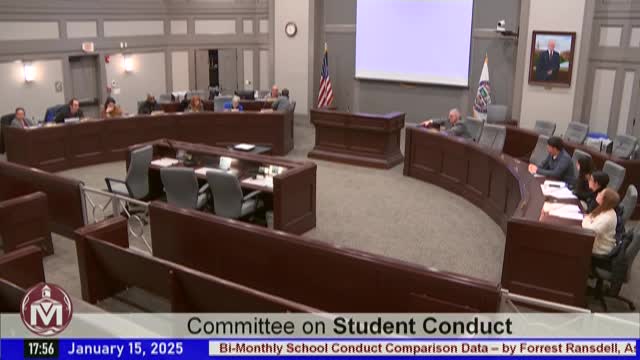
Assistant Superintendent Forrest Randsell opened the Jan. 15 Committee on Student Conduct discussion on the district’s cell‑phone procedures, describing the work as a procedural implementation rather than a policy rewrite and asking for input from students and school leaders.
“[W]e consciously did not change our electronic policy over the summer because we already had a very restrictive policy that allowed us to enforce what we wanted to see happen,” Randsell said. He invited secondary school leaders and student representatives to report mid‑year progress and challenges.
Principals from middle and high schools said consistent enforcement has reduced classroom phone use. Kelly Williams, principal of McLaughlin Middle School, said clear messaging to staff and a grade‑level approach helped: “Administration has met with students 1 on 1 just to say, let me know what the rules are, reiterate those for me, and this is why we have the policies that we have,” Williams said. Southside principal Kelly Espinola described a simple locker‑style system at her school: students drop phones into labeled slots each morning and retrieve them at dismissal.
High‑school leaders reported improvements but flagged fatigue and inconsistent enforcement as ongoing issues. Central High said it uses a “digital hall pass” toggle to record teacher notifications to parents; Central reported 899 parent notifications so far this year and 34 office conduct referrals coded under the electronics code (E LEC). Parkside and Memorial principals reported fewer phone violations overall but noted that students still find ways to hide devices.
Students told the committee the policy improved focus for many but highlighted inconsistent enforcement and long intervals of downtime in block scheduling. Student member Gray said classmates “did understand why they passed it and they said that they were more focused in class and, they got their more work, they got all the work done,” but also reported that when students finished early there was sometimes “nothing else to do.” Another student from Manchester West said longer block periods (about 85 minutes) can lead to attention lapses and phone use later in the period.
Committee members asked about bathroom congregations and the digital hall‑pass rollout. Administrators said the digital hall pass can limit simultaneous bathroom passes and that some schools have students log themselves in and out to reduce teacher burden. A committee member said middle schools enforce the “off and away” rule strictly; principals said pockets or backpacks are acceptable locations when phones are fully off.
Nut graf: District leaders described measurable declines in phone use during instruction at multiple schools and a reduction in some categories of conduct referrals; student and teacher feedback during the mid‑year review also identified inconsistent enforcement, scheduling and supervision issues that the district intends to address.
Ending: The committee encouraged continued coordination between principals, staff and students; staff said training and consistent implementation would remain priorities for the rest of the year.