Get Full Government Meeting Transcripts, Videos, & Alerts Forever!
Get email alerts on the Education Vouchers topic
No spam. Unsubscribe anytime.
Manchester committee hears objections to HB 115 expansion of Education Freedom Accounts
Summary
Members of the Manchester Legislation & Education Committee questioned accountability and fiscal impact of House Bill 115, which would remove the income cap on New Hampshire's Education Freedom Accounts (voucher) program and make it universally available to nonpublic-school students.
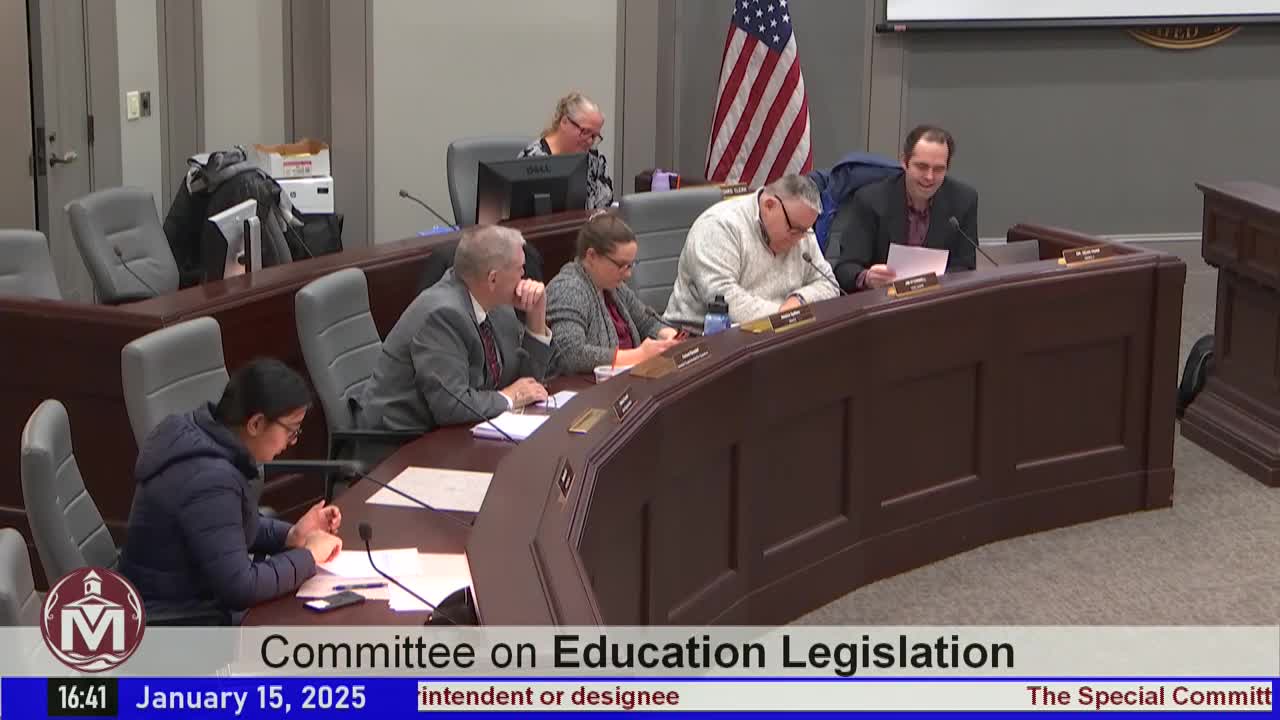
Members of the Legislation & Education Committee of the Manchester School District on Jan. 15 discussed House Bill 115, a bill scheduled for a public hearing the following day that would remove the income cap on New Hampshire's Education Freedom Accounts (EFA) voucher program.
The proposal would allow any student not attending a public school to apply for an EFA. Committee members highlighted uncertainties about the bill's fiscal impact and flagged accountability gaps in the current program. "This program, when first sold to us as a state, was that it was gonna save money," Committee member O'Connell said. "...we've seen what has happened in other states where this has grown out of there's no limit on it."
The committee heard that the average voucher currently is about $5,200 per student, that last year's EFA spending totaled roughly $28 million, and that some projections put costs for a universal program at more than $100 million. The committee also heard that 77% of current voucher recipients already attend private schools or are homeschooled, meaning most vouchers are additional state spending rather than payments substituting for public-school aid.
Committee member O'Connell and others criticized the program's record of oversight. "The Department of Education has essentially farmed out the administration of the program to another corporation, the Children's Scholarship Fund, which takes a 10% cut off the top of all the vouchers," O'Connell said, adding that audits showed errors and that the program's reported data contain inconsistencies. Committee members said audits had found roughly a 25% error rate in program data and that some payments could not be verified as going to New Hampshire addresses.
The clerk noted that many vendors listed in program reports — for example dance studios, museums and online college courses — may reflect services used by homeschooled students to meet curricular requirements. "A lot of those are for kids that are homeschooled that have to have a, like a PE, in order to get a PE... they get enrolled in some of these things," the clerk said, offering one explanation for the variety of vendors.
Committee member Spillers and others pressed concerns about weak monitoring and vague spending categories. "Amazon is one of the biggest beneficiaries of this. Almost $1,000,000 went to Amazon under the category of textbooks, curriculums, or other instructional and supplemental materials or online instruction," Spillers said, calling the category "very vague."
Speakers also noted current eligibility: committee members stated that the EFA program presently covers families earning up to 350% of the federal poverty guideline and that HB 115 would remove that cap and open the program to higher-income households. Committee members warned that expanding eligibility while reducing other state education aid — for example reductions to special-education reimbursements described in the discussion — could worsen funding pressure on public schools.
No formal committee vote on HB 115 occurred; the bill was identified as having a public hearing scheduled in Concord the next day and several committee members said they planned to attend the hearing to testify or follow its progress.
Ending: Committee members asked the public and colleagues to monitor the upcoming hearing. The meeting proceeded to a separate agenda item on school choice and the Manchester School of Technology after the HB 115 discussion.