Get Full Government Meeting Transcripts, Videos, & Alerts Forever!
Get email alerts on the Attendance topic
No spam. Unsubscribe anytime.
Central High outlines plan to raise 90%+ attendance rate to 55.3% by June 2025
Summary
Central High principal presented a data-driven attendance plan that aims to increase the share of students attending at least 90% of school days from 52.3% (2023-24) to 55.3% by June 17, 2025, and described MTSSB-tiered interventions, family outreach and targeted supports for EL students.
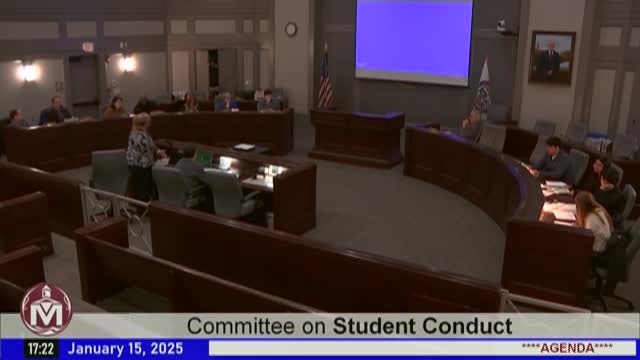
Deb Rookey, principal of Central High School, told the Manchester School District Committee on Student Conduct on Jan. 15 that the school aims to increase the share of students present for at least 90% of school days by 3 percentage points — from 52.3% in 2023–24 to 55.3% by June 17, 2025.
Rookey said the school is refining how it records daily attendance and implementing tiered interventions through attendance and truancy teams. “The goal is by 6/17/25, the number of students present for at least 90% of school days will increase by 3% by 52.3 percent from 23/24 to 55.3% in 24/25,” Rookey said. She described a mix of practices: biweekly attendance-team meetings, home visits, mailed 5/10/15-day letters, counselor check-ins and referrals to embedded mental-health providers.
Nut graf: The presentation combined current attendance figures with planned next steps. Rookey presented quarter‑one data showing improvement — 68% of students recorded 90%+ attendance for the year-to-date measurement, with another roughly 15% in the 80–89% range — and walked the committee through systems for identifying students who need more intensive supports.
Rookey said the school cross-references daily attendance with class‑level attendance to find students who check in for the day but miss multiple class periods, and that one assistant principal has focused on correcting teachers’ day‑roll errors. “We also have different programs that are kinda unique — students at GSIL (Granite State Independent Living) are off campus but still enrolled — so by implementing these processes we’ve determined a better way to take attendance so it's more accurate,” she said.
Committee members and staff pressed for detail on barriers and supports. Committee member Parr noted Central’s approximate enrollment of 1,100 and asked what barriers affected the roughly 500 students not meeting the 90% threshold in 2023–24. Rookey named mental‑health challenges (anxiety, depression) and family obligations or work requirements, and she highlighted English‑learner (EL) newcomer frustration and language barriers as major contributors. “Our EL students make up 30% of our population at Central,” she said, adding that not all EL students face the same barriers and many are doing well academically.
Rookey outlined how referrals are tracked and documented in Aspen and by the attendance team: whether a student has been referred, the tier of services assigned, and what interventions have been attempted. She said data runs can be customized to include or exclude excused absences; when she ran the district report using only unexcused absences, 81% of students were at 90%+ attendance and 9% were in the 80–89% range for the period reviewed.
On next steps, Rookey said the school will focus on students hovering in the 80s percentiles to move them into the 90s, and will continue to cross‑reference referrals with the attendance‑team tracker so every student between 0% and 79% is “on our radar.” She also previewed a family outreach effort called Family Village, a Saturday event for Portuguese‑speaking families to learn Aspen and the parent portal.
Committee discussion also touched on the districtwide context: assistant superintendent remarks noted the district is up 2% year to date, elementary up 4%, middle schools experiencing a winter dip and high schools up 2% overall. Committee members commended Central’s improvements — Rookey reported the school was 6 percentage points ahead of last year’s comparable data as of December — and asked that the team continue to disaggregate data and coordinate referrals across MTSSB (multi‑tiered supports) teams.
Ending: The committee thanked Rookey and district staff for the presentation and encouraged continued work to align data runs, refine interventions and keep families and counselors involved in individualized follow‑up.