Get Full Government Meeting Transcripts, Videos, & Alerts Forever!
Get email alerts on the Economic Development topic
No spam. Unsubscribe anytime.
Brazosport ISD board approves conditional intent for Dow Chemical JEDI tax-incentive application
Summary
The Brazosport ISD board voted to declare conditional willingness to enter a Jobs, Energy, Technology and Innovation (JEDI) tax-incentive agreement for a Dow Chemical project after a public hearing and staff presentations outlining financial and compliance terms.
At a public hearing and subsequent action item, the Brazosport ISD Board of Trustees voted to declare conditional willingness to enter into a JEDI (Jobs, Energy, Technology and Innovation) tax-incentive agreement regarding Dow Chemical Company’s application (Comptroller application J008).
District staff and outside consultants briefed the board on program rules and the specific terms of Dow’s proposed project, which consultants described as a high-technology carbon-capture and manufacturing facility with a total project investment the presentation estimated at about $2,700,000,000 and an initial company commitment of at least 50 jobs. The comptroller’s office issued a recommendation and a “complete” determination before sending the matter to the school district for its response.
The JEDI program, enacted by the 88th Texas Legislature in 2023, differs from the earlier chapter 313 program in multiple ways, presenters told the board: school districts can no longer require indemnity or supplemental payments from applicants; renewable-energy projects are excluded; eligible projects must meet higher job and investment minimums (presenters cited a 50-job and $100,000,000 investment threshold in Brazoria County); and projects located wholly inside a federal opportunity zone may receive taxation of 25% of appraised value for the incentive period instead of a fixed annual figure. Consultants said the comptroller’s 20-year fiscal test showed Dow would pay more to the state over 20 years than the program would cost, a key element of the comptroller’s favorable recommendation.
Consultants explained key procedural points: the comptroller’s office reviews and recommends; the governor’s office signs off and drafts the agreement template; the school board then has 30 days to indicate willingness to enter an agreement and a further year to accept or negotiate the template furnished by the governor’s office. Presenters warned that, under the current template language, the governor’s office reserves the right to unilaterally terminate an agreement for convenience. They also said reporting and compliance monitoring under JEDI would be handled by the governor’s office rather than via annual reports directly to the district, and that the project must show compelling evidence that the incentive was a material factor in its location decision.
Financial details presented to the board emphasized that the project’s non-land taxable value (the portion affected by the JEDI agreement) was estimated to peak at roughly $1,450,000,000 for I&S valuation purposes and that the district’s maintenance-and-operations (M&O) tax base and school-finance calculations were modeled using the district’s 2024 data; consultants said, based on their modeling and assumptions, the district would not be financially harmed by the agreement and might see a modest net gain in certain state tier calculations (a small “golden penny” tier 2 gain estimated at roughly $5,000–$13,000 per year). Consultants also noted that the land itself would not be included in the JEDI incentive and described bonding or self-insurance requirements the governor’s office would require to guarantee potential recovery of lost tax revenue if the project failed to meet its obligations (presenters described a bonding level equal to about 10% of estimated savings over the incentive period).
During public comment, resident Brian Denton urged the board to deny the incentive, arguing that tax breaks for established petrochemical companies reduce funding available for schools and raising environmental concerns about carbon-capture projects in Brazoria County. Other members of the public and Dow representatives spoke during the hearing; Dow’s representative said the company intended to maintain local partnerships with schools and the community.
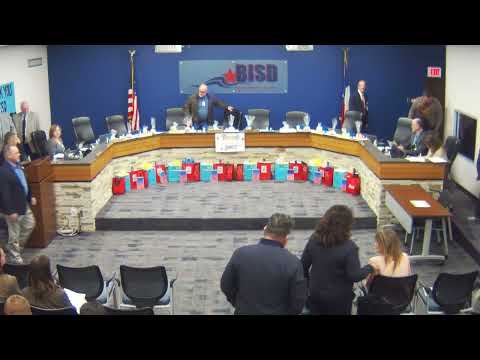
After discussion, Board member Atkins moved to approve the administration’s recommendation and declare conditional intent; Board member Shorten seconded. The motion carried. The administration’s recommendation, as presented, directs staff to notify the comptroller and governor’s office of the district’s willingness to enter the JEDI agreement template and to present final proposed terms to the board for a subsequent yes-or-no vote only after the governor’s office and Dow have consented to the template. The board’s action at this meeting was a declaration of willingness, not final execution of a binding agreement.
The file presented to trustees showed a proposed construction start in 2026, a multi-year construction period through about 2030 and a 10-year incentive period starting in 2031; presenters stressed the district would not be asked to execute a final agreement until the governor’s office and the company provided an agreed template for the board to accept or reject.
The board’s approval followed staff and consultant presentations from Miss Cantino and consultants Molly Hamlin and Kathy Matthias, and answers to trustees’ questions about governor control, reporting, job counts, contractor inclusion in job counts and the mechanics of opportunity zone valuation.
The board’s declaration of willingness triggers the next phase of negotiations and template review by the governor’s office and the applicant; a final contract, if presented later, would require a separate board vote.