Get Full Government Meeting Transcripts, Videos, & Alerts Forever!
Get email alerts on the Campus Cleanliness Student Voices topic
No spam. Unsubscribe anytime.
Student advisory council urges district action on campus cleanliness, cites survey showing bathrooms as top concern
Summary
Members of the Fairfield-Suisun Unified Student Advisory Council presented survey results and recommendations on campus cleanliness and environmental awareness, asking the governing board for support and citing student-reported problems with restrooms, litter and communication with facilities staff.
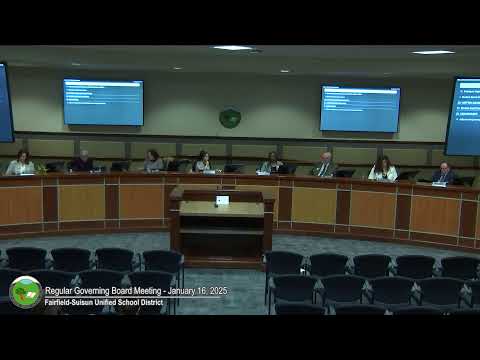
JJ Perry, the student board member and a senior at Rodriguez High School, told the Fairfield-Suisun Unified School District Governing Board that the Student Advisory Council’s “student voices” presentation seeks both attention and action on campus cleanliness and environmental awareness.
The students told trustees that a district survey sent to middle and high school students at 14 of the district’s 31 schools produced consistent concerns: 65% of respondents rated their school’s cleanliness 3 or lower on a 5‑point scale, 69% said littering was a notable problem, and 80% identified restrooms as the campus area most in need of attention.
Those results, the students said, point to a gap between existing policies and on‑the‑ground conditions. Naomi Harper, an 8th grader at Virtual Academy and a Student Advisory Council member, summarized the district policies the students reviewed: “The first policy is called Green School Operations, and the second is called Facilities Inspection.” She said students believe those policies are not consistently enforced at school sites.
Ari Octifne, an 8th grader at Green Valley Middle School, described campus cleanliness as both a hygiene and climate issue: “A clean and well maintained campus cultivates a sense of respect and responsibility,” he said.
Student presenters described outreach the council did to custodial and maintenance managers, who told students improving communication between schools and the district and creating stronger campus pride would help maintain cleanliness. The students proposed practical steps including more trash receptacles, weekly site bulletins, incentives and recognition for student cleanup efforts, expanding summer janitorial student jobs, and turning some disciplinary cleanup assignments into positive community service opportunities.
Board members praised the students’ work and asked staff to consider budget and operational implications. Board member David Duarte called the research “really impressive work,” comparing it to higher‑education level research and analysis. Trustee Dr. Tilly said she would check the budget to determine whether the district could add more recycling and larger trash receptacles. Dr. Parr suggested the city of Fairfield’s “Adopt a Street” resources might be made available to campuses and offered to help coordinate free cleanup equipment.
No formal board action was taken; the presentation concluded with the board offering support and asking staff to follow up on budget and operational feasibility.
Ending
Student presenters asked the board for partnership to implement the recommendations; board members publicly commended the students and directed staff to explore funding and coordination options. The Student Advisory Council presentation and the board’s discussion ended with no motion or vote recorded.