Get Full Government Meeting Transcripts, Videos, & Alerts Forever!
Get email alerts on the Subdivision Septic Repair Area topic
No spam. Unsubscribe anytime.
Highlands commissioners seek county, state clarity on septic "repair area" requirement for new lots
Summary
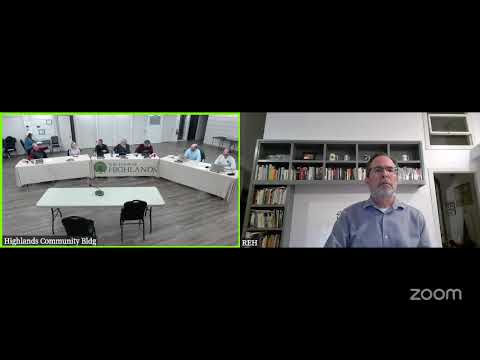
At a Jan. 16 workshop the Highlands Town Board debated whether the town can require health‑department approval that each lot created by a subdivision has space and soil for a septic system and repair area. Commissioners agreed to have staff seek formal guidance from county and state public‑health officials.
At its Jan. 16 workshop, the Highlands Town Board discussed whether the town may require that each lot created by a subdivision include documented adequate land, soil and a septic repair area and directed staff to consult county and state public‑health authorities before drafting any ordinance changes.
Commissioner Patterson, who presented the research to the board, said the town’s authority to regulate subdivisions comes from state statute and the town’s subdivision ordinance and that the town’s ordinance already requires submission of utility approvals with preliminary plats. "We can require that," Patterson said, arguing the Unified Development Ordinance and state rules support requiring a county health‑department letter confirming each lot can accommodate wastewater disposal when public sewer is unavailable.
The exchange centered on how North Carolina rules treat lots platted before Jan. 1, 1983. Patterson cited a state administrative code provision that exempts some pre‑1983 lots from the repair‑area requirement where the recorded deed or plat and lot size meet enumerated conditions; he said the exemption does not apply to most new subdivisions. Town staff and legal counsel discussed a recent example resolved by granting an easement so the septic field remained usable after a lot split.
Town attorney Bob Hagman told the board he read state law and county referral requirements into the question. "To the extent I can tell, the relevant statutes and regulations ... require referral to the county health director regarding the proposed water and sewer systems," Hagman said, and added that a newly created lot would typically be evaluated under current regulations and likely need a drain field and repair area.
Board members raised practical questions about whether a parent tract that predates the 1983 rule could be required to establish a repair area after a subdivision, and whether alternative systems or engineered solutions could satisfy town concerns. Commissioners noted the public‑health purpose of septic repair‑area rules and the potential for costly fixes — including engineered systems or off‑site connections — if a small lot lacks suitable soils or space.
The board did not adopt a new rule at the workshop. Instead the commissioners asked staff to seek a formal position from the county public health office and, if necessary, the North Carolina regulators and to return with recommendations. Josh Ward, the town manager, confirmed staff would approach county and state public health staff for written guidance.
Why it matters: The board’s interpretation will affect how future lot splits and subdivisions are reviewed and whether applicants must provide documented county health‑department approval before a plat is approved. Requiring documented repair‑area capacity at platting would reduce the need for later easements or engineering, but may complicate subdivisions where soils are marginal.
The board scheduled follow‑up work once county and state guidance is received.