Get Full Government Meeting Transcripts, Videos, & Alerts Forever!
Get email alerts on the Arts And Culture topic
No spam. Unsubscribe anytime.
Office of Arts & Culture outlines new grant role, flags arts‑tax erosion and public‑art maintenance gap
Summary
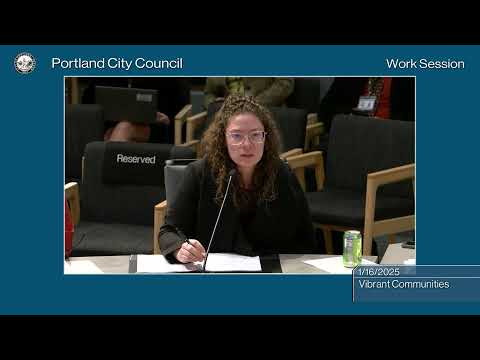
Charity Montes and staff briefed council on Jan. 16 about the Office of Arts & Culture’s new in‑house grant-making role, the relationship transition with the Regional Arts & Culture Council and the shrinking buying power of the $35 arts tax. Staff also noted that most city‑owned public art lacks dedicated maintenance funding.
Charity Montes, director of the Office of Arts & Culture, told council on Jan. 16 that her office has moved general operating support grant administration in‑house and is implementing a Portland action plan following the regional ten‑year cultural plan, “Our Creative Future.” Montes said the office held a convening with 80 nonprofit arts organizations that receive city restricted grants to begin building a shared operating culture.
Montes described the office’s workstreams: managing five city arts centers and venues, administering the percent‑for‑art program and public art collection, and new direct investments in independent musicians. She noted the office operates with six full‑time staff and that arts‑related economic activity in 2022 in Portland was about $405,100,000, per a staff slide.
Staff described two budget challenges for the arts portfolio. First, the city’s Arts Access Fund (the arts tax) is a fixed $35 tax that has not been indexed to inflation; staff said its purchasing power has declined. Second, the percent‑for‑art program and many city‑owned public art pieces do not have dedicated maintenance funds in the current budget; maintenance obligations historically have been managed through capital bureaus or third‑party service providers and staff said those accounting transitions are underway.
Montes and Todd Lofgren said the city and the Regional Arts & Culture Council (RACC) are in a multi‑year transition to clarify a city vision for arts and a revised relationship with RACC. Montes said the office launched in‑house general operating support grantmaking after the prior RACC contract expired, and staff are building a Portland‑specific action plan tied to regional work adopted by the previous council in May 2024.
Councilors asked about accountability and outcomes for the city’s grant spending. Montes said the office is aligning grantmaking with the new citywide grants policy and working with grants management to define outcomes and performance expectations for grantees. Claudio Camposano noted the current arts budget reflects one‑time PCEF funding for specific capital work — for example, a $1,000,000 contribution toward Arlene Schnitzer Concert Hall roof and cooling tower work — and that the percent‑for‑art budget is being transitioned into the office for future updates.
Staff said council will see an arts action plan, an Arts Access Fund oversight committee appointment and an annual impact report this year.