Get Full Government Meeting Transcripts, Videos, & Alerts Forever!
Get email alerts on the Budget And Infrastructure topic
No spam. Unsubscribe anytime.
Portland leaders outline Vibrant Communities portfolio, warn of $600 million parks maintenance backlog
Summary
City staff told the Portland City Council on Jan. 16 that the newly formed Vibrant Communities service area — combining arts, parks and the children’s levy work — oversees major programs and faces a $600 million deferred-maintenance backlog, falling SDC revenue and multi-year grant commitments.
Portland officials presented an overview of the Vibrant Communities service area to City Council on Jan. 16, describing the scope of work covered by Portland Parks & Recreation, the Office of Arts & Culture, and the Portland Children’s Levy and outlining an operating and capital budget picture for fiscal year 2024–25.
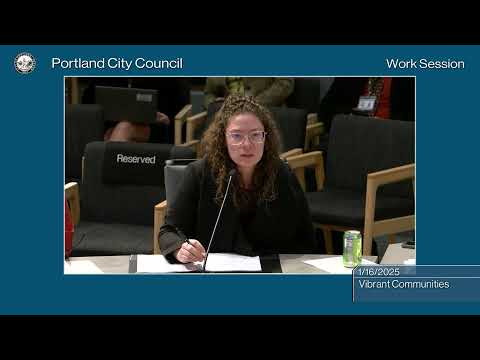
The presentation, delivered by Interim Deputy City Administrator Sonia Chimanski and finance manager Claudio Camposano, described the service area as responsible for parks, public art, recreation, cultural venues and levy-funded children’s services. Chimanski said the teams aim to “do more better” by aligning staffing, grants and administrative functions across the three bureaus.
Why this matters: staff told council that Portland’s parks and recreation capital stock is large and aging; the bureau estimates a roughly $600,000,000 major-maintenance backlog for parks assets. Claudio Camposano said the bureau receives roughly $5 million per year from the general fund for major maintenance while the long‑term need is much larger. The shortfall, staff warned, risks closures or reduced access to park buildings and facilities over time.
Key budget points in the presentation included: parks and recreation draws revenue from nine different funds, including a voter-approved parks levy (collections began in 2021 and the current levy term ends with the next fiscal year), general fund discretionary transfers, a mix of grants and fees, and Portland Clean Energy Fund (PCEF) allocations. Camposano highlighted that system development charges (SDCs), historically a major capital funding source, have fallen sharply — collecting more than $40 million annually in a prior development cycle but less than $2 million collected to date in the current year — and that this decline reduces near‑term capital project revenue.
Chimanski and Todd Lofgren, deputy director of Vibrant Community Support Services, said the service area now tracks nearly 200 metrics and has published an interactive dashboard. Staff reported attendance and service figures for fiscal year 2023–24: about 3.7 million total visits to cultural venues and PPR programs, more than 63,000 children served by levy-funded programs, and nearly 2,600,000 free meals served across programs. Grants and partner funding exceeded $43,000,000 in the prior year, staff said.
Council members asked for more detail about how multiyear grant balances are displayed and how PCEF and other multi‑year allocations appear in current-year fund balances. Camposano said council would see large carryover balances because the bureau has received multi‑year allocations and will draw those funds down over several years, and he agreed to produce clearer graphics showing actual expected spend in each fiscal year.
Staff also flagged other system issues: the parks ADA transition plan lists more than 17,000 accessibility barriers; Portland manages roughly 4.2 million trees citywide and about 8,000 acres of natural areas; and the public art collection includes roughly 1,700 works valued at about $18.5 million. Chimanski said the service-area approach has produced operational efficiencies in communications, grants and constituent relations and will continue to mature.
Looking ahead, staff said council will see proposals this year related to a parks ballot referral, an Urban Forest plan and code updates, an arts action plan, SDC methodology updates required by state statute, and the next round of Portland Children’s Levy grants.