Fairview city manager gives 46‑slide orientation on city structure, departments and programs
Loading...
Summary
The city manager delivered a 46‑slide briefing for the board of commissioners outlining Fairview’s charter, departmental roles, meeting procedures and recent programs including an economic development hire, LISO equipment sales and plans to update codes and the 2040 plan.
The city manager delivered a 46‑slide orientation to the Board of Commissioners reviewing Fairview’s municipal charter, government structure, departments, meeting procedures and recent departmental initiatives.
The presentation opened with an overview of the city’s legal framework: “A municipal charter is the basic document that defines the organization, powers, functions, and essential procedures of the city government,” the city manager said, noting Fairview was incorporated July 28, 1959 under the uniform city manager‑commission charter in the Tennessee Code Annotated. The manager described the city’s structure as a mayor and four commissioners who appoint a city manager to run day‑to‑day operations.
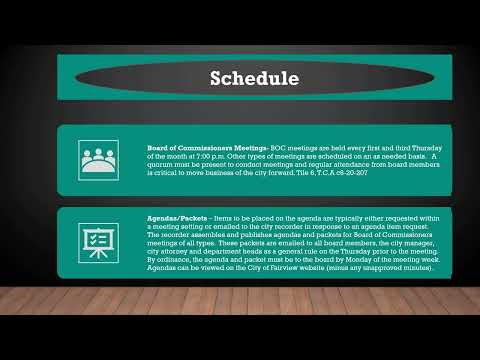
The briefing framed why the orientation matters: commissioners decide policy, adopt budgets and approve contracts and bids, while the city manager supervises department heads and enforces ordinances. The manager also reviewed meeting rules (regular meetings are held the first and third Thursdays; special meetings require 12‑hour written notice) and said that, with the exception of executive sessions, public meetings are recorded and minutes are maintained by the city recorder.
The presentation next summarized departments and staff. The manager said Fairview currently organizes eight departments — administration, public safety (police and fire), finance, municipal court, public works, planning and codes, parks, and an economic development function — and estimated public safety accounts for about 80% of the city’s employee population. The manager identified key staff by title and tenure: the city recorder Rachel Jones (six years with the city), public information/community relations coordinator Richard Ross, Police Chief Humphreys (eight years as chief, roughly 30 years in law enforcement), Fire Chief Hughes (12 years with the city, seven as chief), public works supervisor Todd Bracher (19 years), and planner Ethan Greer (about two years, with staffing rebuild underway). The manager said finance staff include a newer employee, Ben, who completed a municipal finance certification in under a year, and noted longtime finance clerk Sharon Hall has 22 years of service.
On programs and recent results, the manager highlighted the city’s participation in a federal surplus equipment program (referred to in the presentation as LISO/demilitarized equipment). He said the program has helped the city generate roughly $100,000 annually in recent years and that total receipts to date are about $306,000, which the manager said equates to roughly eight patrol cars the city did not have to purchase. The police department runs Shop with a Cop and annual DEA drug take‑back events; the manager said Shop with a Cop delivered about $11,700 in holiday gifts to children.
The economic development officer position, added after the Fairview 2040 planning process, was presented as an active role in reconnecting city staff with state agencies and in pursuing grant opportunities. The manager said that work has helped reopen discussions with TDOT on local road projects and identified potential grant opportunities in the near term.
Planning and codes staff were credited with advancing an ordinance rewrite and working with outside consultants (identified in the presentation as Griggs and Maloney and Kimley Horn) on planning, engineering and a design for a historical village, possible farmers market and amphitheater. The manager said the 2040 plan is a guiding (non‑regulatory) document and that regulatory decisions use the city’s codes, subdivision regulations and design review manual.
Parks staff were described as rebuilding programming after COVID, with Buie Park singled out as the city’s “crown jewel.” The manager said park programming resumed this year after several years without regular offerings.
On meeting communications and records, the manager said agendas and packets are posted on the city website (and by ordinance must be available by Monday of meeting week), that Rachel Jones would distribute an electronic link to the orientation material, and that MTAS, TML/Public Unity Partners and other resources are linked from the city site for commissioners’ reference.
The manager also reviewed the chain of command: department staff report to department heads, department heads report to the city manager, the city manager reports to the Board of Commissioners, and the board answers to the city’s voters. He said the city attorney handles legal matters and attends meetings but does not vote, and that the board must vote to authorize use of the city attorney if a conflict exists.
The presentation closed with an offer to take questions and an explicit logistical note: “Rachel is gonna email you a link with this,” the city manager said.
The briefing was informational; no motions or formal votes were recorded in the transcript of the orientation.
The orientation combined statutory context, internal organization, recent program outcomes and ongoing work on planning and parks, aiming to familiarize commissioners with operations and staff responsibilities.