Get Full Government Meeting Transcripts, Videos, & Alerts Forever!
Get email alerts on the Swicap topic
No spam. Unsubscribe anytime.
Officials explain statewide cost‑allocation plan; committee told program recoups roughly $70–80 million
Summary
JFAC staff presented how the Statewide Cost Allocation Plan (SWICAP) allocates central service costs to agencies and fund sources, the two‑year lag in recoveries and recent program totals and agency‑level estimates.
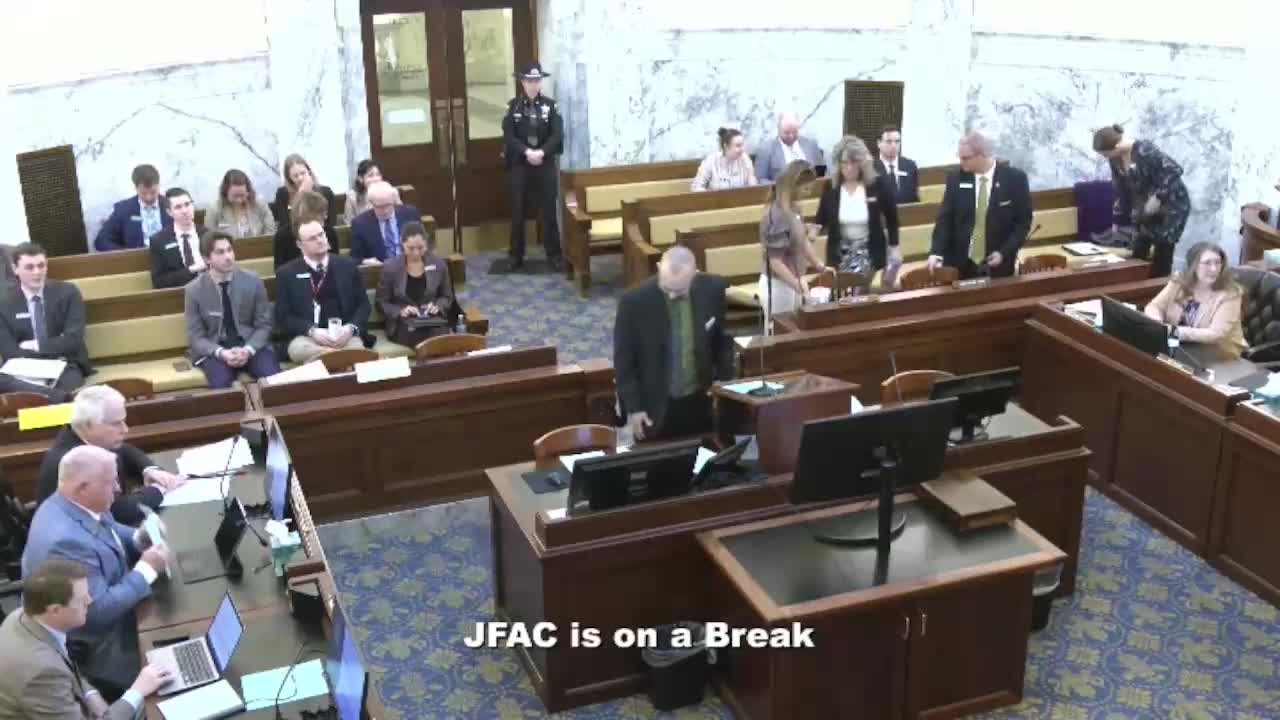
Jared Tetrault, budget analyst for Legislative Services, gave the Joint Finance and Appropriations Committee a high‑level explanation on Jan. 7 of the Statewide Cost Allocation Plan (SWICAP) and how it appears in agency budgets.
Tetrault said SWICAP is the statewide plan, prepared by the Division of Financial Management and reviewed by the federal cognizant agency (for Idaho, Health and Human Services), that allocates central‑service costs to eligible state entities and fund sources. The allocation recovers costs for three central service agencies—the Office of the Attorney General, the Office of the State Controller and the Office of the State Treasurer—and also funds a set of direct‑billing services such as risk management (insurance), building services (capital mall), Legislative Services Office audits and Information and Technology Services (ITS).
“The concept is: we’re going to share costs for central service agencies equitably, and here’s our plan of how we’re going to do that,” Tetrault said, describing the document and its federal review. He emphasized that SWICAP calculations use agency‑level drivers: billable attorney hours (Attorney General), the number of active employees or payroll transactions (Controller), and number of warrants issued (Treasurer). Direct billings cover items such as risk management insurance and building rent.
Tetrault explained the timing mechanics: actual cost and usage in one fiscal year are used to compute adjustments that appear in the budget two years later. For example, costs provided in fiscal year 2023 are recovered in the 2025 budget cycle; there is a consistent two‑year lag in recovery. The Division of Financial Management runs the calculations, notifies agencies by October, and agencies can present concerns before the committee appropriates the adjustments.
He walked the committee through recent figures used in budget adjustments: the State Controller’s recoverable appropriation in 2023 was about $4.8 million; the State Treasurer’s recoverable costs were roughly $966,000; and the Attorney General’s comparable recoverable billings were larger (roughly $14–16 million). ITS base billings were shown at about $39.7 million with an expected decline to $36.8 million in the current cycle; risk management base billings were listed near $18.3 million with an expected reduction to about $16.2 million. Tetrault said the sum of central service and direct‑billing recoveries across the state is in the approximately $78 million range when all elements are combined.
Tetrault cautioned that not every agency cost is allowable: SWICAP recovers costs that benefit state entities broadly, not expenditures specific to a single agency’s internal activities. He also noted some statutory exceptions—criminal divisions’ hours are not counted for AG billings, for example.
Committee members were shown a typical budget‑book line for SWICAP adjustments (for example, Health and Welfare) that itemizes increases or decreases by central‑service category and displays net general‑fund and federal‑fund impacts.
Tetrault told members the office can provide further breakout detail—by insurance line, payroll drivers and ITS components—if the committee needs it during work‑group budgeting. He said the Legislative Services Office will work on more precise percentage reports for committees that want to see the allocation drivers.
Ending: The presentation concluded with committee members saying the SWICAP explanation will help them interpret agency maintenance adjustments during work‑group hearings and recommended staff provide a detailed percentage breakout on request.