Get Full Government Meeting Transcripts, Videos, & Alerts Forever!
Get email alerts on the Lake Pend Oreille Appointments topic
No spam. Unsubscribe anytime.
Senate committee interviews two incumbents for Lake Pend Oreille Commission; no vote taken
Summary
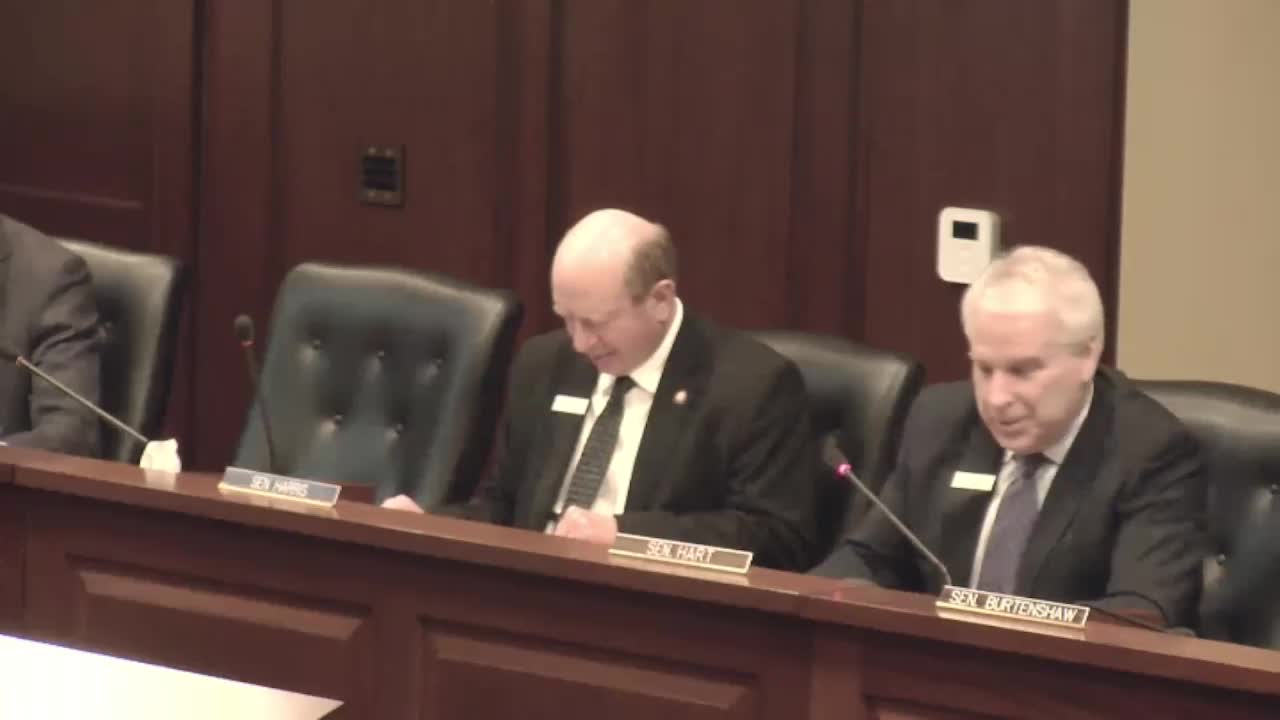
The Senate Resources and Environment Committee interviewed two incumbents — Brent Baker and Frank Brinkmeyer — on gubernatorial reappointments to the Lake Pend Oreille Commission during a committee meeting presided over by Vice Chair Senator Hart. No confirmation votes were taken; Chairman Bertenshaw will set a later meeting to consider appropriateness for floor action.
The Senate Resources and Environment Committee interviewed two incumbents — Brent Baker and Frank Brinkmeyer — on gubernatorial reappointments to the Lake Pend Oreille Commission during a committee meeting presided over by Vice Chair Senator Hart. No confirmation votes were taken; Chairman Bertenshaw will set a later meeting to consider appropriateness for floor action.
The interviews focused on the commission’s priorities on lake levels, an economic-impact study recently authorized by resolution, invasive species control and cross-jurisdictional coordination. The commission represents local interests tied to recreation, fisheries and shoreline economies around Lake Pend Oreille in northern Idaho.
Brent Baker, a longtime commission member and executive director of his county’s economic development organization, said the commission “finally have in place now an agreement to conduct an economic impact study.” He told the committee the University of Idaho will perform the study, “donating half the cost, and we’re contributing half the cost,” and that the work is expected to start “the end of this month and should be done by the end of June.” Baker said the study is intended to strengthen the commission’s position in negotiations with the Army Corps of Engineers and power operators over lake-level management.
Baker described a recurring tension between downstream water interests and local economic uses of Lake Pend Oreille, saying locally “we seem to be being asked to pay a very big price to deliver relatively small economic benefits to lots of people downstream.” He said the commission is advocating for a longer high-water season — higher lake levels in May and an extended season into October — because low winter and shoulder-season levels leave many docks high and dry and harm the local tourism and recreation economy in Bonner County. Baker also raised water-quality and wildlife-habitat protection, and listed invasive species of concern including quagga mussels, zebra mussels, Eurasian watermilfoil and flowering rush. He said the commission serves as a “clearing house for disaster response preparedness” around the lake given limited roads in parts of the basin.
Senator Guthrie noted Baker’s meeting attendance and community work and asked about stakeholders; Baker cited headwaters and tributary jurisdictions in British Columbia and Montana and downstream interests in Washington and Oregon, and said the commission is monitoring the renegotiation of the Columbia River Treaty and has retained legal representation to protect local interests.
Frank Brinkmeyer, owner of Idaho Forest Group and also a commission member since the body’s inception, said the commission is “very careful and thoughtful” in its work and highlighted past involvement in advising on risk issues such as railroad bridge projects and deferred dam-gate maintenance. Brinkmeyer pointed to habitat restoration work at the Clark Fork and Pack River deltas and local fisheries projects including Pritchard Creek, which he said benefited from coordinated work with Fish and Game and national conservation groups.
Brinkmeyer described technology work at Idaho Forest Group, saying the company has used satellite mapping, LiDAR and artificial intelligence in partnership with universities to inventory forest parcels and improve management: “we’ve developed, with Oxford University Cambridge, UK, using satellite technology to map the intermountain forest,” and later referenced work with MIT Lincoln Laboratory. He told senators that the technology helps track treatments and outcomes over time and that the company shares data with the University of Idaho and state partners.
Committee members thanked both applicants for their service. Several senators praised the applicants’ local work in schools, workforce programs and conservation projects. The committee did not take a vote; members said Chairman Bertenshaw will set a later date to consider forwarding the nominations for confirmation votes.
The meeting closed with the vice chair adjourning the session after a final procedural check.