Get Full Government Meeting Transcripts, Videos, & Alerts Forever!
Get email alerts on the Provider Of Last Resort topic
No spam. Unsubscribe anytime.
CPUC rulemaking on "provider of last resort" could change who must supply power if a CCA fails, staff says
Summary
San Diego Community Power staff summarized a California Public Utilities Commission proceeding to define requirements for a provider of last resort; staff said the CPUC is moving in phases and that SDG&E currently serves as provider of last resort under guaranteed cost recovery.
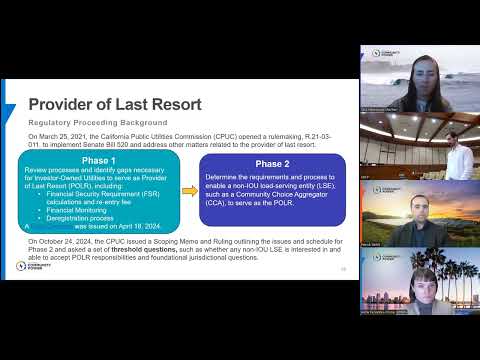
San Diego Community Power staff told the Community Advisory Committee on Jan. 16 that the California Public Utilities Commission is developing a new framework to define a “provider of last resort” for situations in which a load‑serving entity fails and customers must be served to avoid interruption.
“Currently investor‑owned utilities serve as the provider of last resort in our territory; SDG&E is that provider to serve returning customers,” said Steven (surname not provided), an interim manager, during the regulatory update. Staff explained that under the existing framework IOUs recover the short‑term costs of serving those customers through guaranteed cost recovery mechanisms.
Staff said the Legislature formalized the framework in 2019 and that the CPUC opened a rulemaking to implement that law and split the work into two phases. Phase 1 reviewed existing financial security requirements, monitoring, and return‑to‑service procedures; staff said the CPUC issued a decision in April of the prior year and moved to a second phase to determine technical and regulatory requirements if a non‑IOU (for example, a community choice aggregator) were to serve in the provider‑of‑last‑resort role.
San Diego Community Power and its trade association, CalCCA, filed opening comments arguing the CPUC should adopt a framework irrespective of immediate interest from non‑IOU entities, staff said. CalCCA and some community power advocates argued the CPUC must define limited regulatory authority over non‑IOU entities acting in the provider role — confined to the temporary procurement service until customers return to an IOU’s tariff — and also specify cost‑recovery mechanisms for the provider.
Staff also noted SDG&E’s comments that SDG&E does not currently plan to seek transfer of the provider role to non‑IOUs in the near term and believes it is best positioned now to serve that function. The CPUC’s phase‑2 process, staff said, has invited further comments about how a non‑IOU provider would be regulated and what financial assurances would be necessary.
Committee members asked whether the provider‑of‑last‑resort assignment relates to procurement only or also to distribution. Staff replied it pertains to procurement and serving load, not to distribution or transmission operations. Members also asked whether an IOU could scale up procurement quickly enough to serve a large CCA’s customers; staff said the role would rely on short‑term market contracts and the CPUC’s oversight of cost recovery for those transactions.
Staff said San Diego Community Power is monitoring the rulemaking and will file follow‑up comments with CalCCA and other parties; they anticipated filing additional comments the week following the meeting.