Get Full Government Meeting Transcripts, Videos, & Alerts Forever!
Seattle committee previews mayor’s growth strategy as residents voice split over upzoning
Summary
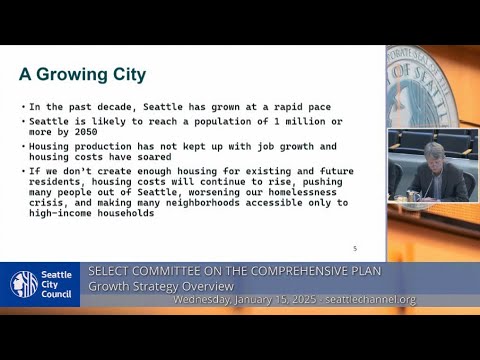
Seattle City Council Select Committee on the Comprehensive Plan heard a briefing and public comment on Jan. 15 about the mayor’s proposed growth strategy, which would expand where denser housing can be built and enact zoning changes to comply with state law HB 1110.
Seattle — The Seattle City Council’s Select Committee on the Comprehensive Plan on Jan. 15 heard a detailed briefing on Mayor Bruce Harrell’s proposed growth strategy and fielded more than an hour of public comment that ranged from support for new neighborhood centers to worries about displacement, tree loss and water infrastructure.
The committee’s briefing, led by Office of Planning and Community Development (OPCD) staff and the mayor’s office, framed the proposal as a zoning and map update to create capacity for substantially more housing and comply with the state’s new requirements under House Bill 1110 (HB 1110). "Providing adequate zoning capacity is foundational in supporting the conditions necessary to bring about more housing," Deputy Director of Policy Chris Tobias said during the presentation.
Why it matters: the plan would expand where multiunit housing can be built — adding and resizing “regional centers,” “urban centers,” and 30 new neighborhood centers — and change development standards in neighborhood residential areas to allow a wider range of “missing middle” housing types (duplexes through fourplexes, stacked flats, townhouses and similar forms). Staff said the zoning packages accompanying the plan could roughly double the city’s high-level residential development capacity to about 330,000 units in modeling used for planning and the environmental review.
Details of the proposal and schedule
- Growth targets and EIS assumptions: Regional and state planning require Seattle to plan for at least 80,000 new homes and 158,000 jobs over 20 years; OPCD studied a preferred alternative that assumes 120,000 new housing units for the environmental impact statement (EIS).
- Place types and scale: The proposal keeps seven regional centers and 26 urban centers, creates 30 neighborhood centers (typically a 1–3 block area around a business node or frequent transit stop), and designates the remainder…
Already have an account? Log in
Subscribe to keep reading
Unlock the rest of this article — and every article on Citizen Portal.
- Unlimited articles
- AI-powered breakdowns of topics, speakers, decisions, and budgets
- Instant alerts when your location has a new meeting
- Follow topics and more locations
- 1,000 AI Insights / month, plus AI Chat