Get Full Government Meeting Transcripts, Videos, & Alerts Forever!
Get email alerts on the Personnel Benefits topic
No spam. Unsubscribe anytime.
Committee debates health-insurance base for state employees; neither proposal wins required cross‑chamber majority
Summary
The committee considered two competing recommendations to set the per‑eligible‑FTE health insurance base for FY2026 — a CEC recommendation of $13,960 and the governor's $14,300 proposal — and debated reserve levels and contract risk. Neither motion secured the required majority of both chambers.
The Joint Finance and Appropriations Committee debated two competing proposals to set the base health‑insurance allowance for eligible full‑time equivalent positions for fiscal year 2026.
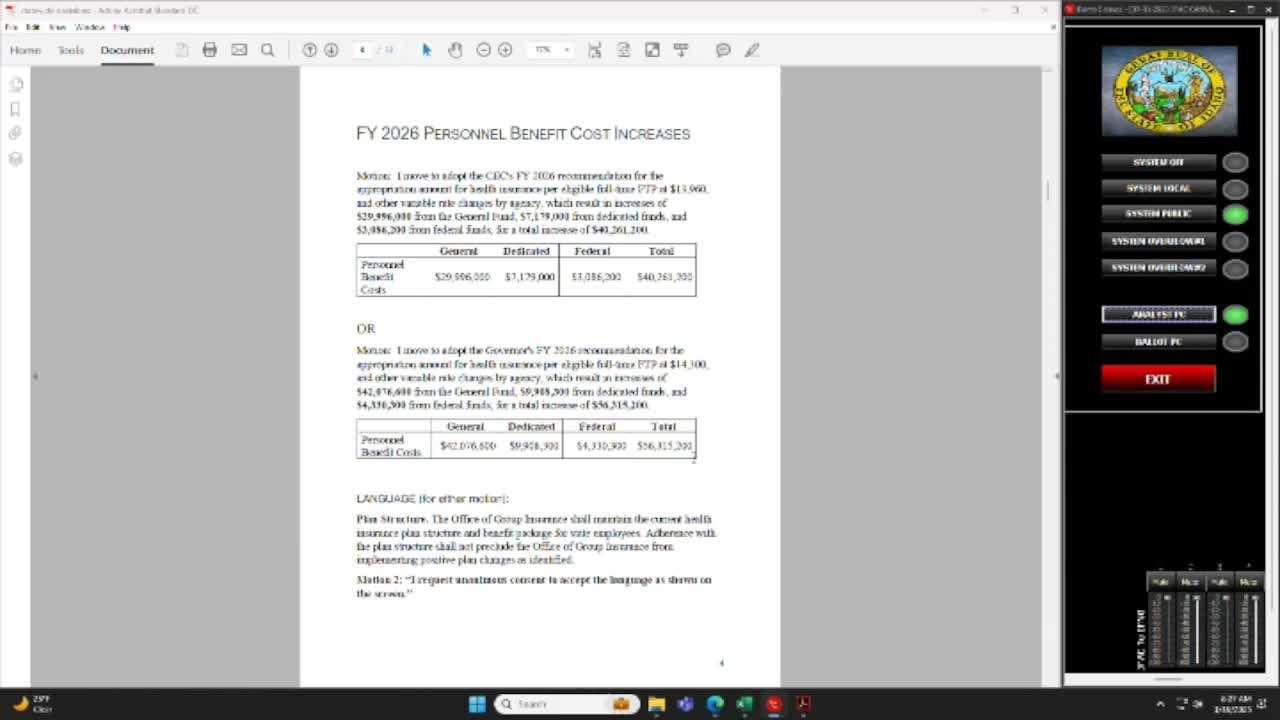
Keith Bybee, Division Manager of the Budget Policy Analysis Division, briefed members that the CEC recommendation would set the base at $13,960 per eligible FTE, which the analysts projected would require $29,996,000 from the general fund and a total of $40,261,200 across all funds. The governor’s recommendation would set the base at $14,300 per eligible FTE and, according to analysts, would increase costs by $42,076,600 from the general fund and $56,315,200 in total.
Representative Miller moved to adopt the governor’s $14,300 figure and Senator Woodward seconded the motion. Representative Furness offered a substitute motion to adopt the CEC’s $13,960 recommendation; Senator Cook seconded the substitute. Members questioned the tradeoff between preserving contingency reserves and lowering premium costs for agencies and schools.
Laurie Wolf, administrator for the Division of Financial Management, warned that the insurance contract includes a 10% contingency minimum and that projections showed a 50 percent probability of meeting or falling below that 10 percent contingency. Wolf said: “That is the floor. I will also just mention that, when we get those numbers from the actuary, that 10% contractual minimum...we have a 50% chance of meeting that or falling below.”
Faith Knowlton, administrator for the Division of Insurance and Internal Support in the Department of Administration, explained consequences if the reserve fell below the contingency: “If we fall below the 10% contingency reserve, then a risk charge can be assessed to the state.” She said the potential dollar amount of any assessment would depend on how far below the contingency the reserve fell.
Members also reviewed projections from the actuary Milliman: the Milliman projection cited in committee materials showed the current reserve balance near $80.5 million; adopting the governor’s recommendation would reduce the projection to about $61.4 million, while adopting the CEC recommendation would lower the projection to about $51.6 million. Members debated whether the current reserve level was excessive and whether tighter funding this year would force larger increases in subsequent years.
The committee first voted on the substitute (CEC) motion; the motion failed to win the required cross‑chamber majorities (grand total 9 ayes, 11 nays). The subsequent vote on the original motion (governor $14,300) also failed to secure the necessary majority from both the Senate and the House; the chair declared the original motion failed because it did not receive a majority from both delegations. No health‑insurance base was adopted during the session and the matter will be revisited when the committee reconvenes.