Get Full Government Meeting Transcripts, Videos, & Alerts Forever!
Get email alerts on the Budget: Governor's Executive Budget topic
No spam. Unsubscribe anytime.
Governor's "keeping promises" budget: education, water, transport, fire and reserves highlighted
Summary
Division of Financial Management Administrator Lori Wolfe presented the governor's executive budget to JFAC, proposing increased funding for public schools, teacher pay and health insurance, workforce training and transportation capacity, while preserving transfers to rainy day funds and a $100 million hold for tax relief.
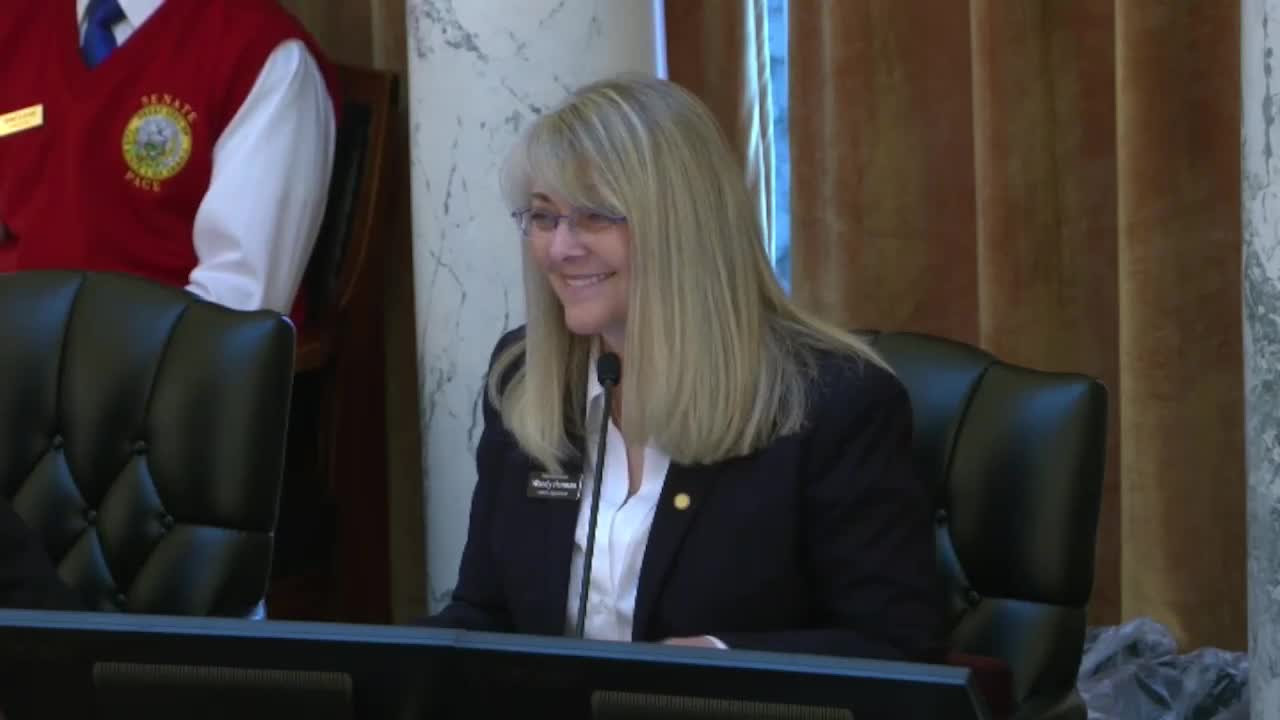
Lori Wolfe, administrator of the Division of Financial Management, presented the governor's executive budget to the Joint Finance and Appropriation Committee on Tuesday, outlining revenue estimates, recommended maintenance funding and a $151 million package of recommended enhancements for fiscal year 2026.
"As you heard from Governor Little yesterday, this is his 'keeping promises' budget," Wolfe said, summarizing the administration's priorities of education, tax relief, regulatory reform and investments in state infrastructure.
Wolfe said the administration used a conservative revenue forecast for FY26 and recommended maintaining structural balance while increasing rainy-day reserves. Her slides — distributed as an "at-a-glance" summary — showed a projected FY26 ending general fund balance of about $227 million after transfers, with a recommended $59 million transfer to the Budget Stabilization Fund and $50 million to the Public Education Stabilization Fund. Wolfe said those transfers would leave a revert reserve near $1.4 billion, about 22% of the budget, which she described as consistent with credit-rating guidance.
On education, the governor proposed roughly $150 million for public schools, including a combined package for teacher pay and related health insurance costs (Wolfe cited about $83 million for teacher pay and roughly $30 million for health insurance). The budget also sets aside $50 million for education-choice initiatives pending policy action and $50 million intended for rural school facility needs, mental health and literacy accountability measures.
Transportation and infrastructure priorities in the request include a $50 million allocation for an expansion and congestion-mitigation fund administered by the Idaho Transportation Department. Wolfe said the funds would support additional bonding capacity for high-value projects once the department completes a final bond sale tied to earlier federal and state capital programs.
Natural-resources and public-safety proposals include a $60 million FY25 supplemental to backfill the fire-suppression account for this past fire season and $40 million ongoing for future fire-management support, plus $5 million for aviation and detection tools. The budget also recommends $30 million ongoing to the Idaho Water Resource Board for prioritized recharge projects.
Wolfe described the administration's workforce and training priorities: a $25 million package to expand workforce training capacity (including $15 million one-time for infrastructure to expand seats and $10 million ongoing for Career and Technical Education operations), and a $15 million one-time transfer to the workforce housing fund.
Addressing the state public defense consolidation and a December Idaho Supreme Court interpretation of statute, Wolfe recommended a FY25 supplemental of $5.4 million and a FY26 one-time recommendation of $16.8 million. The combined FY26 request for public defense totaled roughly $83 million; Wolfe said policy action will be needed to determine the longer-term funding mechanism because public defense is funded via an online-sales-tax distribution statute.
Wolfe also recommended $10 million for statewide cybersecurity and IT resiliency and highlighted population-driven maintenance adjustments (for example, caseload or student-count changes) totaling roughly $80 million. She said total recommended enhancements for FY26 were about $151 million (approximately $129 million ongoing and $22 million one-time).
Committee members asked for clarifications on several items, including the composition of contract-inflation adjustments placed in maintenance, details on TechConnect/ITD project capacity and the mechanics of the fire-suppression supplemental. Wolfe said the $60 million for FY25 is meant to replenish the account after the most recent fire season and that the $40 million ongoing figure corresponds to a multi-year average wildfire cost the administration used to set the request.
Wolfe closed by emphasizing the budget sought to preserve a conservative posture with improved rainy-day balances and targeted investments in education, infrastructure, water and public safety; the committee adjourned the budget presentation to enter its scheduled hearings and working groups.