Get Full Government Meeting Transcripts, Videos, & Alerts Forever!
Get email alerts on the Charter School Financing topic
No spam. Unsubscribe anytime.
Study: Idaho financing program cut charter school facility costs, freed money for teachers
Summary
Matthew Joseph, a senior policy adviser for AccelonEd, told the Idaho Senate Education Committee that a combination of a revolving loan fund and state credit enhancement has reduced charter school facility financing costs, producing an estimated $113 million in savings over 15 years.
Matthew Joseph, a senior policy adviser for AccelonEd, told the Idaho Senate Education Committee that a combination of state programs and private supports has substantially reduced charter-school facility financing costs in Idaho.
Joseph said the study his group conducted found that, without state support, Idaho charter schools would spend about $1,857 per student on facilities and still be left covering roughly $1,294 per pupil from operating funds. "The bottom line of the study...is just amazing, which is the state so far has spent $0 to do this," Joseph said, adding that the programs have produced "a $113,000,000" savings over 15 years and that, when annualized and converted to local teacher salary equivalents, the savings equal roughly "10 teachers per school".
The nut graf: Joseph described two coordinated policies that he said make the savings possible. The first is a short-term revolving loan fund that provides low- or no-interest loans to new charter schools for roughly the first three to five years. The second is a long-term financing mechanism using state credit enhancement — described in Joseph's presentation as a "moral obligation" program — that lowers interest rates when schools refinance in the private market.
In the committee presentation, Joseph said the revolving fund's loans have been repaid to date and there have been no defaults on the long-term credit-enhanced financing. He credited private matching and nonprofit managers for multiplying the program's impact: philanthropic matches (Joseph named the Albertson Foundation) and a manager he identified as Building Hope helped leverage public funds and limit the amount schools must refinance. "Because of the private sector here being involved both in terms of multiplying the revolving loan fund and making sure that the amount of money that has to be borrowed is less, there's been this huge increase," Joseph said.
Joseph gave school-level examples. He said Idaho Novus Classical Academy used the revolving loan fund and additional philanthropic matching to reduce its financing burden and is saving, he estimated, nearly $1 million a year compared with a scenario without the supports. He said Sage International School in Middleton used the state's credit enhancement to lower long-term rates and saved roughly $700,000 annually, enabling program expansions such as International Baccalaureate classes. He also cited Elevate Academy in Caldwell as a school that used savings to fund career-technical equipment and smaller classes for at-risk students.
Joseph warned that the credit-enhancement program is very successful and has reached its statutory or administrative cap in supply; he said demand now exceeds available credit-enhanced capacity and that the cap would need to be raised for additional schools to access the same benefit. He also said the state had intentionally kept program criteria strict to limit risk.
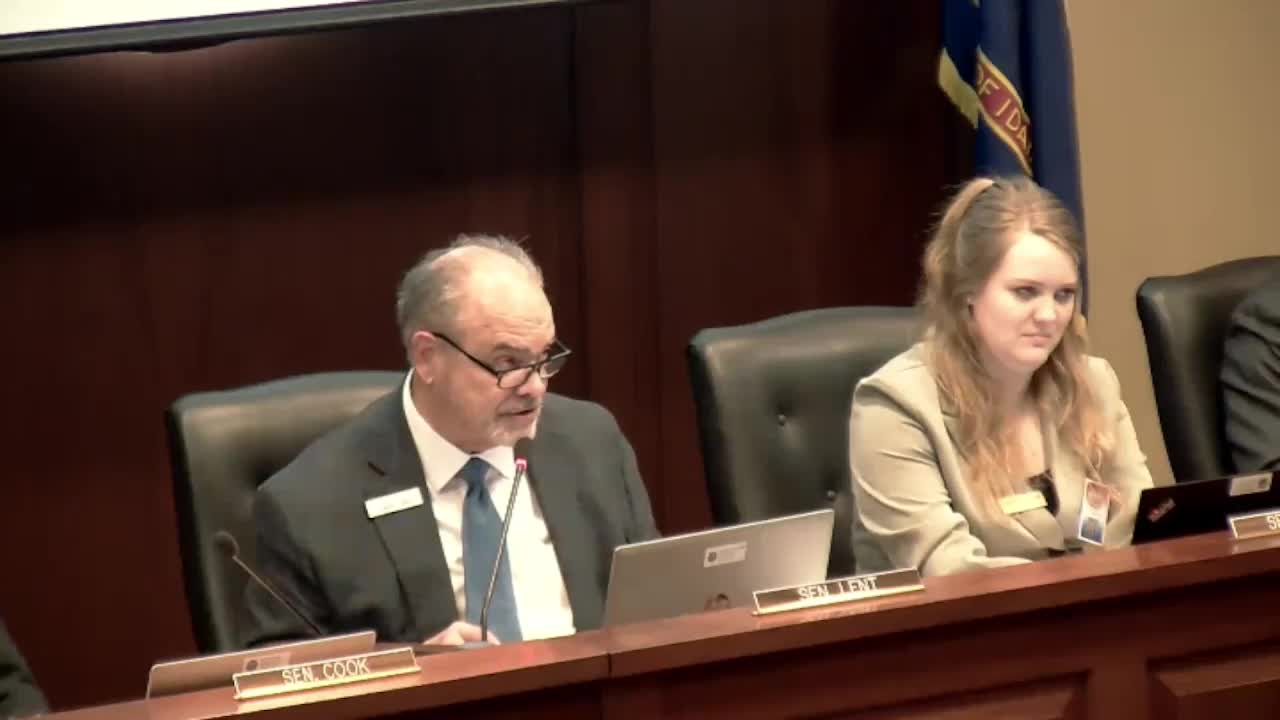
Committee Chair Senator Dave Lent introduced the presentation. Marcus Lopez, Joseph’s colleague, was present and identified as the AccelonEd staffer who covers Idaho more regularly. After Joseph's presentation the committee asked no follow-up questions.
Why it matters: Joseph framed the programs as targeting a market failure that charges higher interest rates to start-up charter schools and forces those schools to divert operating dollars from instruction to facility costs. The combination of short-term low-cost lending, philanthropic matching, and state credit enhancement, Joseph said, lets charter schools lower debt service and redirect funds to teachers and instruction.
The presentation did not propose new state statute language and did not include any committee action; it was an informational briefing. AccelonEd invited lawmakers to its national summit and offered follow-up support.
Ending: The committee received the presentation and did not take action at the meeting. Joseph said he and his AccelonEd colleagues are available to answer further questions.