Get Full Government Meeting Transcripts, Videos, & Alerts Forever!
Get email alerts on the Women Sports Title Ix topic
No spam. Unsubscribe anytime.
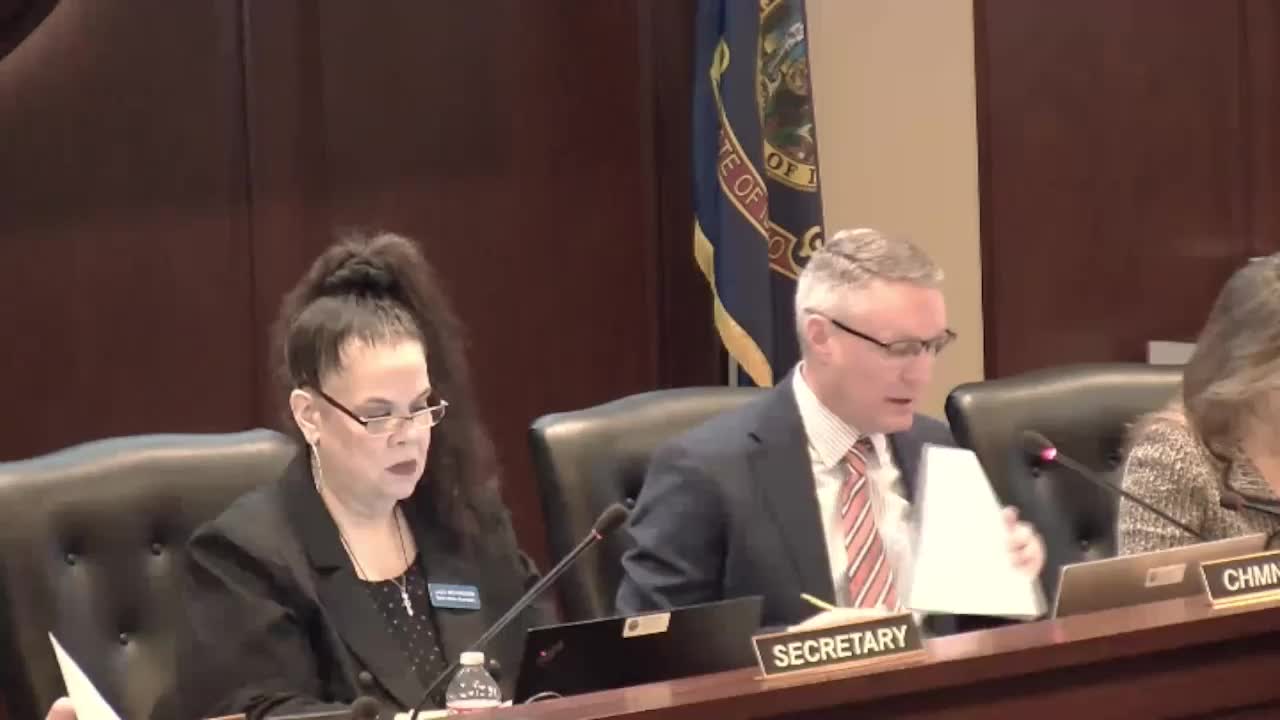
House State Affairs committee sends resolution honoring Boise State volleyball to the floor after hours of testimony on women’s sports and Title IX
Summary
The House State Affairs Committee voted to send House Concurrent Resolution 2 (HCR 2) to the floor with a do‑pass recommendation after testimony honoring Boise State University’s women’s volleyball team for forfeiting matches in protest of a biological male competing on women’s teams.
The House State Affairs Committee on Tuesday voted to send House Concurrent Resolution 2 (HCR 2) to the House floor with a do-pass recommendation after nearly two hours of testimony and questioning about fairness and safety in women’s athletics.
HCR 2, introduced by Representative Barbara Ehart of District 33, commends the Boise State University women’s volleyball team for forfeiting multiple matches, including a Mountain West Conference tournament game, in protest of a biological male competing on women’s teams. The resolution asks intercollegiate governing bodies to revise policies it says compromise safety and fairness for female athletes.
Representative Barbara Ehart, an Idaho state lawmaker and former Division I women’s basketball coach, told the committee HCR 2 “is truly to commend our Boise State women’s volleyball team for taking such a courageous stance” after the team forfeited matches rather than play against a biological male. She said the team’s third forfeit came in the Mountain West tournament, “their only path to the NCAA’s,” and described the decision as an act of “true integrity.”
Riley Gaines, who identified herself as an ambassador for Independent Women’s Voice, vice chair of Athletes for America with the America First Policy Institute and director of the Riley Gaines Center, testified in support of the resolution. Gaines recounted her own experience as a former University of Kentucky swimmer and said competing against a biological male at the 2022 NCAA championships left female athletes without trophies and forced unwanted exposure in locker rooms. “We were not forewarned. We were never asked for our consent,” Gaines said.
Other witnesses who spoke in favor of the resolution included Marshy (Marshie) Smith, who said she co‑founded a female athlete network to support legal and policy measures; Edward Clark, a policy assistant with the Idaho Family Policy Center; and April Chaney, who described herself as an Idaho parent whose child played in the Mountain West. They recounted examples they said illustrated physical and competitive harms and applauded Boise State for its decision.
Nixon Matthews, testifying in opposition, said the issue affects a tiny fraction of athletes and that existing governing‑body rules, including NCAA policies, are better placed to decide eligibility. “This has been made out to be a crisis. It is not,” Matthews said, citing NCAA statements about the small number of trans athletes in collegiate sports.
Committee members questioned witnesses and traded views on where responsibility should sit. Representative Dygert, Representative Hostetler and others asked witnesses about specific examples and about whether other conferences or sports had altered rules. Representative Keeley and Representative Green explained why they would not support the resolution: both praised the witnesses but said they preferred solutions developed by sports governing bodies rather than a state resolution that could, in their view, further marginalize transgender people or undermine the principles of Title IX.
Representative Crane moved to send HCR 2 to the House floor with a do‑pass recommendation. The motion carried; the record shows Representative Green and Representative Achilles asked to be recorded as voting no.
Why it matters: Testimony focused on Title IX, NCAA rules and the Mountain West Conference’s handling of the season. Witnesses said the Boise State team’s forfeitures highlighted gaps in protections they say are required to preserve fair competition and safety for female athletes; those opposing the resolution said policy revisions should be handled by athletic governing bodies and called for balanced solutions that protect all athletes.
The resolution does not itself change NCAA or conference rules; it is a legislative commendation and policy statement sent to the House floor for further consideration.