Get Full Government Meeting Transcripts, Videos, & Alerts Forever!
Get email alerts on the Capital Improvement Programs topic
No spam. Unsubscribe anytime.
PGCPS audit committee reviews CIP delivery methods, flags funding and staffing shortfalls
Summary
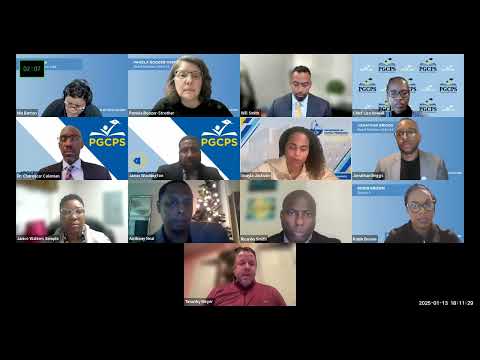
At a Jan. 13 audit committee meeting, Prince George's County Public Schools staff explained construction delivery methods, multiyear CIP funding and causes of cost escalation while board members and staff flagged a persistent funding gap, a roofing backlog and understaffing in Capital Programs.
Prince George's County Public Schools staff briefed the Board Audit Committee on Jan. 13 on construction delivery methods and how multiyear capital improvement program (CIP) funding ties to total project cost, while members pressed officials about chronic underfunding and staffing shortages in Capital Programs.
The overview, presented by Sheila Jackson, director of capital programs, and by William (Will) Smith, project management supervisor, described three common delivery methods — design–bid–build, construction manager at risk (CMAR) and construction manager as agent (CMAA) — and explained why PGCPS selects each depending on risk, unknown site conditions and phasing complexity. "Design–bid–build works well for simpler projects," Jackson said. "When a number of unknowns pile up... that's probably time to consider some of our other tools." Will Smith added that CMAR brings a contractor into the design phase and can include a guaranteed maximum price to reduce surprises.
Jackson said total project cost covers planning, design, construction, furnishings and temporary facilities, but PGCPS requests funding in multiyear increments from the county and state rather than in a single up‑front appropriation. Using Suitland High School as an example, Jackson said the project first appeared in PGCPS's fiscal year 2016 CIP (covering FY16–FY21) and that early figures are a rough order of magnitude that grow more precise through feasibility and design phases. "With each stage of the design, those cost estimates are more and more refined," she said.
Committee members and staff discussed the effects of recent price increases and long funding cycles. Will Smith said market pricing "has plateaued" since the sharp post‑COVID rise but has not fallen to pre‑pandemic levels; he noted that steel prices previously rose about 180 percent and have not dropped by an equivalent amount. Jackson warned that mismatches between scheduled project draws and available CIP allocations can lead to contractor claims or work stoppages.
Members pressed staff on the practical impacts. Jackson told the committee the system needs roughly $570 million a year to complete its modernization plan in today's dollars; she said the system received about $120 million last year and that recent annual funding has fallen further. Staff and board members said the level of funding and the size of the Capital Programs staff make timely delivery difficult. "When you under‑resource the people managing a $1 billion portfolio to save a $90,000 or $120,000 salary, there's a part where it might be penny‑wise and pound‑foolish," Jackson said. Committee members and Will Smith described prior assessments comparing PGCPS staffing to peer districts and said PGCPS previously operated with a smaller planning and project management team than comparable systems.
The presentation highlighted recurring operational issues: a backlog of roof replacements (staff said the district needs to replace roughly 15 roofs per year to keep pace), a largely reactive approach to Americans with Disabilities Act (ADA) needs (staff install accessibility items when individual student needs arise rather than following a district‑wide ADA modernization plan), and competition for design and construction staff in the regional market that has slowed hiring for posted positions. Staff said some projects — Suitland, Cool Springs, New Northern, Cherokee Lane and High Point High School were mentioned — are being delivered under alternative methods such as CMAR; Riverdale Early Childhood Center was cited as an example of adding early‑childhood capacity.
Board members asked how the district communicates project status to the public. Jackson pointed commissioners to PGCPS project pages (pgcps.org/cip) and said staff would improve how prior‑year funding and approved allocations are displayed so the public can see where funds were requested and what was awarded. Jason Washington, associate superintendent of supporting services, introduced the capital team and said follow‑up material and any requested documents will be posted to BoardDocs.
The audit committee did not take formal action on CIP policy or funding at the meeting; the agenda and the Dec. 9, 2024 minutes were adopted without objection and the meeting was adjourned. Staff said follow‑up items and materials will be posted on BoardDocs when available.