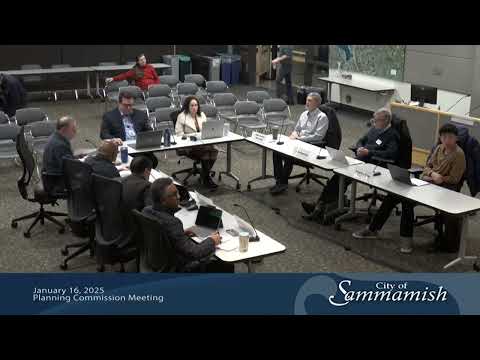
Sammamish launches Town Center form‑based code effort; draft expected late spring
Summary
Staff introduced form‑based code work for the Town Center — including SEPA scoping, a traffic‑impact review, housing diversity and a possible draft in late spring/early summer — and fielded commissioner and public questions about design standards, street sections, heights and applicability to existing entitlements.
Sammamish staff on Jan. 16 gave commissioners an introductory briefing on a proposed form‑based code for the city’s Town Center, describing the work program, environmental review and a target of a draft code in late spring to early summer.
The project will include SEPA scoping that could evolve into a supplemental environmental impact statement, a traffic‑impact review, and analyses of housing diversity and affordability. Staff said the consultant Framework — the firm that previously worked on the city’s comprehensive plan — is assisting the effort and that the transportation consultant DKS is participating on the project team to coordinate the city’s transportation and bike/ped plans with Town Center design.
"It's basically taking into consideration that the design of the site and the building and then also looking at the street frontage," said Matt, the meeting presenter, describing how form‑based codes join building type, site design and public‑space standards in a more graphic, rule‑driven format than conventional Euclidean zoning.
Staff described form‑based code elements as focusing on public space (streets, sidewalks, plazas and landscaping), walkability, mixed uses (ground‑floor commercial with residential above), and coordinated street standards for Town Center streets rather than applying the city’s standard five‑foot sidewalks on all streets.
Commissioners asked about the level of detail the code will include. Matt said architectural modulation, building articulation and landscape requirements would be part of the code, and that the code would define different allowable building types, frontage and plaza options so developers could combine options that match the city’s vision. He said the form‑based code would typically provide a menu of permissible options rather than a single prescriptive design.
Commissioners and public commenters raised additional issues: how the code will handle topography and steeper slopes in parts of Sammamish, how to ensure consistency across different property owners in the Town Center, and how the code will be enforced during the permit review process. Staff said projects with entitlements already under review would be grandfathered and that the code aims to reduce duplicate review steps and give clearer direction up front to shorten later permitting time.
Meeting participants also discussed scale and heights. A scoping notice dated Jan. 8 was cited during public comment; meeting participants noted the city’s current Town Center maximum height is about 75 feet and that the scoping notice lists consideration of taller heights (participants discussed 150 feet as a potential upper bound in the scoping materials). Staff described height limits and shadow impacts as topics for the SEPA and code discussions.
Public comment urged that the project include illustrative examples and massing models and asked that staff identify explicit "community goals" the code is intended to achieve. Resident Paul Stikney noted a contract amount in the Jan. 7 council packet for Framework and said the contract listed $235,000 for the consultant scope; he asked whether a clear list of community goals already exists and, if so, who is managing it.
Staff gave an implementation timeline: staff said a draft form‑based code is likely in late spring or early summer, with further review, public outreach and environmental review through the summer and fall. Staff also said they will provide options and examples for the commission to review, and that Framework will borrow relevant elements from other jurisdictions while adapting them to Sammamish’s context.
The presentation prompted several commissioners to ask that staff bring specific local examples, explain how the code would work across different terrain types, and clarify how transportation, bike/ped and stormwater requirements will be incorporated. Laettner noted that DKS, the city’s transportation consultant, is part of the project team and will review transportation and bike/ped issues as part of the Town Center work.
The form‑based code discussion closed when the commission moved to agenda‑related public comments; staff said they will return with drafts and illustrative examples as the project advances.
AI generated
The text on this page is AI generated. Summaries, highlights, analysis, and video transcripts are all produced from the original source material.
AI can make mistakes, so if you spot one, and we will fix it for everyone.
Note: the source content is unaltered by us. Any content source we link to, be it a video, an audio recording, or a document, is presented exactly as its publisher released it. That publisher is usually a government body, sometimes an individual official or another organisation.