Get Full Government Meeting Transcripts, Videos, & Alerts Forever!
Get email alerts on the Probation Data topic
No spam. Unsubscribe anytime.
Probation releases first adult data book: 4,542 on supervision; alcohol and drugs top service need
Summary
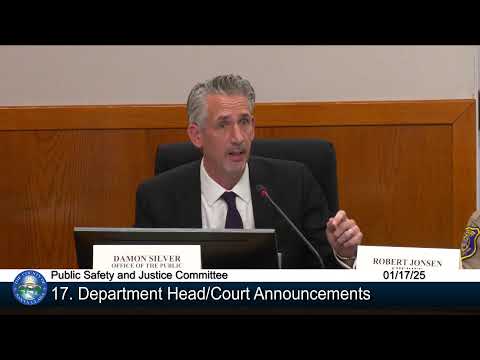
Probation presented the 2023 Adult Probation Division Databook to the Public Safety and Justice Committee on Jan. 17. The report lists 4,542 adults on active supervision, a disproportional share of Latino and Black residents in the supervision population, and identifies alcohol and drug needs as the leading service drivers.
The Santa Clara County Probation Department presented its first annual Adult Probation Databook for calendar year 2023 to the Public Safety and Justice Committee on Jan. 17.
Deputy Director Marielle Caballero and Senior Research Evaluation Specialist Saroj Dital told the committee that as of Dec. 31, 2023 there were 4,542 adults under active probation supervision: 84% male, 58% Latino and 66% aged 25–44. The report highlights disproportionality: Black residents make up about 2% of the county population but 10% of the adult probation population; Latinos are 25% of the county population but 58% of the service population.
Dital summarized risk and needs findings: for men, 32% were assessed high risk, 40% moderate and 28% low; women’s assessed risk distribution was more even. Alcohol and drug problems, emotional factors and relationship issues were the top three principal service needs. The department reported 65% of male clients and 75% of female clients have alcohol- or drug-related service needs.
The report showed a decline from 2018 to 2023 in the number of adults under post-release community supervision (PRCS) and mandatory supervision (MS) but an increase in formal probation grants relative to recent years. Probation staff noted higher shares of high-risk cases among AB109 populations (65% high risk under PRCS, 51% under MS) compared with formal probation (32% high risk).
Committee members asked how the department engages probation clients in substance-use treatment. Probation and partner-agency presenters said the department coordinates referrals with the Office of Diversion and Reentry and contracted treatment providers; probation officers use risk-and-needs assessments to match services and watch for readiness to change. Committee members and staff noted medication-assisted options for alcohol use disorders and flagged that treatment success often requires multiple engagements.
Members also discussed potential effects from Proposition 36, which is expected to increase treatment demand; Deputy County Executive Casey Halcon said partners are beginning preliminary analyses and will brief the committee in April with early data. The committee voted to receive the report.