Get Full Government Meeting Transcripts, Videos, & Alerts Forever!
Get email alerts on the Water Supply topic
No spam. Unsubscribe anytime.
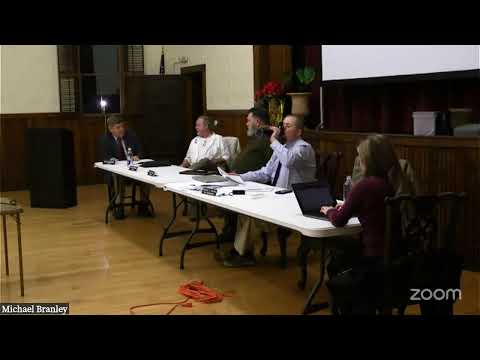
Select Board discusses $6.4 million plan to buy and upgrade West Swanzey water system
Summary
Town staff presented a plan to acquire the privately owned West Swanzey water system and spend an estimated $6.4 million on purchase and upgrades, leveraging an unprecedented 40% principal-forgiveness offer from the state SRF; the meeting focused on cost, who would pay, wastewater capacity and next steps toward voter approval.
Town staff presented a plan for the town to acquire the privately owned West Swanzey water system and pay an estimated $6.4 million to make it “turnkey,” with new pumps, a storage tank and a 12-inch main to serve additional connections and fire flows.
The staff presentation, given at a Select Board meeting, said the purchase price for the utility itself is about $600,000, the new pump house is estimated at $2.5 million and a storage tank at $3.3 million. The town has an application pending with the New Hampshire State Revolving Fund (SRF); staff said SRF is offering 40% principal forgiveness on the loan package, an unusually large subsidy staff said might not recur.
The town’s analysts told residents the full $6.4 million figure includes acquisition and construction to bring the system up to modern standards and to allow new service connections. Staff said the 40% principal forgiveness would reduce the loan principal the town must repay, and the modeling shown to the board assumed a long-term low-interest loan (the presentation used a 30-year amortization in examples) with the principal reduction applied at closing.
Board members and residents pressed staff on who would pay for the improvements. Staff said current users would bear most of the cost through higher water rates and capital reserve contributions; the presentation stated a typical annual residential water bill would rise by roughly $1,000 in the scenario modeled — from about $600 per year today to about $1,600 per year — absent additional grant funding. Staff said they are pursuing supplementary grants to reduce that burden.
Several residents and board members raised wastewater-treatment capacity. A former sewer commissioner warned that the town’s wastewater treatment plant is close to permitted loading and that adding service connections in the Route 10 corridor could require upgrades to the wastewater plant. Town staff said a separate planning study, funded by grant, is under way to identify required wastewater upgrades and timing; staff emphasized that wastewater improvements would be planned in coordination with any water system acquisition.
Speakers also discussed timing and voter approval. The acquisition would require voter authorization. Staff explained the warrant process: one article would authorize borrowing to fund the $6.4 million improvements; a second article would authorize the Select Board to begin negotiations and acquisition steps. Staff noted that the state statutes create waiting periods and that some actions require a higher voter threshold; the presentation said a 60% threshold applies to some funding authorizations and that certain acquisition steps would require a two-thirds voter vote.
Officials outlined other funding pieces mentioned during the meeting: about $500,000 the town has accumulated in reserve funds for system needs, and a previously awarded federal grant of roughly $200,000 staff described as “secure.” Residents asked how those funds factor into the financing model; staff said the $500,000 is part of the town’s trustee/custom fund balance and the $200,000 federal award is included in the funding plan but that waiting to act could risk losing some funding and future SRF principal forgiveness offers.
The presentation invited residents to an open house at Station No. 2 on upcoming Saturdays from 11 a.m. to 2 p.m. for further questions; staff urged residents to review a fact sheet uploaded to the town website and to ask questions before any warrant vote.
Ending: The board did not vote on acquisition at the meeting. Staff said they will continue negotiations, pursue additional grant funding, complete the wastewater planning study and present final warrant language for voter consideration at future meetings.