Get Full Government Meeting Transcripts, Videos, & Alerts Forever!
Get email alerts on the Procurement Practices topic
No spam. Unsubscribe anytime.
Committee trims Roughrider purchase language, adds vendor-pool limits to procurement bill
Summary
Lawmakers in the Government and Veterans Affairs Committee amended House Bill 1122 to remove a provision allowing state employees to buy directly from Roughrider Industries and to add vendor-pool limits aimed at preserving competition and reducing contract fragmentation.
The Government and Veterans Affairs Committee approved amendments to House Bill 1122 that strip proposed language allowing state employees to purchase directly from Roughrider Industries and add a new vendor-pool provision limiting certain contract lengths and preventing fragmentation of purchases.
Supporters said the changes preserve procurement competition and address longstanding concerns about multi-year vendor pools that can lock out potential competitors.
Representative Vetter summarized the collaborative negotiations that led to the revised bill, saying the committee removed the Roughrider-specific employee-purchase language so the procurement provisions could advance without controversy. The committee’s procurement staff and Roughrider representatives agreed to split the Roughrider-specific provisions into a separate Senate vehicle, Representative Vetter said.
Representative Ben Koppelman presented a separate amendment addressing multiple-award vendor pools. Koppelman said his constituent raised concerns about a vendor pool that could, through renewals and extensions, remain in place from 2021 through 2029 with little competition. Koppelman said the amendment would limit such vendor-pool contracts to five years and require a stricter approval process for longer terms. “What this language says is that a vendor pool ... limit[s] contracts to a term of 5 years,” Koppelman said.
Koppelman also said the amendment would ban fragmentation—breaking a large procurement into smaller purchases to avoid competitive thresholds—and require that work awarded from vendor pools be completed within the contract period. He and OMB witnesses said the changes were negotiated with the university system, NDIT and other procurement stakeholders.
Erin Neese of the Office of Management and Budget (OMB) told the committee OMB and other state agencies would promulgate rules and that procurement-advisory structures already exist to develop standards. “OMB is required to promulgate rules on this chapter,” Neese said, and she noted existing statutory cross-agency collaboration with the university system and NDIT on procurement policy.
The committee also discussed language in the bill referencing purchases from work activity centers. OMB staff and agency counsel said the statute cited in the bill, chapter 25-16.2, already authorizes governmental entities to purchase from licensed work activity centers at a fair and reasonable price; removing it would leave other parts of procurement law incomplete, they said.
Committee members and OMB staff discussed the situational nature of vendor pools and procurement timelines, and OMB described practical scheduling used to ensure continuity (for example, beginning procurement work well before a contract’s final year). The committee asked about administrative-rule processes and public input; Neese and OMB witnesses said rules and a procurement advisory council provide opportunities for agency and vendor input.
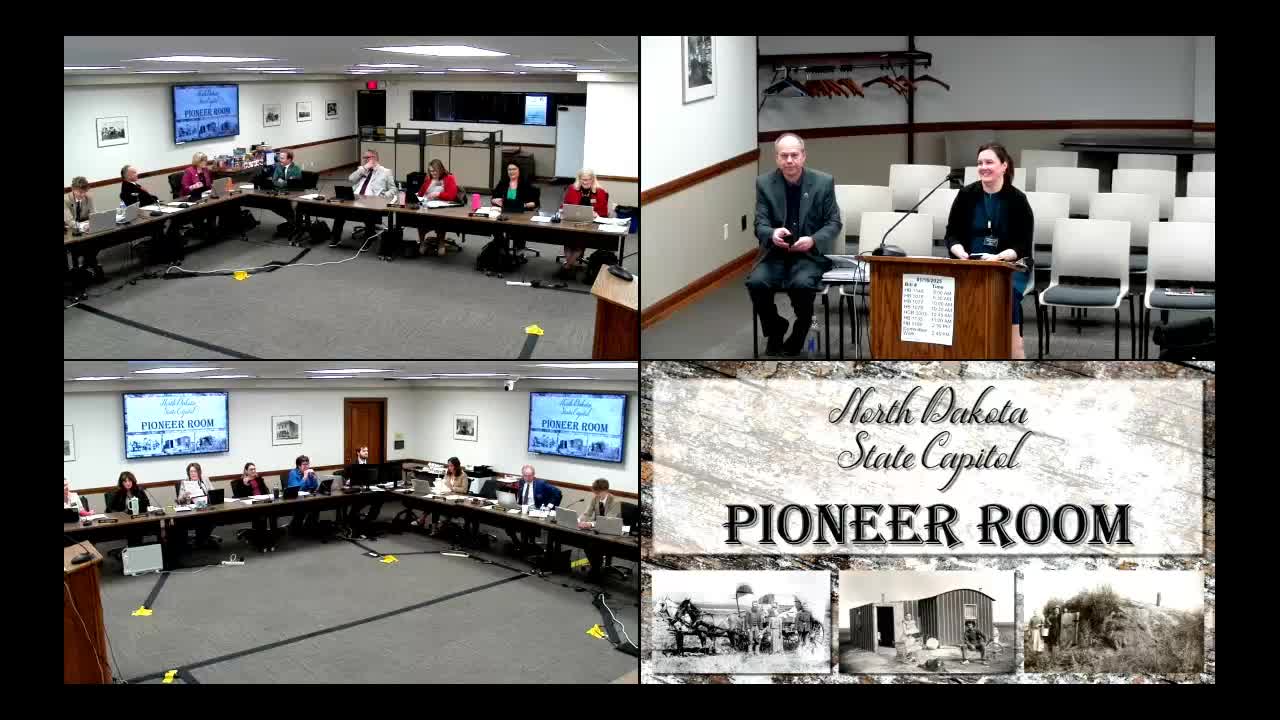
Representative Vetter moved the amendments to House Bill 1122; the motion was seconded by Van Winkle. The transcript records the clerk's announcement: “Amendment passes 120.” The committee then voted on the bill as amended (moved by Representative Greenberg, second by Van Winkle) and the transcript records final action: “Motion carries 110.”
Supporters said the amendments preserve Roughrider Industries’ existing authorities but remove the employee-purchase provision and add procurement safeguards aimed at ensuring competition and limiting long, noncompetitive vendor pools. Opponents or neutral witnesses recorded in the hearing included Protection & Advocacy representatives who had raised concerns about work-activity-center language; OMB staff said that statute remains in force and would require separate legislation to repeal.
The committee approved the amendments and the bill as amended; the transcript records the roll-call announcements as cited above. The revised procurement language now moves forward under the committee’s recommendation.