Get Full Government Meeting Transcripts, Videos, & Alerts Forever!
Get email alerts on the Veterans Benefits topic
No spam. Unsubscribe anytime.
Committee recommends bill to align state eligibility language with VA for veterans' benefits
Summary
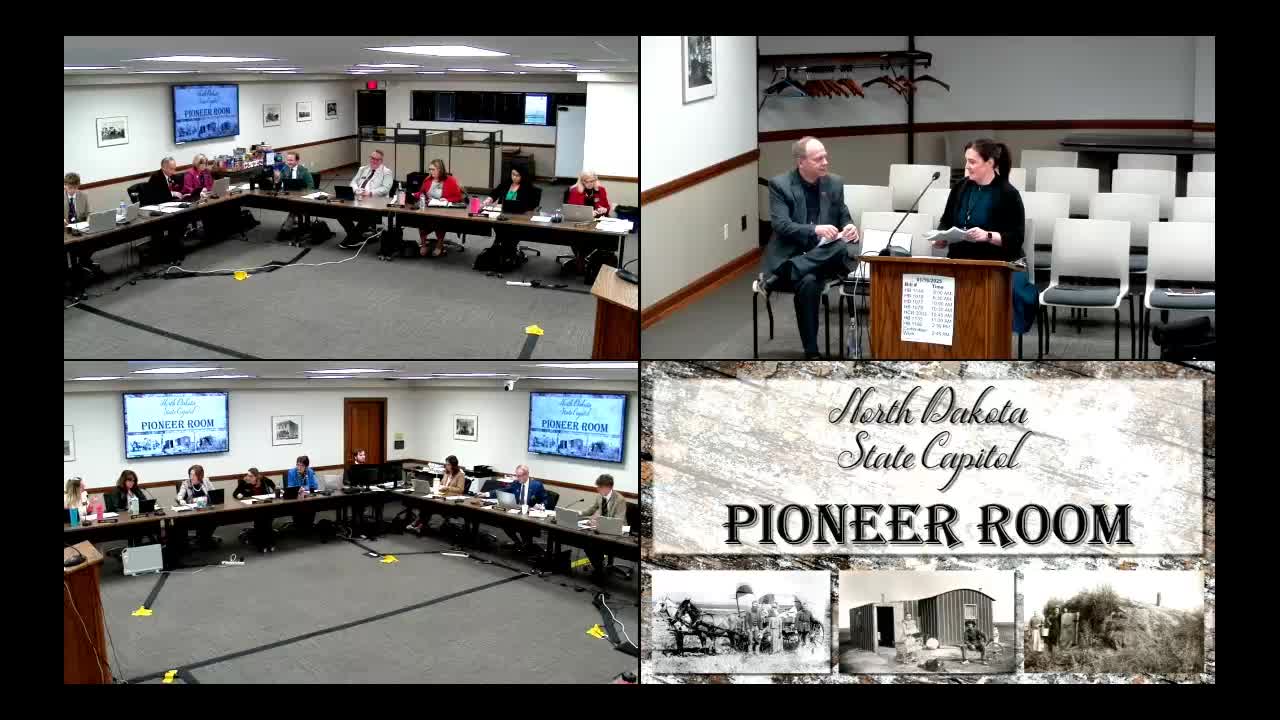
The Government and Veterans Affairs Committee voted to recommend House Bill 1180, a housekeeping change to state statutes that aims to align North Dakota law with Department of Veterans Affairs terminology to reduce confusion over disability ratings and eligibility for earned benefits.
The Government and Veterans Affairs Committee voted to recommend passage of House Bill 1180, which would adjust state statutory language to match Department of Veterans Affairs terminology and clarify how individual unemployability (IU) affects veterans' eligibility for existing state benefits.
The change is intended to reduce administrative confusion when veterans present VA disability letters to state agencies for things such as vehicle registration or property-tax reductions, supporters said.
Representative Ann Pyle, who introduced the bill, told the committee the measure is “rooted in the housekeeping, but has significant implications for individual unemployability.” She said the purpose is to “align our state laws with the federal terminology used by the Department of Veteran Affairs” so that state employees and new staff “understand and differentiate between these laws.”
Lonnie Wongen, identified in testimony as North Dakota’s commissioner of veterans affairs, explained the technical issue the bill addresses and walked the committee through how the VA combines disability ratings. Wongen said the VA issues an “extra scheduler rating to include individual unemployability” that can result in a veteran being paid at the 100 percent rate even though the VA’s combined-service-connected evaluation does not reach 100 percent. “The VA doesn't change your combined rating when they give you the IU,” Wongen said, adding that the discrepancy can lead to denials or delays when veterans apply for state benefits.
Wongen provided a sample VA benefits letter and a step-by-step illustration of VA “math,” showing how multiple ratings are combined and rounded only at the end of the calculation. He and Pyle said the bill does not create new benefits but clarifies statutory language so state workers can determine eligibility from VA documentation without unnecessary denials or lengthy appeals.
Keith Peach, who identified himself as a veteran and as CEO of Naderf, testified in support and said he was personally affected by the discrepancy. “I don't know how anybody could vote against it,” Peach told the committee after hearing Wongen’s explanation.
After closing testimony, Representative Bail moved a due-pass recommendation for House Bill 1180; the motion was seconded by Schneider. The committee conducted a roll call and the transcript records the result and the clerk's announcement: “Motion carries. 130.” Jackson called the roll during the recorded vote.
Supporters said the change is procedural and aimed at reducing paperwork burdens and misinterpretation by state offices, not at creating additional benefits. Opponents or neutral witnesses were not recorded.
The committee recorded the recommendation in favor of House Bill 1180; next steps include floor scheduling by the House and any subsequent committee referrals required by the legislative calendar.