Get Full Government Meeting Transcripts, Videos, & Alerts Forever!
Get email alerts on the Elder Care Community Model topic
No spam. Unsubscribe anytime.
Lawmakers discuss expanding Cass County 'community of care' model; grant funding and scalability debated
Summary
Committee members heard about a Cass County community of care model and discussed whether to promote or fund similar projects statewide. Lawmakers and witnesses cautioned that local leadership and seed funding are typically needed to replicate the model.
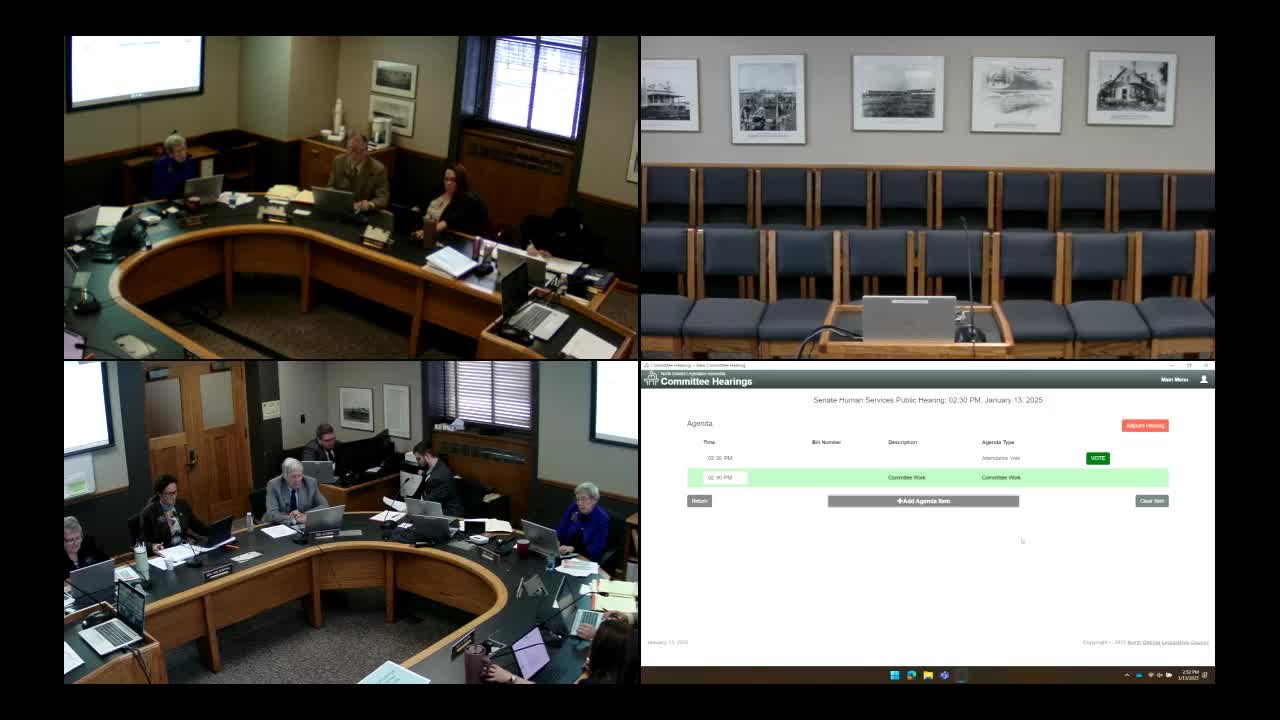
Members of the Senate Human Services Committee discussed a community‑based elder care model that originated in Cass County and a Morton County demonstration that used grant funding to replicate aspects of the program. The discussion arose while committee members considered language in Senate Bill 2138 related to elder care grants.
Committee members described the Cass County program as starting with volunteers and then supplementing services with modest funding. A committee member said the original Cass County model operated on local fundraising and volunteer coordination and that grant support helped Morton County to pilot a similar model for about 3½ years. A senator referenced an annual figure of "125,000 a year" as the scale of local funding used in one example.
Members and witnesses emphasized two consistent themes: (1) communities need local organizers to get a volunteer‑based program started, and (2) small grants can help but states should avoid penalizing a successful pilot by redistributing funds away from an existing program. Aaron Burson of the Association of Counties was noted in the discussion as having testified about the model; committee members urged promotion of the Cass County example rather than forcing a uniform statewide structure.
No committee amendment or final vote on Senate Bill 2138 was recorded in the transcript excerpt; members agreed to continue discussions on how best to encourage expansion without undermining existing local efforts.
Committee members asked staff to research options for supporting local organizers and to consider modest promotion or targeted grants that would help communities stand up the model rather than supplant existing local funding.