Get Full Government Meeting Transcripts, Videos, & Alerts Forever!
Get email alerts on the Cybercrime Capacity topic
No spam. Unsubscribe anytime.
Panel backs appropriation to embed two BCI cybercrime agents with Grand Forks police
Summary
The committee voted to recommend House Bill 1102 be re-referred to Appropriations. The bill would provide a one-time appropriation to the Attorney General to fund two Bureau of Criminal Investigation agents embedded in the Grand Forks Police Department to handle cybercrime and regional digital evidence needs; the motion passed 12-0.
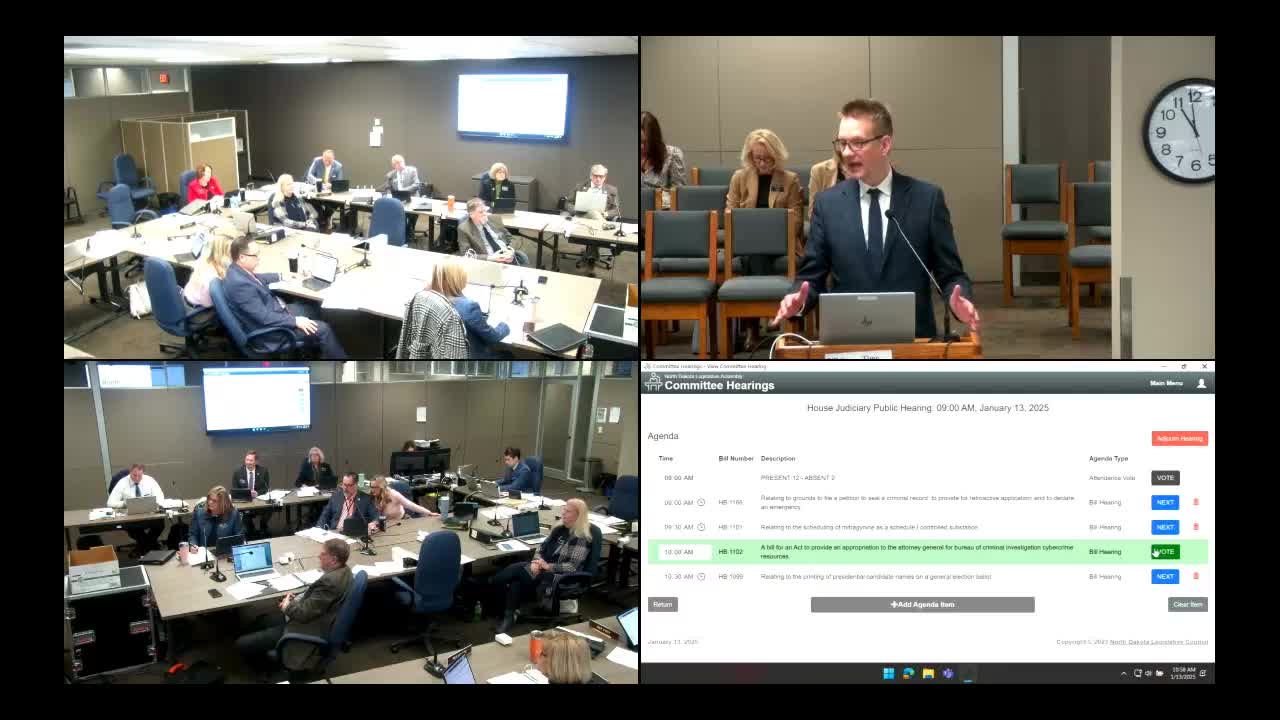
The House Judiciary Committee voted to give House Bill 1102 a do-pass recommendation and to re-refer the measure to the Appropriations Committee. The bill would appropriate funds to the Attorney General to pay for two Bureau of Criminal Investigation (BCI) cybercrime agents to be embedded with the Grand Forks Police Department and to serve the northeast region.
Rep. Murphy outlined that two BCI agents embedded with local law enforcement would add forensic and investigative capacity for cybercrime — including child-exploitation investigations — and would also support neighboring jurisdictions. The city of Grand Forks pledged office space and partial cost-sharing; committee discussion referenced additional one-time equipment and vehicle costs that may raise the initial $775,000 request by roughly $40,000 to $50,000 when the appropriation reaches appropriations review.
Todd Phelan, Grand Forks city administrator, said the city and mayor support the measure and are renovating space for the agents. Interim Chief Love of the Grand Forks Police Department said the department needs dedicated technical expertise to process digital evidence efficiently and cited a recent attempted-murder investigation that required extraction from a dozen phones.
Steve Harstead, a chief agent with the Bureau of Criminal Investigation, provided operational context: forensic extractions, software licensing and training are costly, require specialized equipment and continuous training as devices and software change, and the workload requires staff dedicated full time to digital forensics. Harstead noted the statewide cost for commercial extraction tools and services is substantial and that specialized agents increase efficiency for regional law enforcement partners.
Representative Vetter moved a do-pass recommendation and re-referral to Appropriations; Representative McLeod seconded the motion. The roll call showed unanimous committee support: Chair Clamine and 11 other members voted yes (12–0). The committee will forward the bill to Appropriations for fiscal review and possible amendment before floor consideration.