Get Full Government Meeting Transcripts, Videos, & Alerts Forever!
Get email alerts on the Controlled Substances Kratom topic
No spam. Unsubscribe anytime.
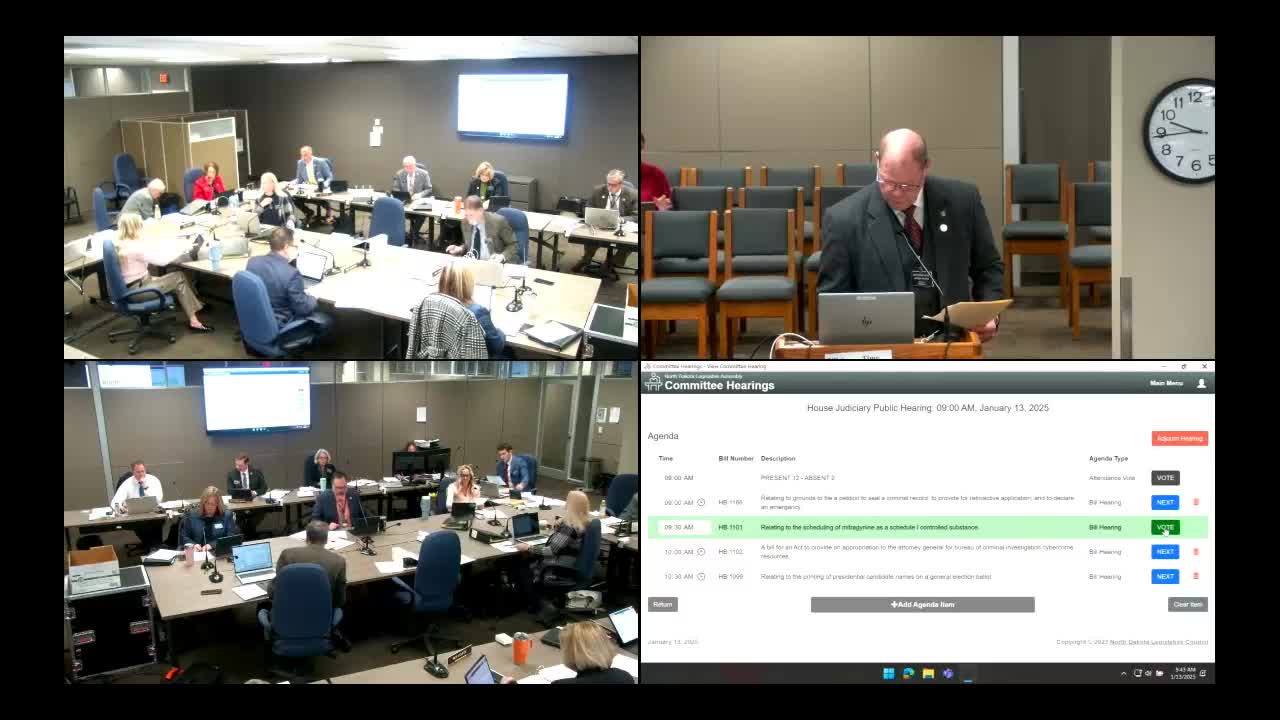
Committee hears divided testimony on bill to classify kratom as Schedule I
Summary
House Bill 1101 would add mitragynine (kratom) to the state’s Schedule I list. The committee heard hours of testimony from treatment providers and the state pharmacy board supporting scheduling and from consumers, advocates and the American Kratom Association urging regulation instead of a ban.
The House Judiciary Committee heard testimony on House Bill 1101, sponsored by Rep. Jeremy Olson, to classify mitragynine — commonly known as kratom — as a Schedule I controlled substance under state law.
Supporters, including some treatment providers and the North Dakota State Board of Pharmacy, told the committee that kratom acts on opioid receptors, has been linked to dependence and, they said, to overdoses and deaths in some cases. Opponents — including kratom consumers, advocacy groups and the American Kratom Association — urged regulation rather than a criminal ban, saying available studies and international reviews do not support an outright prohibition and that regulation would better protect consumers and preserve a tool some users say helped them reduce opioid use.
Rep. Jeremy Olson, the prime sponsor, said constituents at Providence House treatment center in western North Dakota reported serious problems with kratom and that the product “can be purchased easily, has opioid-like effects, and has caused physical harm and death.” He asked the committee to consider scheduling as a public-health response.
Mackenzie McCoy, a registered nurse at Providence House, described cases she said involved kratom dependence, withdrawal and relapse to illicit opioids. “I witnessed numerous kratom withdrawals,” McCoy said, and told the committee she had observed clients move from kratom to fentanyl or heroin and back to kratom in attempts to self-manage withdrawal.
Mark Hardy, executive director of the North Dakota State Board of Pharmacy, said the board has been monitoring reports from pharmacists and healthcare professionals and recommended classifying kratom to address public-health threats. Hardy said kratom contains a psychoactive compound that binds opioid receptors and that several states have scheduled or taken other regulatory steps.
Opposition testimony included long-form statements and dozens of online submissions. Matt Caddo, senior fellow on public policy for the American Kratom Association, argued the federal agencies that considered scheduling kratom concluded the evidence was insufficient and urged a regulatory alternative commonly called a Kratom Consumer Protection Act. Caddo and other opponents pointed to peer-reviewed surveys and consumer reports indicating many people use kratom to reduce opioid use or to manage pain and anxiety.
Individual opponents described personal experiences. Susan Efferd said her 22-year-old son’s autopsy listed mitragynine as a cause of death and that she and other parents have formed a group recording kratom-related fatalities. Consumer witnesses including Misty Brown and Jennifer Gilles said kratom helped them stop or reduce use of prescription opioids and improved their daily functioning; they opposed criminalization and said regulation and labeling would be preferable.
Committee members asked about available data. Witnesses debated the quality of national surveillance and toxicology testing and whether kratom alone causes the fatal outcomes cited in some cases. Board of Pharmacy and law-enforcement witnesses said postmortem testing and reporting are imperfect and that many reported fatalities involve multiple substances.
The committee set time limits for testimony (30 minutes per side) because of the volume of written and oral testimony and closed the hearing after hearing many in favor and many opposed. No vote was taken at the hearing; members said they would review written submissions and evidence before deciding on next steps.