Get Full Government Meeting Transcripts, Videos, & Alerts Forever!
Get email alerts on the Life Skills Transition Center topic
No spam. Unsubscribe anytime.
Senate hearing probes bill to let Life Skills and Transition Center serve a small number of non‑DD youths for short stabilization
Summary
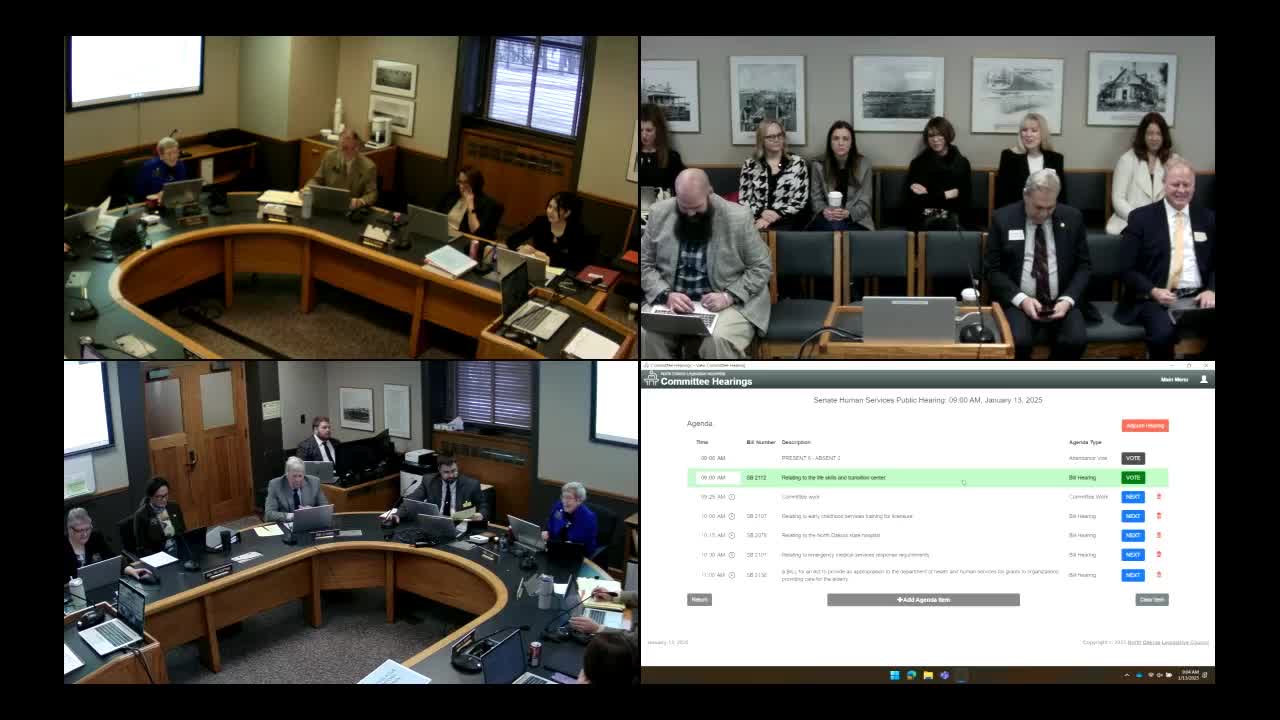
Senate committee members heard extended testimony on Senate Bill 2112, which would let the state’s Life Skills and Transition Center in Grafton serve a limited number of minors who are not eligible for developmental disability services for short‑term crisis and stabilization.
Senate committee members heard extended testimony on Senate Bill 2112, which would let the state’s Life Skills and Transition Center in Grafton serve a limited number of minors who are not eligible for developmental disability services for short‑term crisis and stabilization.
The bill’s sponsors and Department of Health and Human Services (NDHHS) officials said the change would be narrowly applied, require senior approvals and not be intended to replace community‑based services.
What it would do and why supporters say it matters
At the start of the hearing, Jessica Thomason, executive director for the Human Services Division at NDHHS, told the committee: “What we’re talking about in senate bill 2,112 is a highly specialized service option for a very, very small number of youth who have extremely complicated needs.” Thomason said the bill’s drafting simply adds the term “non eligible” where statute currently only allows admission of people eligible for DD services, and that any admission of a non‑eligible minor would require approval by both the commissioner and the LSTC superintendent.
Thomason and other department witnesses said the bill would allow LSTC to provide a range of services for non‑DD youth: consultative or non‑residential supports, up to 90 days of residential stabilization with a possible 90‑day extension on superintendent approval, and short‑term residential crisis care when no community option exists. As Thomason put it, the proposal “offers a small but important expansion of a safety net resource that may help answer the need for short term crisis and stabilization services for a small number of children in our state.”
NDHHS and human services zone leaders described the population the bill targets as extremely small and complex. Tina Bay, director of the Developmental Disability Section at NDHHS, cautioned: “While I do not oppose the proposed changes, I do have concerns regarding the potential impact this will have on [the] developmental disability system,” noting risks from commingling populations and existing capacity pressures. Kelsey Bless, children and family services licensing unit administrator, told the committee the department’s goal is family‑based care but that “the very small number of children we are talking about today who need the kinds of residential based… crisis and stabilization services offered by the Life Skills and Transition Center have life experiences that require a highly specialized approach.”
How many children, and where they would live
Witnesses repeatedly said the targeted group is small and hard to quantify. Thomason said the number is limited to “a very small number” and later estimated in conversation that, for child welfare specifically, it is “probably less than 20 to 30 kids statewide” with that very high level of complexity. Kelsey Bless summarized child welfare data, saying North Dakota has about 1,150 children in care and that roughly 5% of them — about 55 children on any given day — have high, complex needs; of those, only “1, 2, 3” might ever require the very specialized stabilization LSTC offers. Desiree Sorensen, Mountrail‑McKenzie Human Service Zone director, said the real count is uncertain: “it could be 3. It could be 10. It could be 12. We just don't know.”
Supporters emphasized that LSTC would be a last‑resort safety‑net, that admissions would be rare, and that NDHHS is simultaneously working to expand community options (for example, host home pilots and enhanced case management) so fewer children require institutional stays.
Opposition and concerns
Multiple disability, mental‑health and provider groups opposed the bill or urged caution. Kirsten Dvorak, executive director of The Arc North Dakota, said LSTC’s core mission must remain serving people with developmental disabilities and argued the state should instead invest in community‑based mental health services: “Institutionalizing minors in an environment that is not tailored to their needs risks isolating them, undermining their well‑being,” she testified.
Carla (Carlotta) McCleary of Mental Health America and the North Dakota Federation of Families urged expanding community crisis beds and other services before broadening LSTC’s mission, pointing to the state’s large population of children with serious emotional disturbance and saying community supports prevent out‑of‑home placements.
Protection & Advocacy’s Veronica Zitz raised a constitutional concern, pointing the committee to North Dakota Constitution Article IX, Section 12 and the longstanding statutory purpose that the Grafton facility serve individuals with developmental disabilities. Zitz warned that admitting non‑DD residents and nonresidents could risk access to beds for DD residents and could raise civil‑rights and safety issues. Angela Dineas of the North Dakota Association of Community Providers also urged opposition, saying the bill’s language does not specifically limit the new population to “complex needs” and cited staffing shortages and potential diversion of LSTC resources away from DD clients.
Fiscal and program details
Committee members noted a fiscal note attached to the bill. During testimony a department witness referenced a fiscal note of $87,969 for the current request. Witnesses described current and planned alternatives: a host‑home pilot funded from a one‑time Home and Community‑Based Services capacity fund, enhanced case management in human service zones, and existing qualified residential treatment providers (QRTPs) and the Ruth Myers Adolescent Center.
Committee discussion and next steps
Several senators asked whether the change would become a long‑term default rather than a short emergency option. Thomason, Bay and others repeatedly said the intent is temporary, rare admission only after other options are exhausted, and that family‑based placements remain the priority. Multiple senators and witnesses suggested guardrails such as time limits or revisiting the policy in a future session; some witnesses (including advocacy groups) proposed a sunset or time‑limited pilot as a condition for moving forward.
The committee recessed the hearing and asked Jessica Thomason to return later in the day with follow‑up details. No committee vote on the bill occurred during the hearing.
Ending
The testimony reflected a clear split: NDHHS and human‑services leaders urged a narrowly targeted expansion of LSTC’s authority to close a gap in crisis stabilization for a handful of highly complex youth, while disability, mental‑health and provider advocates warned the change risks diluting LSTC’s mission, exposing DD residents to safety risk, and diverting scarce staff and beds away from eligible DD clients. Senators asked for tighter limits, reporting and guardrails and asked NDHHS to return with more detail before the committee takes further action.