Get Full Government Meeting Transcripts, Videos, & Alerts Forever!
Get email alerts on the Behavioral Health topic
No spam. Unsubscribe anytime.
Lawmakers hear behavioral‑health progress: telehealth expansion, CCBHC rollout and a $300 million hospital proposal
Summary
The Appropriations section received a detailed briefing from the Department of Health and Human Services on behavioral‑health programs, including tele‑behavioral crisis services, the rollout of certified community behavioral health clinics, outcomes for reentry support programs and a governor-backed $300 million state hospital proposal.
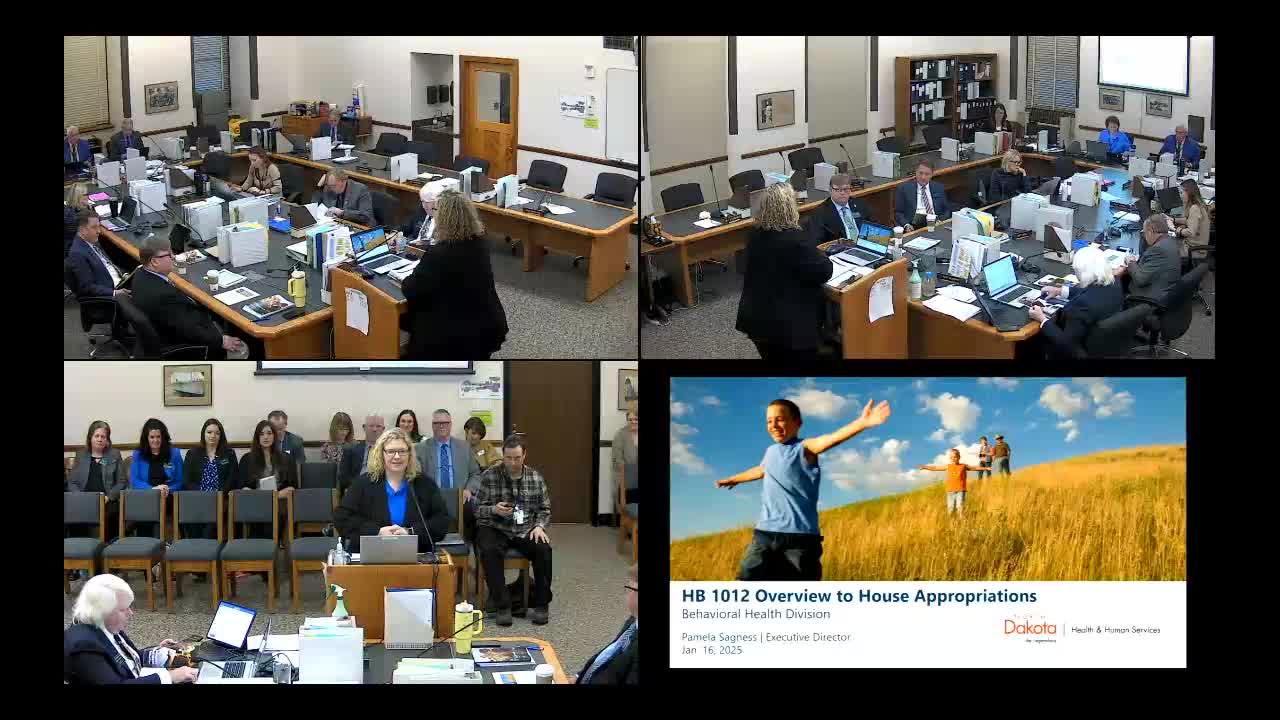
BISMARCK — The Appropriations - Human Resources Division section heard an overview of North Dakota’s behavioral‑health system on the morning session, where Department of Health and Human Services officials outlined program outcomes, upcoming clinic certification steps and a proposal for a new state psychiatric hospital.
Pam Segnus, executive director of behavioral health for the Department of Health and Human Services, told the panel the department is pursuing a systemwide shift that treats “behavioral health as health,” and that recent investments have focused on expanding community‑based services, strengthening early intervention and building workforce capacity.
The briefing matters because legislators must weigh ongoing funding for community programs, one‑time capital for a new state hospital and rules and certification changes needed to allow state clinics to participate in a federal‑style prospective payment system known as the CCBHC (certified community behavioral health clinic) model.
Segnus said the department is building the pieces needed for CCBHC certification at its eight regional clinics — including enhanced care coordination, expanded substance‑use treatment, primary‑care integration and strengthened data and revenue‑cycle functions — and expects administrative rules and certification processes to be in place by spring–summer 2026. She said North Central (Minot), Southeast (Fargo) and Northwest (Williston) clinics had declared intent to pursue certification.
Mark Johnston of Evelle Ecare, a tele‑medicine vendor that has expanded crisis telehealth for law enforcement, described rapid uptake of on‑scene virtual behavioral assessments. “We are currently live in 73 jurisdictions across the state,” Johnston told the section. He said the vendor’s clinical triage nurses supported nearly 200 field encounters in about nine months, and that after those encounters individuals were handed off to regional community mental‑health resources 94 percent of the time. Johnston added that 73.3 percent of those encounters involved reported suicidal ideation.
Segnus and other DHHS staff reviewed a range of programs the department funds or oversees. Key numbers presented to the committee included: - Free to Recovery (justice‑involved reentry program): 7,380 individuals served since the program began; 1,451 active participants and 52 providers. The department said the program reimburses providers based on four monthly outcome domains and costs under $500 per participant per month. Segnus described reimbursement as tied to outcomes, not fee‑for‑service. - Community Connect (civilly referred recovery support): 7,878 served to date; 1,418 current participants and 57 providers. Segnus said Community Connect operates on the same outcome‑based payment model as Free to Recovery. - Jail telepsychiatry: a contractual program serving 16 jails and delivering 791 services since launch in January (contracted psychiatric assessments and prescribing). DHHS staff clarified the jail telepsychiatry contract is separate from on‑scene crisis telehealth (Evelle Ecare) and that the different services are complementary. - Substance Use Disorder voucher: more than 7,000 individuals served to date, with 1,489 active participants and 35 licensed treatment provider sites. The department stressed the voucher is state‑funded and used as a payer of last resort when other billing sources are not available. - Peer support and workforce: DHHS reported more than 1,200 people trained and 446 certified peer support specialists; 406 certified at peer level 1 and 38 at peer level 2 were listed for billing eligibility across programs. - Opioid settlement funds: the state had received roughly $22.7 million with an expectation of further receipts; the legislature appropriated $8 million in the current biennium for opioid‑related programming. The department reported 65 applications for settlement awards and 14 funded projects to date, including expanded outpatient medication‑assisted treatment and recovery housing.
Segnus also reviewed school behavioral‑health grants and prevention funding, noting the 2023–24 school year provided $2.7 million to 24 districts and the 2024–25 allocation increased to $4.4 million for 25 districts and special education units. She described the grants as tailored to local district needs, with most spending on direct services.
On the clinics and administrative side, DHHS described two newly centralized functions: a revenue‑cycle team hired in early 2024 to improve payer enrollment, credentialing and billing, and a quality and technical services unit launched in December 2023 to manage the electronic health record, data reporting and clinical quality improvement. Segnus said initial improvements included enrolling more than 20 clients in commercial and Medicaid coverage in two months and measurable gains in timely‑filing metrics and credentialing throughput.
The department briefed the committee on longer‑term infrastructure: Pam Segnus and hospital leaders discussed a governor’s proposed $300 million capital request for a new state hospital. Dr. Edward Yabut, medical director at the North Dakota State Hospital in Jamestown, described current hospital primary‑care and allied‑health services (dental, optometry, podiatry), specialty referrals and clinical education partnerships with the University of North Dakota School of Medicine. Dr. Yabut said the hospital regularly supports medical diagnoses that require specialty care and noted the hospital’s role in training medical, nursing, pharmacy and behavioral‑health students.
Superintendent Olson and staff said demolition of obsolete campus buildings is complete and under budget; department staff said they would return to detail hearings with refined cost and design information aligned to the governor’s $300 million request. Committee members pressed staff to identify cost levers and the schedule implications of adding one‑time funds now to accelerate construction; DHHS said it would return with options.
Lawmakers asked about regional inpatient capacity and the CCBHC rollout. Segnus said the legislature appropriated funding in the last biennium to spur 10‑bed regional inpatient units in Williston and Dickinson; DHHS has a contract moving forward for Williston but had no private partner come forward for Dickinson by the deadline. The department said the state hospital continues to serve as a regional safety net while private partners stand up regional units.
Committee members also asked about data on overdose and suicide. Segnus presented preliminary figures (through Dec. 10, 2024) showing about 91 drug overdose deaths and 129 suicide deaths statewide; she noted those counts are preliminary and that the department would provide detailed data and methodology at the committee’s request.
What happened next: committee members asked DHHS to return for detailed testimony on clinics, the state hospital plan and revenue‑cycle improvements. Legislators pressed for clearer lists of providers by service and for caseload and staffing data for outcome‑based programs.
The department provided the committee with documents cited during the briefing, including the 2018 Human Services Research Institute behavioral‑health system study, more recent implementation reports, and a data book summarizing prevalence and service use. Segnus told the section the department aims to continue shifting services into the community, expand recovery and early‑intervention supports, and use prospective payment mechanisms for certified clinics when federal and state rules allow.
Ending detail: Segnus repeated the department’s guiding principle: “Behavioral health is health,” and urged the committee to consider both one‑time capital and ongoing operating funding needed to sustain expanded community services while building the workforce and revenue infrastructure necessary to support those services.