Get Full Government Meeting Transcripts, Videos, & Alerts Forever!
Get email alerts on the State Budget topic
No spam. Unsubscribe anytime.
Human Services budget overview: $6.2 billion request, major IT, behavioral-health and hospital bond items
Summary
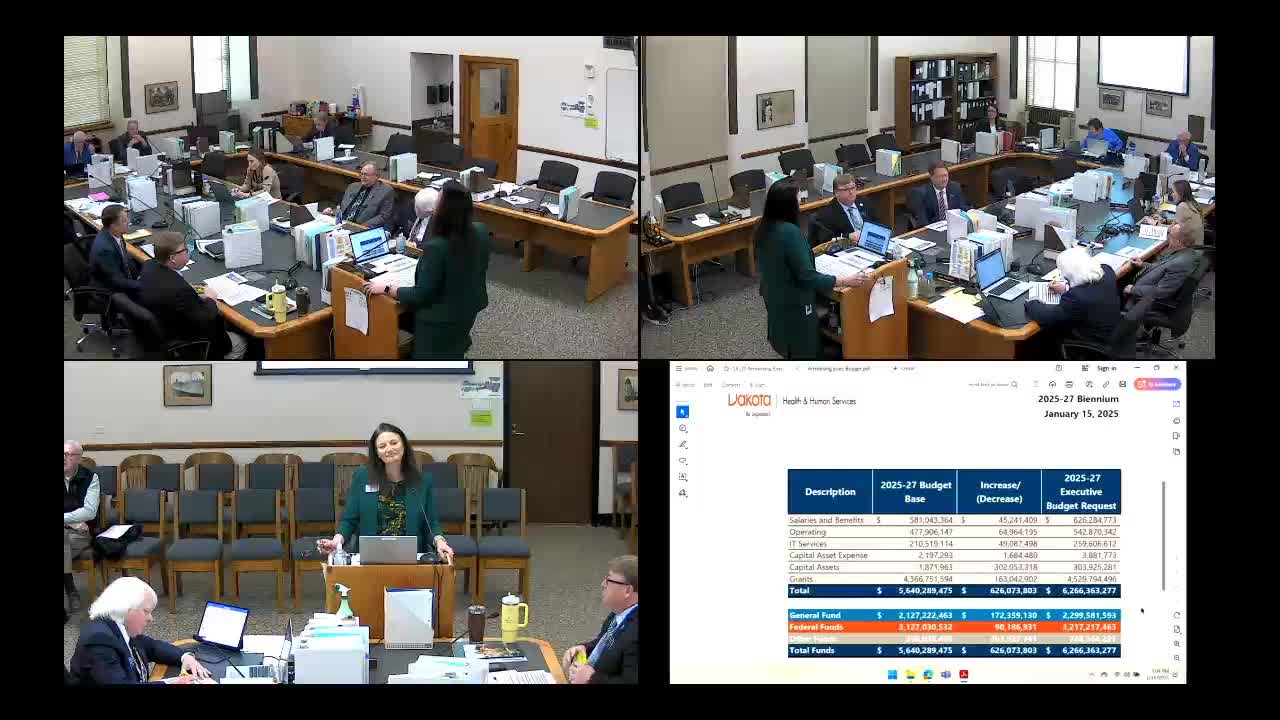
Donna told the HR appropriation section the executive budget request increases the Human Resources Division’s total request to about $6.2 billion, including roughly $2.3 billion in general fund, and outlined $626 million in increases across dozens of decision packages.
Donna, presenting the Human Resources Division budget to the HR appropriation section, summarized the executive budget request and highlighted major decision packages and the division’s plan to use an FTE block grant rather than add new permanent positions.
“What we just added was the 2527 budget base…This would move our total request to $6,200,000,000, of which approximately 2.3 billion is general fund,” Donna said, describing the difference between the division’s base and Governor Armstrong’s executive budget request. She told the committee the governor’s request is about $626 million above the base budget.
The presentation covered decision-package-level items across many program areas rather than final actions. Key requests and funded items in the executive budget highlighted in the overview include:
- Home- and community-based services (HCBS): Donna described a requested cost-to-continue growth line estimated at $64 million to cover anticipated entitlement growth in HCBS over the next two years.
- Adults Adopting Special Kids (ASK): A $4.9 million general-fund request to reinvest the state’s 50% share of maintenance payments back into the adoption program, following a federal match change.
- IT and legacy-system work: The division asked for inflationary authority of about $20.7 million for large IT contracts (general-fund portion shown in the request; Donna said an estimated 57% federal match exists in the base). The budget also requests roughly $15 million to retire legacy systems and $500,000 for EHR pharmacy system recovery/backups at the state hospital, plus $500,000 for state-hospital network redundancy.
- Behavioral health and children’s services: The executive request funded a range of items including continuation of current behavioral-health services, provider inflation to some 24-hour providers, a $2 million one-time partial-hospitalization/intensive-day-treatment development item for children, a $408,000 expansion for the treatment collaborative for traumatized youth, a $1.3 million increase for QRTP access for private-custody youth, and a two-region youth crisis-stabilization pilot at $3 million per region ($6 million total).
- Provider and targeted rate increases: Among many rate items, the division asked for $4.4 million to rebase ambulance Medicaid rates, $5.4 million for HCBS qualified-service-provider targeted rate increases, and $2.4 million for home health and private-duty nursing targeted increases tied to the DOJ settlement work.
- Facilities, public health and lab build-out: The request includes capital and transition costs such as a $712,000 roof replacement for the Cedar Grove building, $972,000 to renovate non-ADA-compliant bathrooms at the Southeast Human Service Center, roughly $2.9 million in transition expenses tied to the new public health lab, $251,000 for nonfatal toxicology equipment so those tests can be done in-state, and a $1.8 million Community Health Trust Fund increase to support a forensic-pathology contract with UND.
- Large initiatives and bonds: Donna listed a $14.5 million housing initiative and included authority for a proposed $300 million state-hospital bond on the division’s list of items conveyed in the executive budget request.
Donna said the division did not add new FTE counts in the executive request: “There are 0 additional FTE count added. There is a little bit added into the FTE block grant,” she told Chairman Nelson. She and committee members discussed use of the FTE block grant to manage vacancies and hiring rather than creating many new line-item FTEs.
Committee members asked for more detail and follow-up materials. Representative Murphy asked for clearer federal accounting on items where federal authority remains in the base; Donna said the federal portions were left in the base budget and that she would provide clearer line-by-line federal amounts. Committee members also requested turn-back (unspent) dollars per program, itemized FTE-pool usage and vacancy detail by program, and communications plans for public-facing program rollouts.
The division said it would return with detailed presentations by division directors and staff (including aging/medical services, behavioral health, compliance and quality, and public health) to walk through the decision packages and answer the committee’s 15 questions on ongoing vs. one-time funding. Donna closed the overview by saying staff would provide the same, detailed program-level reports that the committee received in prior biennia.
No formal committee votes were taken during the overview; members set follow-up requests and scheduled further briefings for the next day.
Ending: The HR appropriation section recessed and planned to reconvene the following morning for a detailed review led by the DD Council and division subject-matter presenters. Donna and staff agreed to provide the requested detailed breakdowns before those sessions.