Get Full Government Meeting Transcripts, Videos, & Alerts Forever!
Get email alerts on the Investment Policy topic
No spam. Unsubscribe anytime.
Retirement and Investment Office requests funding to expand internal investing; TFFR funding level reported at about 71.7%
Summary
The Retirement and Investment Office asked appropriators for funds to continue a multi‑year IT modernization, host pension administration software, and expand an internal investment program that officials say could produce multimillion‑dollar net benefits as asset management is brought in‑house.
The House Appropriations Government Operations Division received budget testimony Oct. 23 from the Retirement and Investment Office (RIO). Interim executive director Jody Smith and interim chief financial and operating officer Rachel Kametz outlined the office’s base budget, recent accomplishments, and five change packages that together total roughly $6.4 million, of which the governor’s recommendation included about $2.9 million.
RIO described two principal priorities: completion of a multi‑phase pension administration system modernization for the Teacher's Fund for Retirement (TFFR) and expansion of an internal investment program the agency calls an opportunity to reduce external manager costs and improve liquidity and rebalancing.
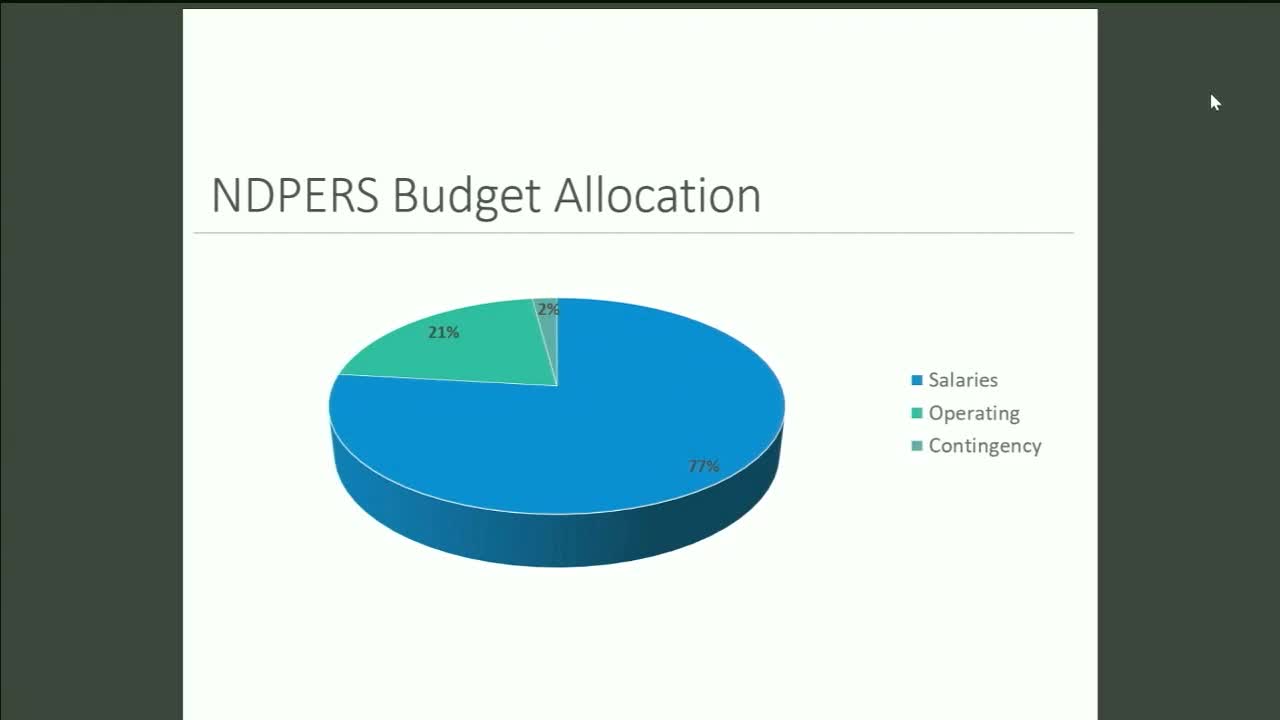
TFFR funding and IT modernization RIO Deputy Director Chad Roberts told the committee TFFR’s funding level is about 71.67% and that the agency expects to continue work on a pension administration modernization project. Rachel Kametz said the project is in its final phase and the agency expects the new pension administration tool to go live in February 2025. RIO’s base budget for the 2023–25 biennium was described as roughly $13.3 million, covering about 34 FTE and two temporary positions.
Internal Investment 2.0: staffing, timeline and projected net benefit Scott Anderson, RIO chief investment officer, described the agency’s internal investment program and a proposed expansion from an initial 15% of assets managed internally toward 30% and beyond. Anderson said the initial 15% internal program produced an expected net benefit of about $16 million annually after costs at the time the business case was developed and that the additional 15% (the second tranche, or "2.0") would yield about $9 million in incremental net benefit at current asset levels. "The net benefit of that would be about an incremental $9,000,000 at our current size," Anderson said, and he presented a scaled return case showing larger dollar benefits as assets under management grow.
RIO requested funding for the second year of positions created in the prior session (internal investment staff) and additional positions for internal investment 2.0: several investment professionals and fiscal staff. Committee members asked for an implementation timeline and requested an itemized breakdown of costs and expected savings; Anderson agreed to provide a more detailed timeline and periodic implementation reports to the committee.
Other budget items RIO asked for continued hosting and support for the pension administration system, incremental NDIT charges tied to unification, operating funding for communications and an ongoing internship program, and additional internal audit capacity to support the internal investment expansion. RIO said some positions created in 2023 were funded for just one year of the biennium and need funding for the second year.
Procurement and implementation notes Anderson described implementation milestones and said staff hires were slower than originally anticipated because of a state procurement process for large IT systems. He said staff hires are largely in place and that contract discussions with certain counterparties remain on the critical path. He also committed to providing the committee with an implementation progress report like the one RIO provides to its oversight board.
House Bill 1022 At the start of the session the clerk read the title of House Bill 1022, "To provide an appropriation for defraying the expenses of the Retirement and Investment Office." Committee discussion of RIO’s budget followed; no formal committee vote was recorded during the hearing.
Quotes from RIO officials - Jody Smith, Interim Executive Director, Retirement and Investment Office: "I will be spending time with OMB and with the governor's office just to ensure that our budgets align." - Rachel Kametz, Interim Chief Financial and Operating Officer, Retirement and Investment Office: "The state investment board is the oversight board for Rio and TFR board is responsible for the administration of the TFR benefits program." - Scott Anderson, Chief Investment Officer, Retirement and Investment Office: "What we're proposing is that we go from 15 to 30, so that's another 15% that we bring internally, and the net benefit of that would be about an incremental $9,000,000 at our current size."
Next steps Committee members asked RIO to provide a detailed implementation timeline, a breakdown of net savings and costs for internal investment 2.0, and an implementation progress report for future hearings. RIO indicated it will return with additional details and that some follow‑up meetings are expected.