Get Full Government Meeting Transcripts, Videos, & Alerts Forever!
Get email alerts on the Public Pensions topic
No spam. Unsubscribe anytime.
PERS briefs appropriators on shift to defined‑contribution plan, seeks staff and IT funding to implement change
Summary
Members of the House Appropriations Government Operations Division heard an overview from the North Dakota Public Employees Retirement System on Oct. 23 as the agency summarized growing membership, the Jan. 1, 2025 closure of its main hybrid retirement system to new hires and the budget and staffing it says are needed to administer the change.
Members of the House Appropriations Government Operations Division heard an overview from the North Dakota Public Employees Retirement System on Oct. 23 as the agency summarized growing membership, the Jan. 1, 2025 closure of its main hybrid retirement system to new hires and the budget and staffing it says are needed to administer the change.
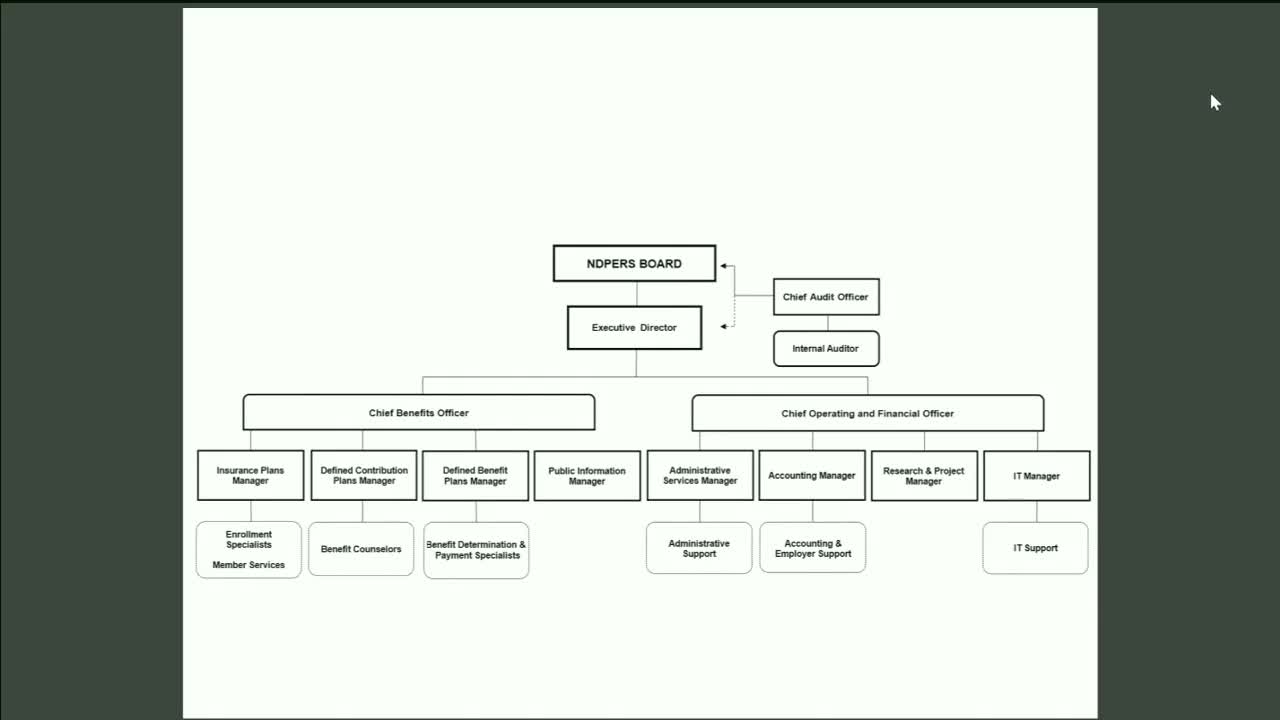
The agency, led by Executive Director Rebecca Fricke, told the committee that PERS now administers nine retirement programs and multiple group insurance plans and that significant demographic changes and statutory changes — including House Bill 1040 — are shifting more new hires into a defined‑contribution (DC) framework. "Effective January 1, 2025, this plan was closed to new participants," Fricke said during her overview, noting the legislature-authorized change that makes the defined contribution tier the default for new employees without prior PERS service.
The change means PERS must expand enrollment outreach, employer education and back‑office processing. "With the move to the defined contribution plan, what they'll receive at retirement will be based on the contributions that go into the plan and then how their investments do," Fricke said, describing the programmatic and communications work the agency is doing for new hires. Chief Operating and Financial Officer Derek Cobine told the committee that PERS has begun targeted welcome materials and twice‑monthly meetings with the deferred‑compensation vendor to help new employees make timely elections during the 30‑day IRS election window.
Why it matters: The shift from a defined‑benefit main system to a DC tier changes who manages investment risk and increases the importance of employer reporting, timely enrollment and member education. PERS officials told lawmakers they face heavier onboarding workloads and are seeking budget authority to avoid service disruptions.
Key statistics and fiscal context - Assets and payouts: Fricke said the plans have received about $3.23 billion in contributions since inception; as of October 2024 PERS reported about $4.5 billion in assets and roughly $3.46 billion paid in benefits. - Membership trends: PERS reported a 222% increase in active, deferred, retired and beneficiary counts since 1990 across plans the agency administers and steady growth in retirees year‑over‑year. The agency reported adding 11 new employer groups during the prior two years. - Deferred compensation and portability: The deferred compensation program has grown about 57% from 2012 to 2024, and the agency highlighted the Portability Enhancement Provision (PEP) enacted in 1999 that helped create the main hybrid plan as a companion to supplemental savings.
Health insurance and reserves PERS also described its health plan contract with Sanford Health Plan and an upcoming renewal arrangement in which PERS will receive 100% of any gain if claims are below premiums and bears no downside risk under the current contract terms. "We have 0 risk of loss, and we get all of the gains back," Cobine said of the proposed renewal terms. Committee members asked about reserves; Cobine said PERS has roughly $60 million on file with the Retirement and Investment Office (RIO), about $57.5 million of which he said would be available to the legislature to buy down premiums for the upcoming biennium.
Budget requests and staffing PERS officials described one‑time and ongoing budget items tied to the DB closure and DC launch: - One‑time items already appropriated or requested included $125,000 for an additional developer, $200,000 in temporary salaries to support transition work, and other operating costs; the agency reported it expects to use about half of the temporary salary authority for interns and temporary accounting help. - The agency said it has 40.5 full‑time equivalent positions and is asking to restore several FTEs and temporary positions it had proposed cutting under a governor's 3% reduction scenario. Officials warned that a 3% reduction would force discontinuing services for outside deferred‑compensation providers and eliminate two FTEs, an outcome they said would cause significant member disruption for roughly 11,000 participants who use providers outside the state companion plan. - PERS collects a longstanding $2.80 per contract administrative fee on the health insurance side; staff said that fee does not cover administrative costs and that reserves have been used to make up the difference.
Discussion and committee questions Committee members pressed for trend data and reserves history; Cobine agreed to provide a graph of prior renewals and the reserve trajectory. Lawmakers also probed operational details: how the 30‑day DC election window (Internal Revenue Code rules) amplifies workload, the agency's communications and enrollment efforts, and the tradeoffs of discontinuing optional deferred‑compensation providers to save administrative expense.
Quotes from PERS officials - Rebecca Fricke, Executive Director, North Dakota Public Employees Retirement System: "PERS is directed by an 11 member board... Effective January 1, 2025, this plan was closed to new participants." - Derek Cobine, Chief Operating and Financial Officer, North Dakota Public Employees Retirement System: "We have about $60,000,000 on file with Rio. We have about 57.5 that would be available for the legislature's use to do things like buy down premiums." He added of the Sanford arrangement: "We literally have the best aspect of a fully insured arrangement and the best aspect of a self insured arrangement. We have 0 risk of loss, and we get all of the gains back."
What the agency will do next PERS staff told the committee they will return for follow‑up briefings and provide requested data on reserve history and insurance trend lines. They said they will continue employer outreach, expand new‑hire education sessions and rely on temporary staff and interns to process special election windows tied to the DB closure.
Ending PERS officials emphasized that the change in plan design increases operational workload and the need for technology and staffing to avoid member disruption. Lawmakers asked for follow‑up materials on reserves and renewal history; the agency agreed to provide those items at a future hearing.