Get Full Government Meeting Transcripts, Videos, & Alerts Forever!
Get email alerts on the Deaf Education topic
No spam. Unsubscribe anytime.
School for the Deaf asks lawmakers to fund staff, security upgrades and online high‑school courses
Summary
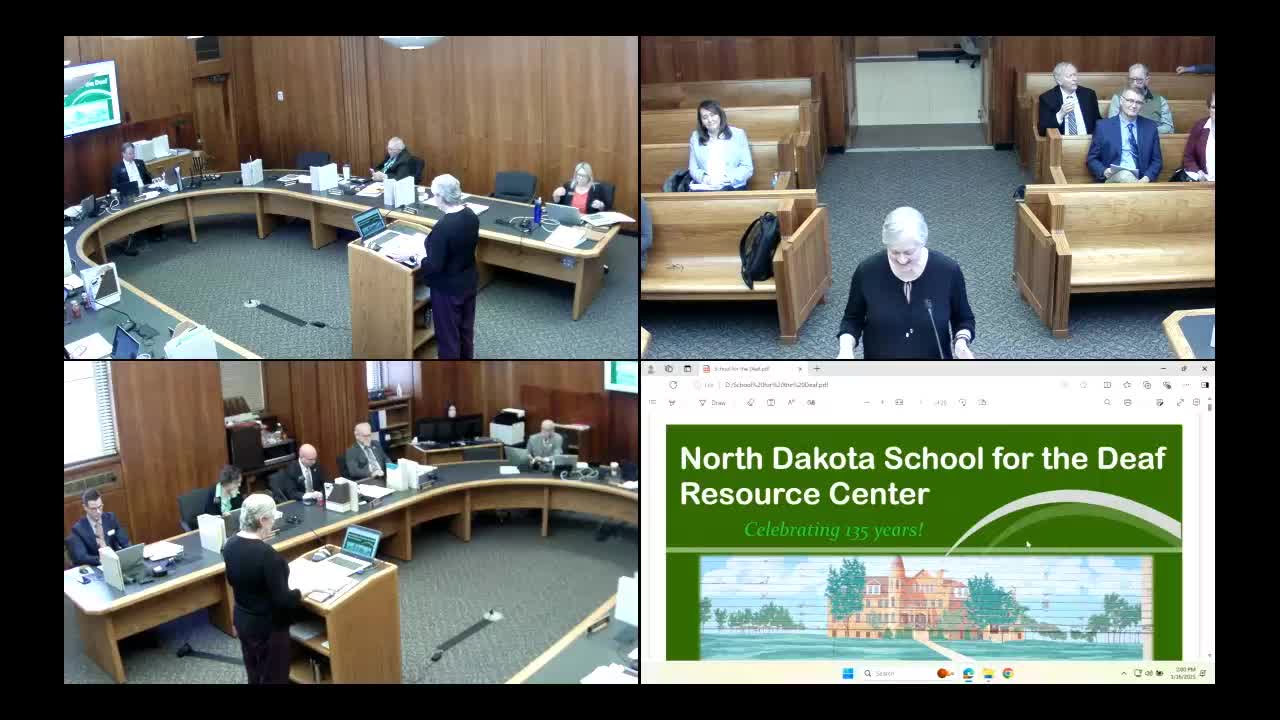
Donna Sorensen, superintendent of the North Dakota School for the Deaf and Resource Center, told the House Appropriations and Education and Environment Division during an HB1013 overview that the school needs additional staff and facility investments to maintain programs that serve deaf and hard‑of‑hearing children and adults statewide.
Donna Sorensen, superintendent of the North Dakota School for the Deaf and Resource Center, told the House Appropriations and Education and Environment Division during an HB1013 overview that the school needs additional staff and facility investments to maintain programs that serve deaf and hard‑of‑hearing children and adults statewide.
The School for the Deaf provides on‑campus instruction through eighth grade, a residential high‑school program for students who live on campus and a statewide outreach program that supports local districts, Sorensen said. "Our purpose is just to serve as a statewide resource," she said.
The superintendent said the school seeks staff investments to reduce burnout and improve student safety: an additional paraprofessional position, and converting a temporary overnight night‑watch role into a permanent dormitory counselor with state benefits. Sorensen told the committee that making the overnight position permanent and providing benefits would be "so much more attractive to someone," a change she said would cost about $1,500,000 (as presented in testimony).
Sorensen described student counts and program structure: the on‑campus program serves roughly 25 students at the time of testimony, including a new preschool student and a second‑grader starting soon; about 18 of the students live on campus. High‑school students currently attend Devil's Lake High School while the school pilots supplemental online courses through the American School for the Deaf’s online academy; she asked the committee to restore a $70,000 line item to continue that pilot in the coming biennium.
The presentation listed recent accomplishments and challenges: the school earned Cognia accreditation, filled 14 of 16 vacancies within a month in the last biennium, added a licensed practical nurse for evenings and restored a second overnight staffer after more than a decade of single‑person coverage. Sorensen also highlighted a new deaf‑mentor program based on a Utah State University model and an expanding communications and advocacy program to help deaf adults access state agencies and court services.
Facility work included a prolonged roofing and HVAC project that delayed other capital items. In the budget summary Sorensen identified an executive request for a campus security camera upgrade (listed at $238,800 in testimony), operating equipment replacement (about $283,800) and a request to carry over capital dollars for boiler and pneumatic control replacements.
Diane Fralick, the school’s business manager, answered questions about remaining special‑fund balances and explained that a recently purchased snowplow and other equipment under $5,000 had been charged to that balance; she confirmed there was no specific planned use for the remaining $35,418 at the time of testimony. Representative Richter and other committee members asked about paraeducator wages and professional development; Sorensen said paras are paid hourly (she cited a current starting rate near $20.21 an hour) and that state employee positions include benefits, while some temporary positions do not.
The committee did not take a vote on the school’s requests at the overview hearing; members indicated they would return for a more detailed review.