Get Full Government Meeting Transcripts, Videos, & Alerts Forever!
Get email alerts on the Attorney General Budget topic
No spam. Unsubscribe anytime.
Attorney General outlines $29.3 million base request, seeks funds for crime lab, BCI, fraud unit and victim services
Summary
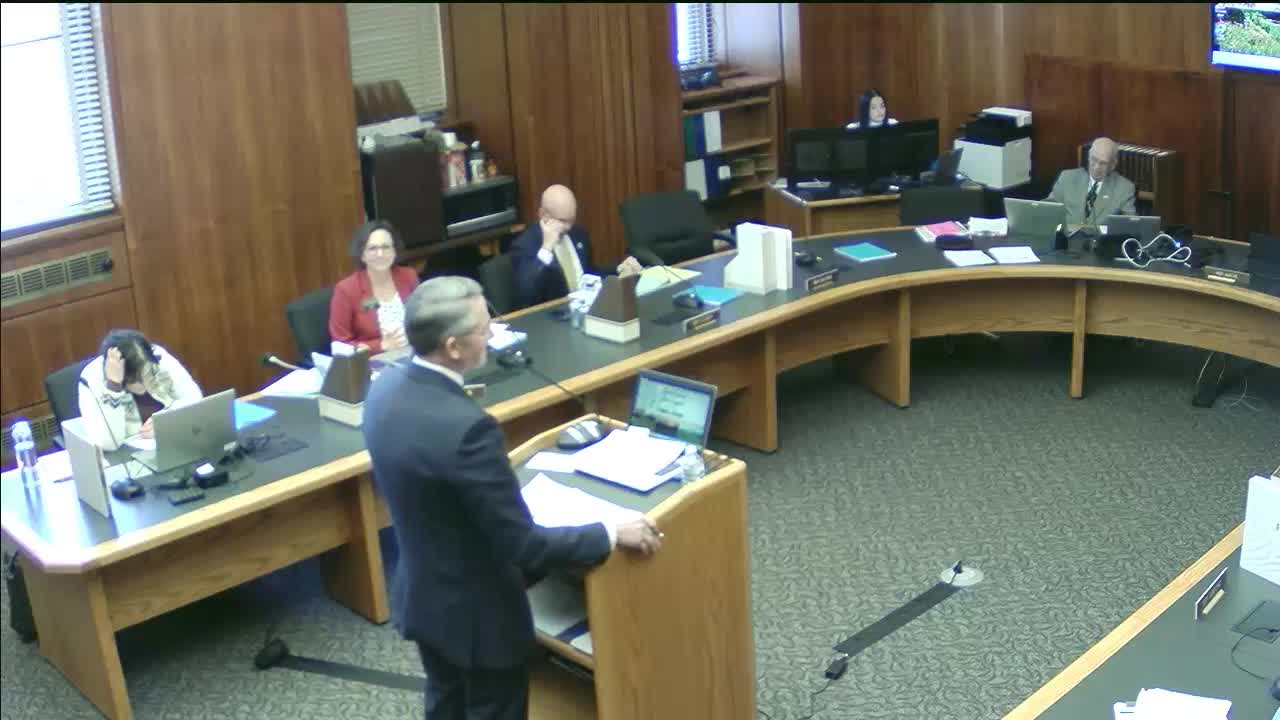
Attorney General Drew Wrigley laid out the Office of Attorney General’s budget priorities for House Bill 1003 before the Appropriations — Education and Environment Division, asking to continue pay and equity adjustments and to add equipment and staff across the crime lab, BCI, Medicaid Fraud Control Unit, victim services and IT systems.
Attorney General Drew Wrigley told the Appropriations — Education and Environment Division on a hearing for House Bill 1003 that his office is seeking funding to sustain recent hires and expand services across criminal justice, forensic science and victim support.
Wrigley said the attorney general’s office now has “266 staff members in the attorney general's office and 14 different divisions” and described a multiyear plan that builds on approximately 20 FTEs added in the prior legislative session. "We have those numbers," he said, and outlined requests ranging from crime-lab equipment and staff to additional prosecutors in the Medicaid Fraud Control Unit and consumer-protection work.
The hearing focused on a mix of continuing costs and optional requests. Wrigley highlighted crime-lab improvements and staffing gains made last session, saying the lab no longer has the large backlogs it once did: “There are none that are backlogged. We always have some that are in the queue as part of investigations but those backlogs are long gone,” and he thanked Jennifer Penner, the lab director, for her work.
Why it matters: the budget requests tie directly to public-safety and legal services across North Dakota — from evidence turnaround times that affect prosecutions to expanded enforcement and recovery in Medicaid fraud and gaming enforcement. The proposals include equipment and software updates that the office says are required to meet statutory notification and records-management obligations.
Major items discussed
- Pay and personnel: Wrigley asked for ongoing funding to continue the recent raises and equity adjustments for attorneys and non-attorney staff. He said the office is pursuing pay-for-performance and a goal of bringing non-attorney staff to about 90% of midpoint over time. He described attorney recruitment pressure from other public-law employers, saying some county state's attorneys make substantially higher starting salaries.
- Crime lab: The attorney general requested multiple equipment replacements and additions (GCMS instruments, thermal cyclers, hydrogen generators, a temperature-monitoring system) and two crime-lab FTEs: an additional intake/evidence technician and a full-time quality-assurance manager. Chief Deputy Claire Nasse described a bottleneck in evidence intake: the lab once had four intake positions before 2017 and now has one.
- BCI and tribal task forces: Wrigley described three BCI task forces already established near reservations and said the office is pursuing additional staffing — including requests to add three BCI agents (to bring some locations to three agents total), training expansion through the National Forensic Academy, and administrative support for tribal field agents. He said the state currently processes about 900 sex-offender registration forms per month and has roughly 1,800 registered offenders.
- Cyber and discovery needs: The office cited a sustained increase in cyber tips (recent years near 1,500 tips) and asked for additional cyber investigators and an administrative assistant to address report backlogs. Attorneys also requested discovery- and redaction-software to manage large electronic discovery sets.
- Medicaid Fraud Control Unit (MFCU) and consumer protection: MFCU is described as 75% federally funded and 25% state-funded. Marina Spahr, who identified herself as the MFCU director, said the unit must turn away an estimated 10–15 major cases per year because of limited attorney capacity and that additional staff would allow the unit to pursue more recoveries and deterrence. The attorney general proposed converting an existing paralegal FTE to an attorney in the Consumer Protection Division (estimated biennial cost: $30,000) to accelerate investigations.
- SAVN replacement and IT: Chief Deputy Claire Nasse said the statewide automated victim notification (SAVN) system currently uses VINE, whose support has degraded since the vendor was acquired, and asked for roughly $1.5 million to procure a replacement and related IT items. Other IT requests included e-prosecutor (replacement for Justware), jail-management systems, and increased NDIT service rates.
- Litigation pool and legal-defense costs: Wrigley requested an $8 million litigation pool for the biennium, citing increased multistate and federal litigation costs. He said the pool previously was $5 million and argued the requested amount mirrors expected near-term costs.
- Funding-source change: The attorney general described a long-standing practice of using refund funds (recoveries from litigation) to temporarily pay some recurring salary costs (BCI and lab raises) and said the office intends to seek a transition of those salary costs to the general fund. He estimated the price tag for that change at about $22.8 million per biennium.
- Tobacco settlement compliance auditor: The office proposed an FTE funded from the state’s tobacco-master settlement proceeds to monitor compliance and protect that revenue stream, which Wrigley said is about $20 million yearly for North Dakota.
- Victim services and human-trafficking funding: Representatives from YouthWorks asked the committee to increase the attorney general’s human-trafficking appropriation by $500,000 (to $1.6 million total) to preserve federal-match opportunities and extend services into rural counties and reservation communities. Amy Boyd of YouthWorks said state funds leverage federal grants and that the organization served victims on all five reservations.
Committee questions and clarifications
Representatives pressed for details on vendor relationships for IT replacements, causes of lab backlogs and capacity, and where recovered funds from fraud prosecutions flow. The MFCU director said recoveries generally come to the state and are shared with the Department of Health and Human Services, which retains roughly half after federal match obligations; the director estimated the unit currently turns away roughly 10–15 major Medicaid fraud cases annually for capacity reasons.
No final actions recorded
The hearing was informational; the transcript does not record committee votes or formal actions on House Bill 1003 during this session. Committee members said they will continue to examine the proposal and follow up in future meetings.
Ending note
Committee members asked for follow-up materials (crime-lab space-study cost estimates, precise counts of cases MFCU declines, and details on proposed funding-source transitions). Wrigley and staff offered to provide the requested documents and to arrange lab tours and further briefings during the budget-review process.