Get Full Government Meeting Transcripts, Videos, & Alerts Forever!
DPI details K‑12 budget request, seeks tools to intervene in chronically low‑performing schools
Summary
Kirsten Basler, state superintendent of public instruction, told the House Appropriations Education and Environment Division that DPI's 2025–27 budget request focuses on tools to support and, when necessary, intervene in chronically low‑performing schools while continuing per‑pupil funding and statewide programs.
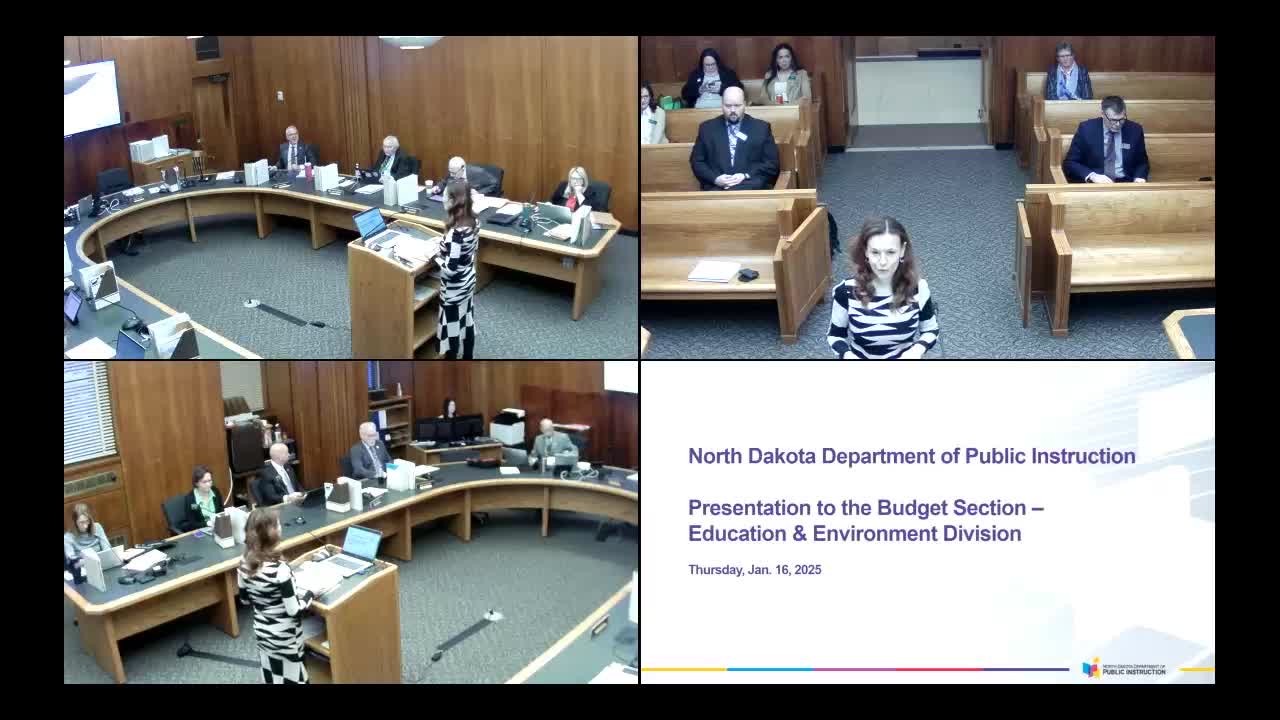
BISMARCK — Kirsten Basler, the state superintendent of public instruction, told the House Appropriations Education and Environment Division on Jan. 15 that the Department of Public Instruction’s (DPI) 2025–27 budget request centers on continuing classroom supports while expanding tools to intervene in chronically low‑performing schools.
Basler opened the presentation by describing DPI’s role and partners and showing “the chart that we lovingly call the spaghetti chart,” a diagram she used to explain how multiple state, regional and nongovernmental entities interact with K‑12 education in North Dakota. “I’m the state superintendent of the North Dakota Department of Public Instruction,” she said at the start of her remarks.
Why it matters: about 98% of the department’s appropriation is distributed to local school districts through the per‑pupil foundation formula. DPI told lawmakers the overall per‑pupil foundation payment currently sits at roughly $2.3 billion; most policy decisions about distribution are made at the local level, but the department said it needs authority and funding to respond when schools show no improvement.
DPI emphasized two policy tools lawmakers may consider. The first is ND First, a recently created intervention tier for school districts that remain chronically low‑performing for more than three years. Under ND First, the department now has limited authority to approve and require changes to local improvement plans and to adjust staffing in some circumstances. Basler described the change as a middle path: it does not allow the state to close schools or take full operational control, but it does permit DPI to approve improvement plans and require different staffing when local plans have failed to produce results. “If you keep doing the same things and expect a different…
Already have an account? Log in
Subscribe to keep reading
Unlock the rest of this article — and every article on Citizen Portal.
- Unlimited articles
- AI-powered breakdowns of topics, speakers, decisions, and budgets
- Instant alerts when your location has a new meeting
- Follow topics and more locations
- 1,000 AI Insights / month, plus AI Chat