Get Full Government Meeting Transcripts, Videos, & Alerts Forever!
Get email alerts on the K12 Budget topic
No spam. Unsubscribe anytime.
DPI details K‑12 budget request, seeks tools to intervene in chronically low‑performing schools
Summary
Kirsten Basler, state superintendent of public instruction, told the House Appropriations Education and Environment Division that DPI's 2025–27 budget request focuses on tools to support and, when necessary, intervene in chronically low‑performing schools while continuing per‑pupil funding and statewide programs.
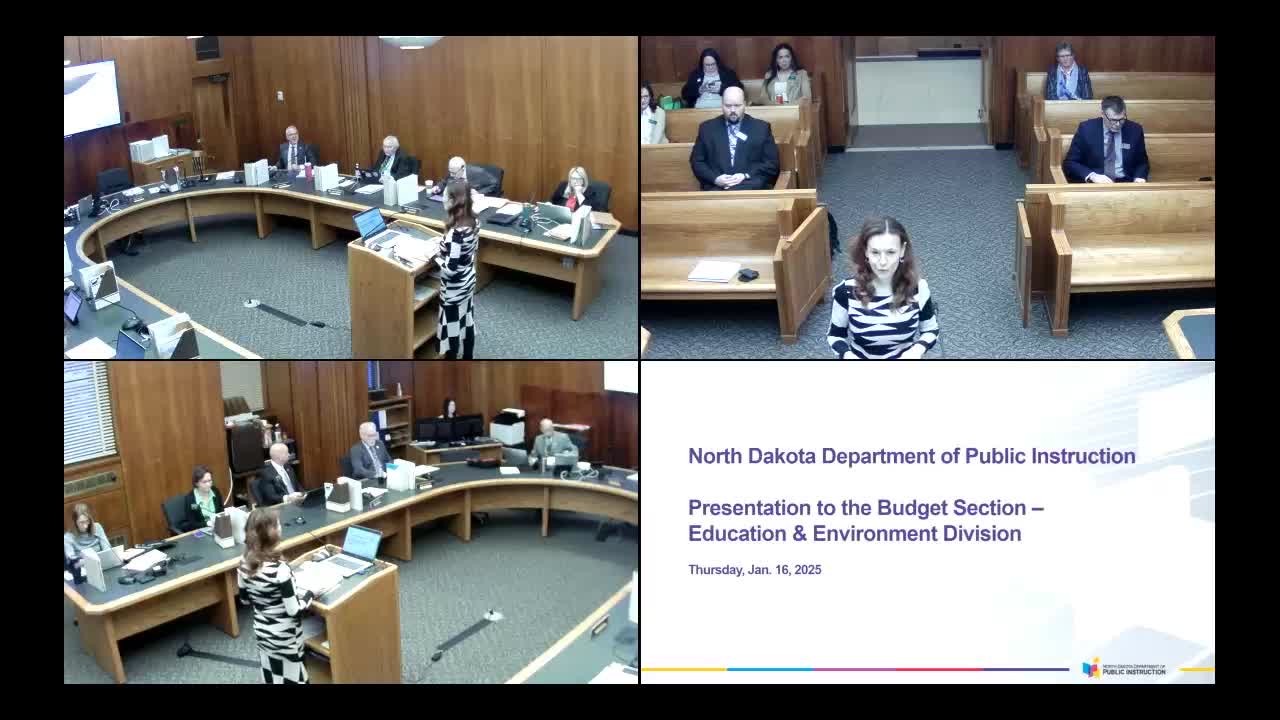
BISMARCK — Kirsten Basler, the state superintendent of public instruction, told the House Appropriations Education and Environment Division on Jan. 15 that the Department of Public Instruction’s (DPI) 2025–27 budget request centers on continuing classroom supports while expanding tools to intervene in chronically low‑performing schools.
Basler opened the presentation by describing DPI’s role and partners and showing “the chart that we lovingly call the spaghetti chart,” a diagram she used to explain how multiple state, regional and nongovernmental entities interact with K‑12 education in North Dakota. “I’m the state superintendent of the North Dakota Department of Public Instruction,” she said at the start of her remarks.
Why it matters: about 98% of the department’s appropriation is distributed to local school districts through the per‑pupil foundation formula. DPI told lawmakers the overall per‑pupil foundation payment currently sits at roughly $2.3 billion; most policy decisions about distribution are made at the local level, but the department said it needs authority and funding to respond when schools show no improvement.
DPI emphasized two policy tools lawmakers may consider. The first is ND First, a recently created intervention tier for school districts that remain chronically low‑performing for more than three years. Under ND First, the department now has limited authority to approve and require changes to local improvement plans and to adjust staffing in some circumstances. Basler described the change as a middle path: it does not allow the state to close schools or take full operational control, but it does permit DPI to approve improvement plans and require different staffing when local plans have failed to produce results. “If you keep doing the same things and expect a different result, that is insanity,” Basler said as she summarized the rationale for the new authority.
Second, DPI’s budget request for 2025–27 includes new and continued funding lines: a $6 million anticipated contract for statewide school improvement services, $1.5 million for ND First implementation (outside contracting and supports), and a $2 million increase to the school food processing program, which DPI said helps districts obtain lower per‑unit prices for processed food items. DPI officials also asked for one‑time and federal funding items, including $650,000 to print updated tribal history textbooks and federal grant dollars tied to a five‑year comprehensive literacy grant that the department said will require additional state administration in years two and three.
Staffing and operations: DPI staff told the committee the agency is relatively small — 86.25 authorized FTEs, of which roughly 82.5 are filled at present and about 3.75 positions are vacant and federally funded. Basler said DPI has about 83 employees total and emphasized the department often uses contracts rather than expanding permanent FTEs. Human resources manager Christa Schultz said DPI was required to transfer $789,815 into the statewide FTE funding pool during the 2023–25 biennium and was allowed to request back 70% as vacancies were filled.
Budget details and grants: Chief Financial Officer Jamie Mertz told the committee DPI’s operations make up about 2% of the department appropriation; the remaining 98% goes to districts. He described operating expenditures: roughly 28% for consulting/contracted services, 15% for assessments and 12% for the school food processing program. Mertz said DPI requests modest salary adjustments for staff, $1.5 million to continue the Be Legendary school‑board training, $1 million for math training paired with $1.1 million for science‑of‑reading professional development, and other grant lines supporting tribal history, dyslexia training and teacher retention efforts. He described a one‑time request of about $2.729 million to address a federal maintenance‑of‑equity finding the U.S. Department of Education has raised related to the state’s ESSER allocations; DPI said it is disputing the finding but included the amount in the request to cover the potential obligation.
Accountability and supports: Basler reviewed North Dakota’s accountability framework under the Every Student Succeeds Act. She said DPI can identify targeted‑support and comprehensive‑support schools and now has ND First authority to require stronger interventions when districts fail to improve after multiple years. Basler said the department provides monitoring through desk audits and onsite visits, and that state law prescribes many duties: “unless you give me the authority to take such action, I cannot take such action,” she told lawmakers, citing the North Dakota Century Code as the source of the superintendent’s powers.
Technology and student data: DPI said the state completed a multi‑year RFP and intends to move away from explicit vendor naming in statute; the new student information system vendor is Infinite Campus under the statewide contract. Basler and staff also described a recent security incident affecting PowerSchool, the vendor previously used under NDIT/EDUtech: according to DPI staff, a breach on Dec. 28 exposed district instances and districts received notifications on Jan. 6. Basler described steps taken with NDIT and districts to limit exposure and noted federal and state mitigation efforts are ongoing. Basler said student data previously housed in PowerSchool continued to flow nightly to the state’s SLDS; the procurement and vendor transition are intended to consolidate services and reduce local district costs for add‑ons under the new contract.
Programs and evidence: DPI defended its investments in the science of reading and related literacy work, saying early pilots and implementation beginning in 2019 produced promising trends but that most impact appears over multiple years. On the Be Legendary school‑board training, DPI described a two‑day institute plus implementation coaching; the state covers 50% of the two‑day training and the full cost of year‑one and year‑two implementation for districts that participate. DPI said about 30% of districts have completed initial training to date.
What lawmakers asked: committee members pressed DPI on how many statutorily required reports districts must file, what the department actually uses, and what enforcement tools exist for missed or inaccurate reports. Basler said most compliance action involves audit follow‑ups, calls and desk audits; in specific cases the county state’s attorney may pursue violations if law is broken. Lawmakers also questioned costs for statewide programs, how DPI will measure effectiveness, and whether teacher preparation programs are incorporating the state’s reading approach.
Looking ahead: DPI said it will provide the committee with more detail on report calendars, uses of the reports, staffing lists, training cost breakdowns and assessment trends. Basler noted the nation’s report card (NAEP) release and offered further assessment information for the committee’s next meeting.
Ending note: DPI officials delivered extensive budget details, staffing counts and program requests while repeatedly flagging limits on their statutory authority and the department’s reliance on contracts and federal grants to carry out large initiatives.