Get Full Government Meeting Transcripts, Videos, & Alerts Forever!
Get email alerts on the Reentry Pretrial topic
No spam. Unsubscribe anytime.
Pretrial, reentry and county overflow: DOC expands community supervision while prisons remain over capacity
Summary
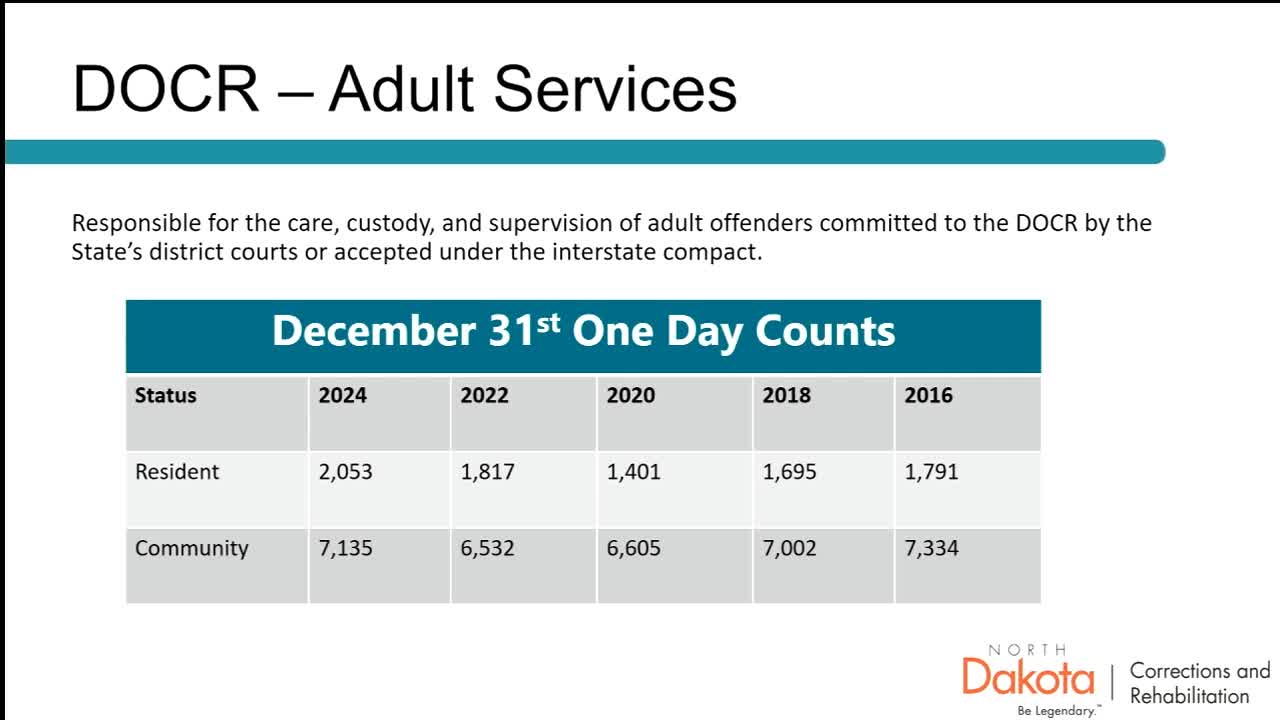
Department of Corrections Director Colby Braun told the Senate appropriations panel that pretrial services and reentry programs have reduced jail pressure, but several state facilities remain at or above rated capacity and the department is using county beds and temporary units to manage overflow.
The Department of Corrections and Rehabilitation told the Senate appropriations panel that pretrial services and expanded reentry centers have helped reduce county jail pressure, but that statewide jail and prison populations continue to exceed rated capacity in several facilities.
Colby Braun, DOCR director, and staff said pretrial supervision—which provides assessments and community oversight for people awaiting trial in several districts—has shown results in reducing custodial populations and supplying better information to judges. Braun described Grand Forks as a site where appropriations supported the program and said the department will bring pretrial services to full-time staffing in that district.
Nut graf: Despite investments in pretrial and reentry programming, DOCR said it remains over capacity at several men—s facilities and uses partnerships with counties to house overflow inmates. Counties receive state reimbursement for room-and-board and medical costs for deferred admissions and overflow placements, a cost DOCR says it prefers to reduce by increasing community programming and adding temporary state bed capacity.
Key points
- Capacity: Agency slides showed the rated capacity for key facilities (examples given): James River Correction Center (capacity 490), Missouri River Correction Center (187), North Dakota State Penitentiary (779) and two Heart River Correction Center cottages (combined 54). The department said current combined population plus transitional/reentry beds was near or above the stated capacity for the biennium.
- Deferred admissions and county billing: DOCR described a population of inmates who remain in county jails under deferred admission when the department lacks space. "If somebody gets sentenced today at Burley County and we don't have room to bring them in, we start paying for them, for room and board plus medical costs," a department official said. County charges vary; DOCR presented rough per-day estimates that county costs can range from about $85 to $125 per day plus medical, compared with an internal estimate of roughly $148 per day for care inside state facilities (estimates depend on services required).
- Reentry and transitional placements: The department emphasized partnerships with county jails (Mackenzie County, Rugby, Dickinson) and contracts with private providers (e.g., Management & Training Corporation) and local reentry centers to add available beds and work-release slots. Braun highlighted Bismarck Transition Center and the addition of reentry capacity in Minot and Dickinson as part of the inmate management plan.
- Temporary man-camp plan at MRCC: The department described a plan for two temporary 44-bed units at MRCC (88 beds total) as a short-term measure; those beds would be portable units intended for programming while a larger women—s facility project proceeds.
Why it matters
Overcapacity affects classification, programming schedules and staff workload; the department said it prioritizes bringing in the most dangerous or clinically complex people first when space is short. Committee members asked for details on costs and prioritization; staff said they would provide additional data on county billing, overflow costs and the classification criteria used to select inmates for county placement.
Ending note
Legislators asked the department to continue work on reentry and pretrial programming while providing clearer cost comparisons for county placements vs. state facility care. DOCR said it would supply more detailed fiscal estimates and a prioritized plan for proposed temporary bed units and community expansions.