Get Full Government Meeting Transcripts, Videos, & Alerts Forever!
Get email alerts on the Behavioral Health And Reentry topic
No spam. Unsubscribe anytime.
Corrections seeks funding for behavioral health programs, community reentry and Free to Recovery supports
Summary
Department presenters outlined behavioral health services delivered in facilities, a Free to Recovery program run by DHHS for people involved in the criminal justice system, and requests for county jail programming and a 25‑bed reentry center in northwest North Dakota.
Department of Corrections officials told the Senate Appropriations Committee that behavioral health programming and community reentry supports are central to reducing recidivism and that they seek funding for programming in county jails and a 25‑bed reentry center in northwest North Dakota.
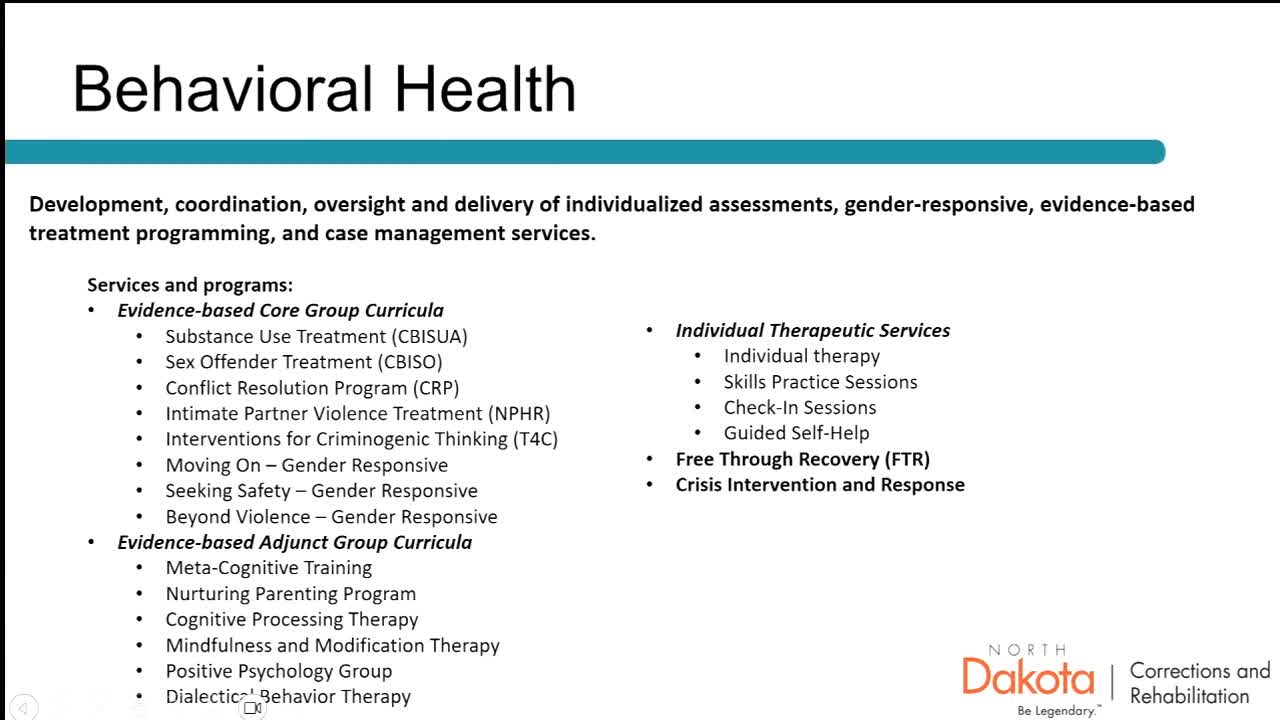
Rochelle Juntunen, Deputy Director of Adult Services, summarized the department’s in‑custody behavioral health offerings — substance abuse treatment, cognitive behavioral therapy, gender‑responsive groups, parenting classes, individual therapy and peer‑support teams. She described intake assessments that assign residents a mental‑health care level and determine housing and programming needs.
Free to Recovery: presenters explained the Free to Recovery program, run through the Department of Health and Human Services (DHHS), which pairs participants who are involved in the criminal justice system with care coordinators in the community. Juntunen said the program is voluntary, has had about 1,451 current participants and over 4,000 participants in the past biennium; she said 69% of participants meet at least three of four positive outcomes (housing, employment, addressing substance abuse, and no further criminal‑justice contact).
Budget asks: the department reported $15.7 million in its base budget for behavioral health, and said the executive recommendation includes staff salary increases, restoration of RSAT grant‑funded telehealth and $1.5 million for county jail programming plus $1.6 million for a 25‑bed reentry center in northwest North Dakota. Committee members asked about program funding flows between DHHS and corrections; presenters said the programs work in partnership and track outcomes but funding responsibilities have shifted between agencies in prior sessions.