Get Full Government Meeting Transcripts, Videos, & Alerts Forever!
Get email alerts on the Corrections It Modernization topic
No spam. Unsubscribe anytime.
Corrections seeks new client‑management system and EHR upgrades in IT budget request
Summary
Department officials told appropriators the current facility management software is aging and costly to maintain; they asked for a phased client‑management replacement that would unify facility and community systems, plus upgrades to electronic health records and other IT projects.
Department of Corrections officials told the Senate Appropriations Committee they need a phased replacement of their client management systems to unify facility and community records, and they outlined additional IT requests for medical software upgrades and security technology.
Amy Borachek, Chief Administration Officer, said the department’s facility management system (an older “elite” system provided by a vendor called Syscon) has accrued many add‑on applications and is near end of life. She said the department and NDIT assessed the need for a unified client‑management system to eliminate duplicate data entry and improve case management.
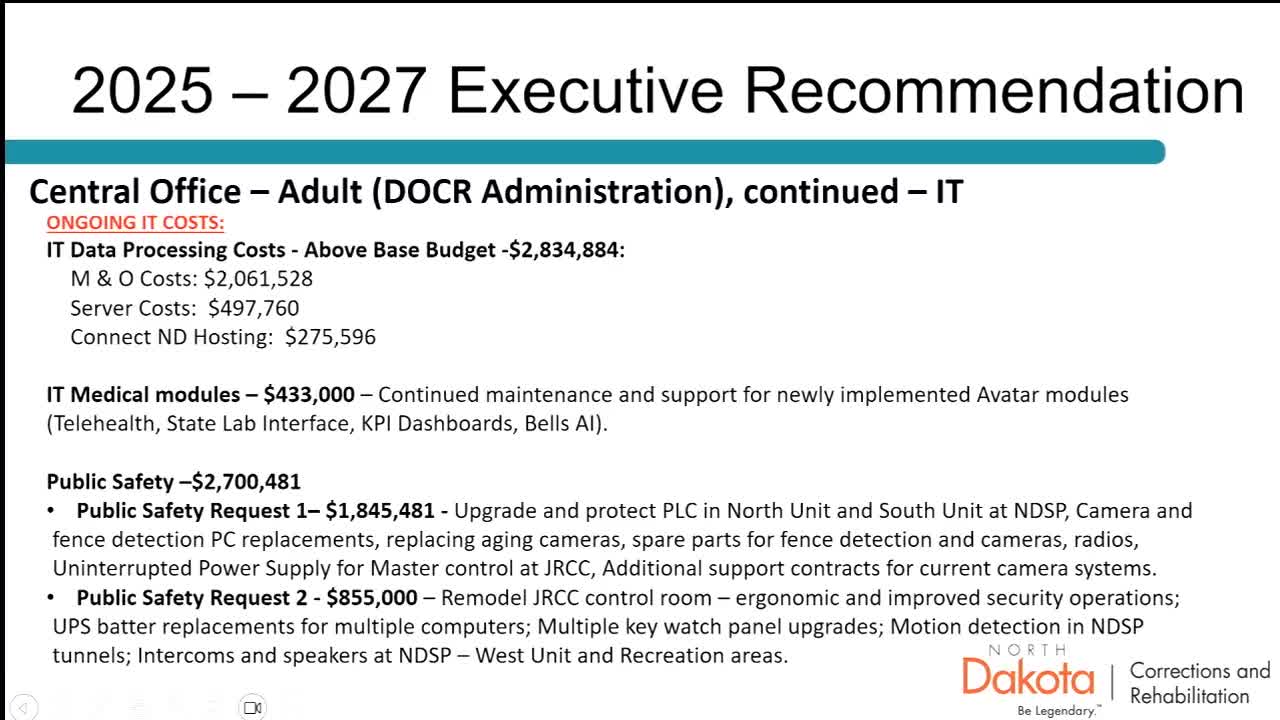
“We really do need a new client management system,” Borachek said, adding the change is a phased, multi‑biennium effort. She described ongoing costs for server hosting, ConnectND hosting, and additional modules for the department’s electronic health record. The department said it has already implemented an electronic health record application and needs further modules (telehealth, state lab interface, dashboards) and vendor upgrades (NX upgrade of Netsmart/Avatar) to remain supported.
Why it matters: committee members asked about vendors, hosting and whether upgrades would be cloud‑based. Borachek said the new client‑management system would consolidate the “elite” facility system and DocStars (community side) over time, and that some add‑on IT projects are mission‑critical and have ongoing maintenance costs.
Budget and next steps: presenters provided a prioritized list of ongoing IT costs and new project asks, including robotic process automation, Recidiviz dashboards, a millimeter‑wave body scanner, security and public‑safety systems, and enhancements to community program tracking. Committee members asked for more detailed project plans, vendor information and cost breakdowns before advancing major IT appropriations.