Get Full Government Meeting Transcripts, Videos, & Alerts Forever!
Get email alerts on the Workforce Staffing topic
No spam. Unsubscribe anytime.
Corrections officials flag alarmingly high turnover among correctional staff; median tenure under six months
Summary
Travis Engelhardt, chief human resources officer for the North Dakota Department of Corrections and Rehabilitation, told the Senate Appropriations Committee that correctional officer turnover remains unusually high, with the department losing 4060% of newly hired officers within their first year in recent years.
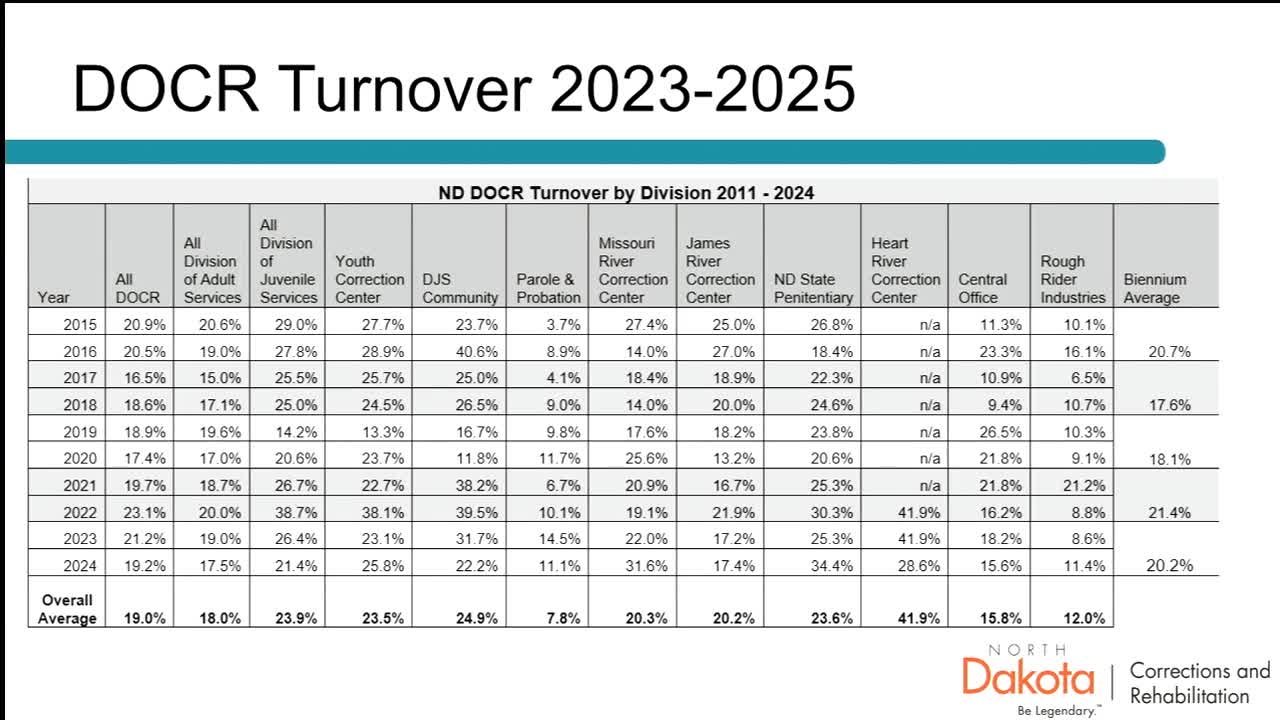
Travis Engelhardt, the Department of Corrections and Rehabilitation—s chief human resources officer, told the Senate Appropriations Committee the agency—s overall turnover fell to just under 20% for calendar year 2024 after a difficult prior period, but that correctional officer losses remain especially high.
"We are losing between 40 and 60% of all our hired correctional officers in that first year," Engelhardt said. He added that when the department analyzed tenure, "the median stay of a correctional officer in those two years was five and a half months. So essentially, we train them and then they're gone." The committee heard detailed exit-survey data showing about 70% of departing employees reported having another job when they left and 60% said the new job paid more.
Nut graf: The staffing crisis affects facility operations, programming and safety, the department said. DOCR is seeking continued targeted market-equity funding to raise hiring rates and address pay compression that has left experienced staff paid near the same as new hires. The agency also supports legislation to move state correctional officers into the public-safety retirement plan—a change the department says would make state positions competitive with county and local employers.
Details and why it matters
- Turnover numbers: Engelhardt said correctional-officer turnover historically averages 3035%, but the agency experienced a sharp increase in 202223; for some positions the department lost 4060% of newly hired officers within their first year in the 202223 period.
- Pay compression: Engelhardt described a compression problem that emerged after targeted market-equity increases. He told the committee, "If you look at the 5-to-10 year service group, there's a 3% difference in pay from a 10-year correctional officer to a brand-new correctional officer. That's what I mean by compression." The department said the legislative market-equity allocation helped hiring but created internal compression issues that should be addressed.
- Retirement plan disparity: Engelhardt highlighted that state correctional officers are currently not part of the state's public-safety retirement plan, unlike county correctional officers and other law-enforcement personnel. He said a pending bill in the legislature would add state correctional officers to the public-safety plan; the department supplied an estimated fiscal figure but noted actuarial updates are pending.
- Recruitment factors and response: The department described a complicated set of causes—shift work, the inability to telework, the physical and emotional demands of corrections work, and a decline in qualified applicants starting in 2019. DOCR said it added a talent-acquisition manager and is reviewing recruitment, selection and pre-employment assessments to reduce mis-hires and early separations.
Member questions and follow-up
Committee members pressed for comparison data with other states and for more detail about the age and tenure of departing staff; Engelhardt responded that he would provide comparative wage data and said some requested analytic detail was in the handout provided to the committee. Engelhardt also noted a marked improvement in registered-nurse turnover after pay changes, dropping from near 50% to below 25%.
Ending note
Lawmakers asked the department to return with additional benchmarking and prioritized cost options. The DOCR said its priority is to hold staff pay competitive with county employers and to reduce early separations that leave shifts and supervision teams understaffed.