Get Full Government Meeting Transcripts, Videos, & Alerts Forever!
Get email alerts on the Appropriations Budget topic
No spam. Unsubscribe anytime.
Senate panel hears Department of Corrections budget request covering women—s facility, treatment, IT and Hepatitis C funding
Summary
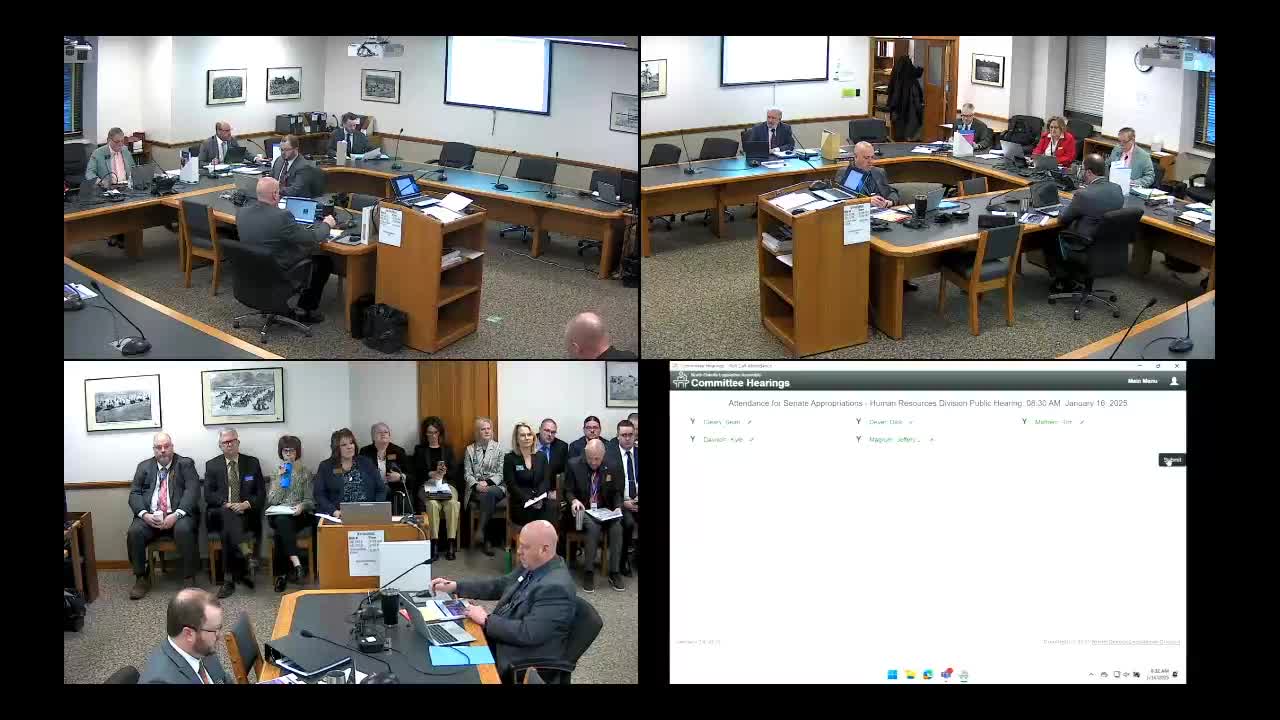
Senate Appropriations Committee Chairman Senator Deaver opened the Human Resources Division public hearing on Senate Bill 2015, an appropriations measure for the Department of Corrections and Rehabilitation (DOCR).
Senate Appropriations Committee Chairman Senator Deaver opened the Human Resources Division public hearing on Senate Bill 2015, an appropriations measure for the Department of Corrections and Rehabilitation (DOCR). Colby Braun, director of the department, and Michelle Zander, DOCR chief financial officer, presented the agency—s base budget, new requests and several one-time items the department says are needed to maintain operations and planned projects.
The appropriation bill under review covers the department—s central office, adult facilities, juvenile services and community corrections. Colby Braun, Director of the Department of Corrections and Rehabilitation, told the committee the department—s work focuses on people "whether it's people who work there or it's people who live in our facilities or if it's people who are supervised out in the community." He said the budget presentation would highlight facilities, parole and probation, pretrial services and other sections of the agency.
The DOCR asked the committee to fund several multi-year and one-time needs. Michelle Zander outlined FTE adjustments and vacancy-pool transfers the agency used in the current biennium, and described line items in the executive recommendation: restoration of prior one-time inflationary funding for food, clothing and inmate wages; funding for IT and data-management enhancements; maintenance and plant repairs; and multiple equipment and safety requests, including body cameras, tasers and ballistic vests for staff.
Why it matters: the department says several items in the request are tied to operations and safety, and to projects already underway. Braun told the committee the new women's facility is a central project, and the agency is carrying forward legislative funding and bid packages for an expansion at the women's facility. He also said the department expects to complete other capital projects within budget, but that some plant work and extraordinary repairs remain on the list.
Key details from the hearing
- Women—s facility and beds: Braun described the ongoing project to construct a new women's facility and an interim plan to add beds at the Missouri River Correctional Center (MRCC) campus, including two 44-bed units (88 beds total) intended as temporary units. Separately, the department has added 44 beds to the women's facility and released the first construction bid package for that project.
- Hepatitis C: Braun said funding provided in the current session has enabled the department to treat people in custody for hepatitis C. "When we're done and at the end of this session, every single person who currently resides in one of our prison facilities will be cured from hep C," he said.
- IT and client management: Braun said the department's client management system (called ELITE) is at end-of-life and needs replacement or significant modernization. Michelle Zander and staff requested IT/data-management funding to address the system and other public-safety IT needs.
- Heating plant and extraordinary repairs: juvenile services director Lisa Bearguard and plant services director Chris Jangula described an aging heating plant at the Youth Correctional Center that the department says is more than 100 years old and showing structural failures; the department requested funding to replace the heating plant and to address deferred maintenance across the system.
- One-time vs. ongoing funding: Zander described prior one-time allocations (ARPA/other carryover) the agency used for deferred maintenance and operations. The executive recommendation restores some previously one-time increases to ongoing budgets for inflationary items; other capital requests are submitted as one-time SIF requests.
What the department asked for and next steps
The department's executive recommendation includes both ongoing restorations (inmate wages, medical/food inflation and salary increases) and one-time SIF items (IT upgrades, plant and heating-plant repairs, kitchen equipment, dental imaging units and safety equipment). Zander said some federal grants and awards (notably VOCA and other victims grants) have declined, creating pressure to use state funds to keep community subrecipients whole if federal awards do not recover.
Braun warned the committee that pending legislation outside this bill could have fiscal effects on the DOCR budget. He specifically referenced a potential Senate bill (2128) that, as drafted, would reduce eligibility for work release and reentry centers and change credit-earning rules (an 85% time-served requirement was described), which he said could increase bed demand and cost.
Ending note
The committee scheduled further line-item review in the afternoon. Committee members asked the department to provide prioritization of one-time requests and additional detail on IT and deferred maintenance packages. The session recessed for lunch pending further analysis and follow-up materials from staff and agency presenters.