Get Full Government Meeting Transcripts, Videos, & Alerts Forever!
Get email alerts on the Agricultural Research Funding topic
No spam. Unsubscribe anytime.
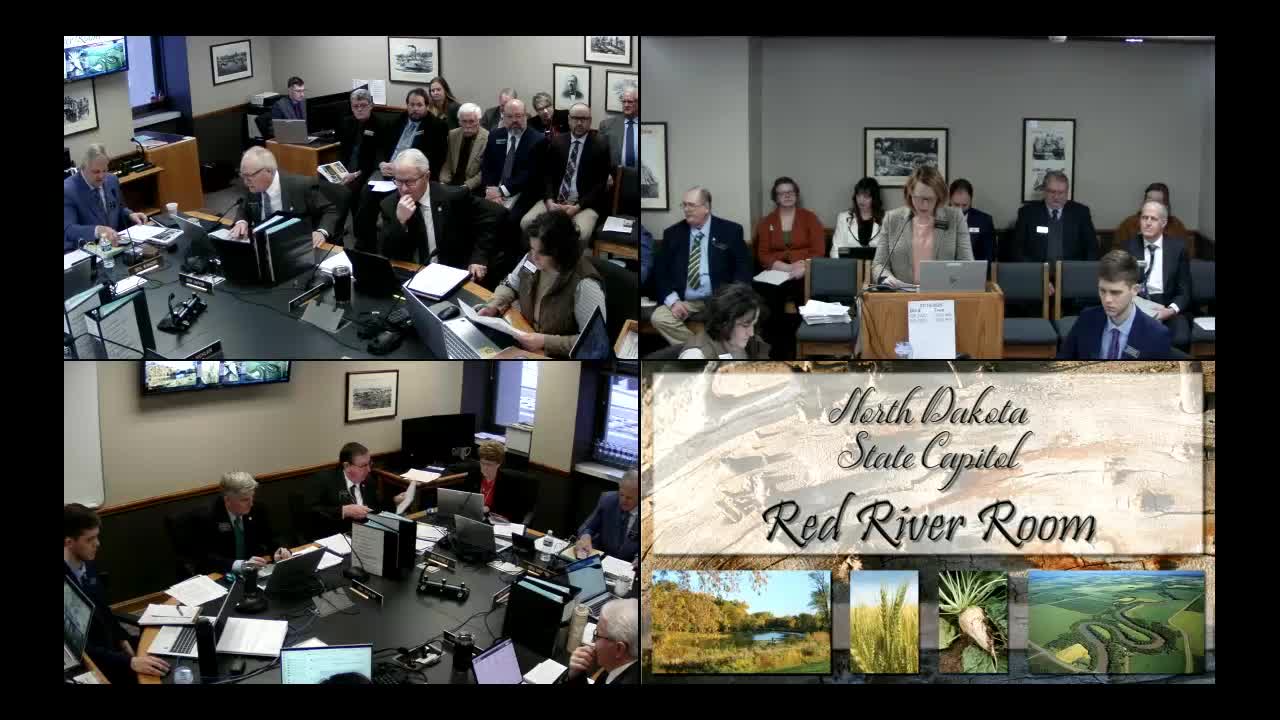
NDSU experiment station urges funding for research, facilities and new data initiatives in SB 2020 hearing
Summary
Lawmakers heard more than three hours of testimony Thursday on SBARE’s funding priorities, which include new policy and trade staff, a digital-agriculture initiative, a veterinary toxicology resident, operating and equipment increases, and several capital projects tied to research facilities.
Lawmakers heard more than three hours of testimony Thursday on the State Board of Agricultural Research and Education’s (SBARE) funding priorities, a package of programmatic and capital requests that supporters say are essential to North Dakota agriculture’s economy and future competitiveness.
SBARE chair Sarah Hall Lovas, an agronomist from Hillsboro, told the Government Operations Division of the Senate Appropriations Committee that the board’s stakeholder-driven priority list supports both the North Dakota Agricultural Experiment Station and NDSU Extension and “there is no better investment for a state dollar than into agriculture research and extension.”
The priority list presented by NDSU and SBARE asks the Legislature to fund a mix of program positions, operating support, graduate assistantships and several capital projects. Among the highest-ranked program requests are funding to establish a Center for Agricultural Policy and Trade Studies ($975,000 for three FTEs), a digital-technology initiative to accelerate precision and “digital agriculture” research (staff and operating support), a veterinary toxicology resident at the Veterinary Diagnostic Laboratory ($325,000), expanded operating and equipment budgets and additional research specialists statewide.
“Much like our national championship football team, agricultural research at NDSU brings a national championship level of effort to the state of North Dakota as well,” said Greg Lardy, director of the North Dakota Agricultural Experiment Station, describing the range of work from livestock health to plant breeding and data analytics.
Why it matters: testifiers emphasized the economic stakes. Witnesses cited a recent study showing agriculture’s contribution to the state economy at roughly $30 billion and noted new processing investments — soybean crush facilities, dairies and a potato plant — that increase demand for locally developed research and varieties. Supporters said state-funded research helps preserve market access and improves farm profitability by producing region-specific solutions for pest control, nutrient management, new varieties and livestock health.
Key program requests and context
- Center for Agricultural Policy and Trade Studies: SBARE ranked this its top programmatic priority. The request covers three positions (an ag policy analyst, a market and trade analyst and an economic-impact specialist) and was framed as essential for analyzing how national and international policy and trade dynamics affect a landlocked, export-dependent state.
- Digital agriculture / data initiative: SBARE seeks staff and operating funding to expand precision- and data-driven research (positions such as AI/ML engineer, data scientist, GIS specialist, database architect and unmanned aircraft systems specialist) and subscriptions/server access. Testimony stressed that modern breeding and sensor research require secure, high-performance data infrastructure.
- Veterinary toxicology resident: The Veterinary Diagnostic Laboratory would add a resident in veterinary toxicology to address livestock toxin events (mycotoxins, ergot, blister beetle toxins) and build in-state capacity.
- Operating support, equipment and graduate research assistantships: Multiple REC directors described rising costs for fuel, repair, feed and laboratory supplies and asked for increased recurring operating budgets, new equipment funding, and additional GRA support to sustain experiments and retain early-career scientists.
Capital and one-time requests
SBARE’s capital list included the Oaks Irrigation Research Building completion ($620,000 estimated), a modern seed-cleaning facility at Langdon REC (SBARE rank #2, $2.6 million requested), additional storage sheds at branch centers (three sheds requested, roughly $1.567 million total), and a deferred maintenance package (SBARE requested $1.5 million in one-time funding toward a larger backlog).
Williston/Nesson Valley change in scope: At the Williston Research Extension Center (WREC) the original plan for a larger facility at the Nesson Valley irrigated research site exceeded available appropriations and actual bids. WREC director Sam Funk and other witnesses described a recommended change in scope — focusing construction on a heated shop, restrooms and employee break room — plus requests to carry forward prior general-fund appropriations and receive special-fund authority to raise additional dollars for completion.
Other capital items on SBARE’s list included special-fund authorization requests for a swine research facility and a greenhouse addition on the Fargo campus.
Governor’s recommendation and next steps
Committee members were told that the governor’s executive recommendation announced recently (Governor Armstrong) included partial support for some SBARE items: special-fund authority for equipment/graduate support (initiative #4), $525,000 in general funds for the biofuels/carbon management initiative (initiative #5), $1.5 million in SIF funds for deferred maintenance and $620,000 in SIF funds for Oaks Irrigation Building completion. Committee staff said the printed budget book still reflected the previous governor’s recommendation and that written updates would be provided.
Voices from across the state
About two dozen directors, producers and organization representatives testified in favor of the SBARE priorities. REC directors from Carrington, Central Grasslands, Dickinson, Langdon, Minot (NCREC), Williston and Hettinger described how facility upgrades and technician/staff additions would protect expensive precision equipment, support on-farm and branch-station research, and retain scientific personnel. Commodity and producer groups — including North Dakota Farmers Union, North Dakota Corn Growers, North Dakota Grain Growers, North Dakota Stockmen’s Association and others — urged approval of SB 2020 and highlighted the policy, trade and biofuels research elements as crucial to market access and producer income.
Sample quotations: “The investments that the legislature has made ... have resulted in significant and positive impacts for North Dakota agriculture and will last for future generations,” SBARE chair Sarah Hall Lovas said. Greg Lardy added, “We really believe that much like our national championship football team, agricultural research at NDSU brings a national championship level of effort to the state of North Dakota as well.” Williston REC director Sam Funk summarized the local funding challenge: “At multiple times ... the construction ... was quoted to be well in excess of the $1,700,000.”
What was not decided
No formal votes or committee decisions were recorded during the hearing; the session consisted of testimony and questions. The committee recessed for lunch and scheduled continued business and deliberation later in the appropriations process.
Ending
The hearing recessed until the afternoon and committee staff said they would provide updated printed materials reflecting the governor’s executive recommendation before further consideration.