Bismarck State reports enrollment surge, opens Advanced Technology Center and seeks funding for workforce programs and housing
Loading...
Summary
Interim Bismarck State College President Brent Sanford and EVP Rebecca Collins told the Appropriations committee the college has consecutive enrollment growth, substantial workforce programming tied to an Advanced Technology Center, and near‑term needs for housing and health‑sciences instructional space.
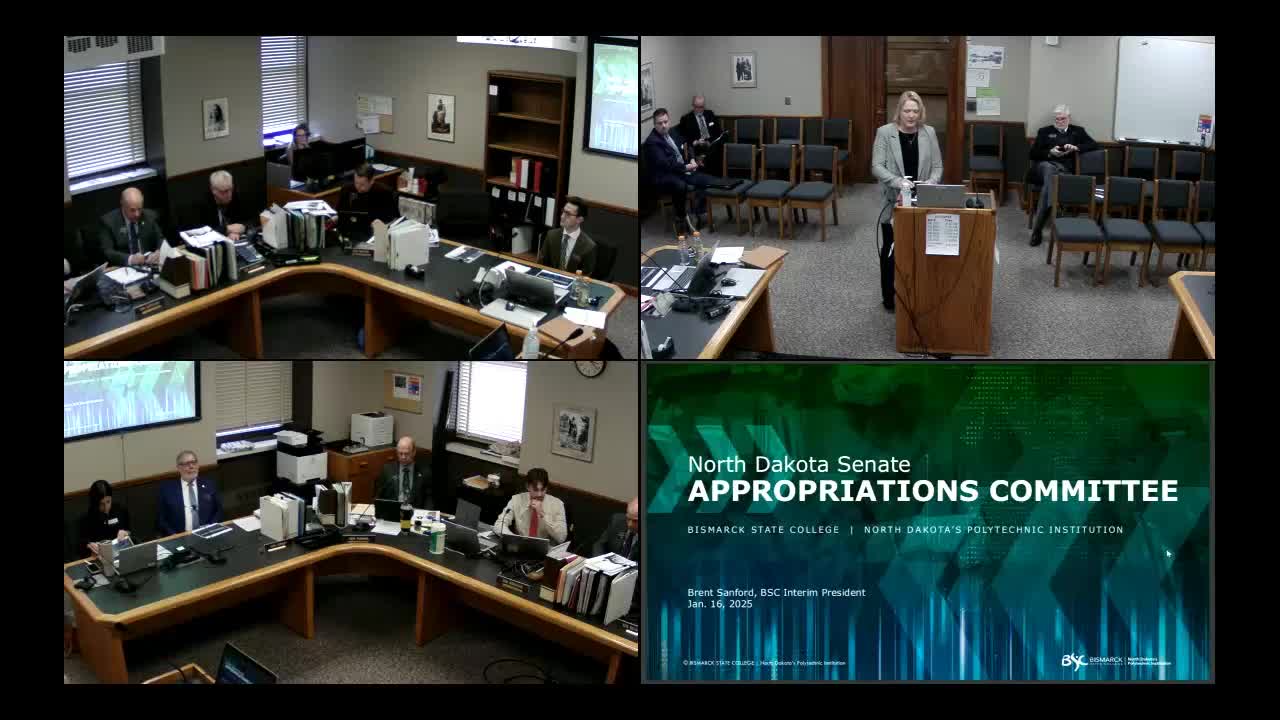
Brent Sanford, interim president of Bismarck State College, told the Senate Appropriations — Education and Environment Division that Bismarck State is experiencing rapid enrollment growth, has opened a near‑complete Advanced Technology Center and is pressing the Legislature for program start‑up funding and infrastructure to expand health‑care and workforce training.
“We are on track to not only have our highest enrollment in BSC history, but also our sixth consecutive semester growth,” Sanford said. He told the committee the college is meeting five‑year enrollment goals two years early.
Sanford and Rebecca Collins, executive vice president, summarized accomplishments including 35 new credentials since the last biennium (25 certificates, six associate degrees and additional bachelor pathways), new industry partnerships, and the near‑complete Advanced Technology Center. The center — funded with a mix of general fund and fiscal relief dollars — includes an immersive room for XR/VR workforce projects, a security operations center, lab bays for large equipment and a live event venue; Sanford invited legislators to a March 4 ribbon cutting and said $400,000 of start‑up funding for program startup remains available.
The college cited several workforce initiatives: Grand Energy outreach to western CTE centers, an automation and electrician technician pipeline, a Mystic Smiles dental clinic (no state funds used to stand up the clinic), XR/VR and a $9.9 million grant for VR work intended to connect people with disabilities to career possibilities. Sanford said industry demand frequently outstrips available program capacity; he described letters of support from about 50 medical and dental providers for expanded health‑sciences programming.
Sanford and Collins also described a critical student‑housing shortage. Collins said the college sold $30 million in student‑approved bonds (an 83% student approval) to finance a multipurpose athletics and student‑athlete facility, with a $10 million foundation pledge; students will pay the bond via student fees. The college said it has 524 housing applications and 54 students on a wait list after increasing capacity to about 470. Sanford described a planned residence‑hall project under negotiation with potential private partners and said the college would seek access to a proposed revolving loan fund in House Bill 1128 if it becomes law.
On capital requests, the college described a potential $43 million, 62,000‑square‑foot expansion of the Bismarck State Health Sciences building to accommodate additional programs and clinical capacity; that proposal has been presented to the State Board of Higher Education. Sanford also noted the college had no audit findings in its most recent audit and that the Composite Financial Index improved from 0.6 in 2016 to 9.22 currently.
Sanford said Bismarck State is requesting continued challenge‑grant support and additional start‑up funding for expensive, high‑tech workforce programs; he warned these programs often require hiring staff and buying equipment months before tuition revenue begins. The college also asked the committee to consider energy program weighting in the funding formula; Sanford said a proposed Senate bill (2034) would raise weighting for energy programs to better reflect costs.
Committee members asked about the college’s fiscal position and the student fee plan for the athletics facility. Collins confirmed students voted to issue $30 million in bonds and that student fees will fund that debt service, with a $10 million foundation contribution. Sanford closed by noting the college has site plans and estimates ready for housing and health‑sciences expansion and will return with more detail as the budget process continues.