Get Full Government Meeting Transcripts, Videos, & Alerts Forever!
Get email alerts on the Career Technical Education And Capital topic
No spam. Unsubscribe anytime.
NDSCS seeks $24.5 million to convert underused library to educational innovation center, advances aviation and ag expansions
Summary
North Dakota State College of Science told the committee it has record or near‑record enrollment in several CTE programs, is expanding precision agriculture and diesel facilities and asked for $24.5 million to convert an underused library into a multi‑use educational innovation center plus $3 million to demolish vacant dorms.
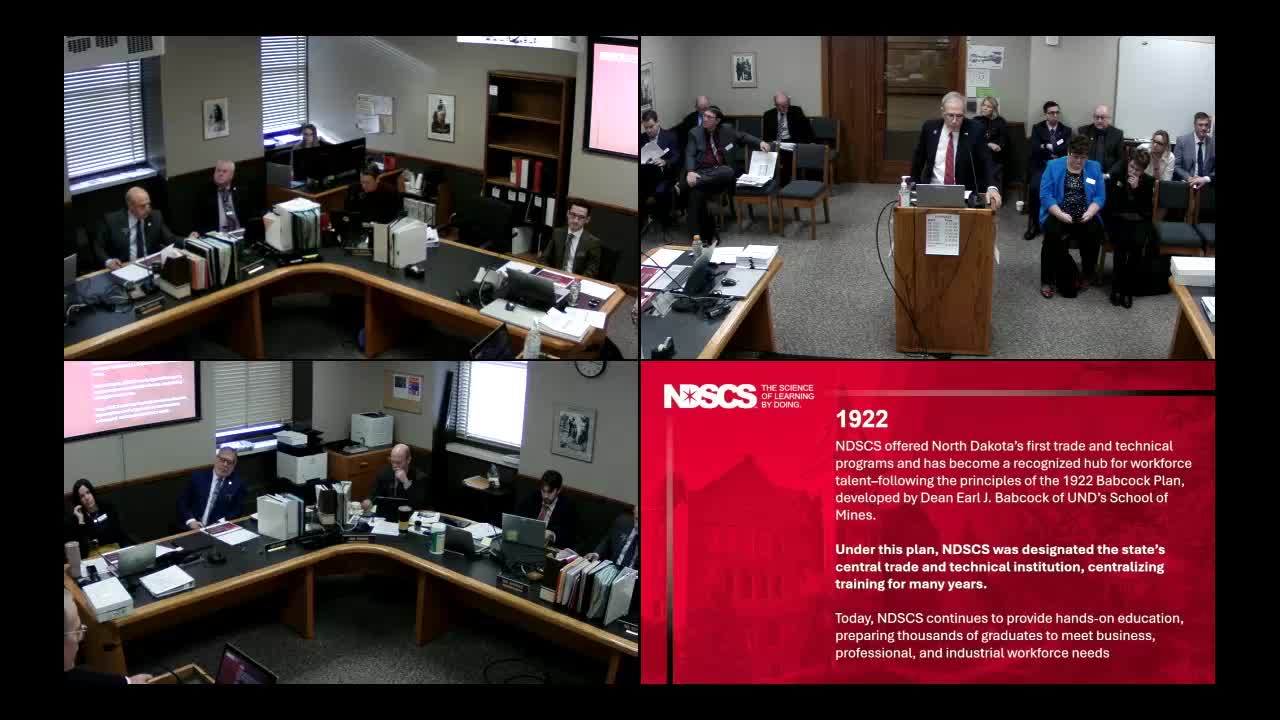
Rod Flanagan, president of North Dakota State College of Science (NDSCS), told the Appropriations committee that the college has a 20 percent increase in student enrollment over four years and produces more career‑technical credits than the rest of the state’s institutions combined.
Flanagan said NDSCS recorded 3,367 total enrollments for fall 2024, including 1,346 dual‑credit students, and that many workforce programs have grown substantially. “This past year, we, reimagined our guiding statements, and we, developed a new strategic plan. The number that led the rest of the strategic plan is our goal for student credit hours,” he said, adding the college’s target of 80,000 credits by 2030.
The college outlined capital and program requests. NDSCS asked for about $24.5 million to renovate the campus library into an educational innovation center that would create flexible labs and maker space to support robotics, automation, electrical and allied health growth; presenters said conversion would also remove about $8 million of deferred maintenance from the college’s capital backlog. Flanagan said the new space would allow growth in electrical (reported at more than 150 students), robotics/automation, nursing and allied health and provide a student activity hub.
NDSCS also asked for roughly $3 million to demolish three vacant dormitories that have sat unused about 15 years; the college said demolition includes asbestos abatement. Flanagan described a separately funded project — a precision‑ag/diesel expansion — that received nearly $20 million in prior legislative support and matching private gifts; he reported progress and on‑time, under‑budget delivery of that package.
Flanagan described new program planning including an aviation maintenance program supported by Federal Aviation Administration grants and partnerships with a local jet center for hangar access and lab space. He said the aviation program will be capital intensive and will require additional seed funding to stand up instructor and lab capacity before enrollment grows.
The presentation emphasized NDSCS’s role in statewide workforce training and the college’s high composite financial index. Flanagan asked legislators to support targeted capital for the educational innovation center and demolition and highlighted the workforce innovation bill discussions as essential to fund high‑cost program starts.
Ending: NDSCS pitched a conversion of an underutilized library into a shared innovation center to expand multiple CTE programs; it also requested demolition of unused dorms and seed funds for new aviation maintenance training tied to FAA grants.