Get Full Government Meeting Transcripts, Videos, & Alerts Forever!
Get email alerts on the N Dsu Extension Budget topic
No spam. Unsubscribe anytime.
NDSU Extension asks Senate panel for staff, operating support and new specialists tied to carbon, livestock and AgriBiome work
Summary
NDSU Extension director Greg Lardy and stakeholders urged the Senate Appropriations —Government Operations Division to fund initiatives in Senate Bill 2020 that would add specialists and operating dollars for biofuels/carbon work, livestock precision and 4-H, while county soil conservation groups urged increased state operating support.
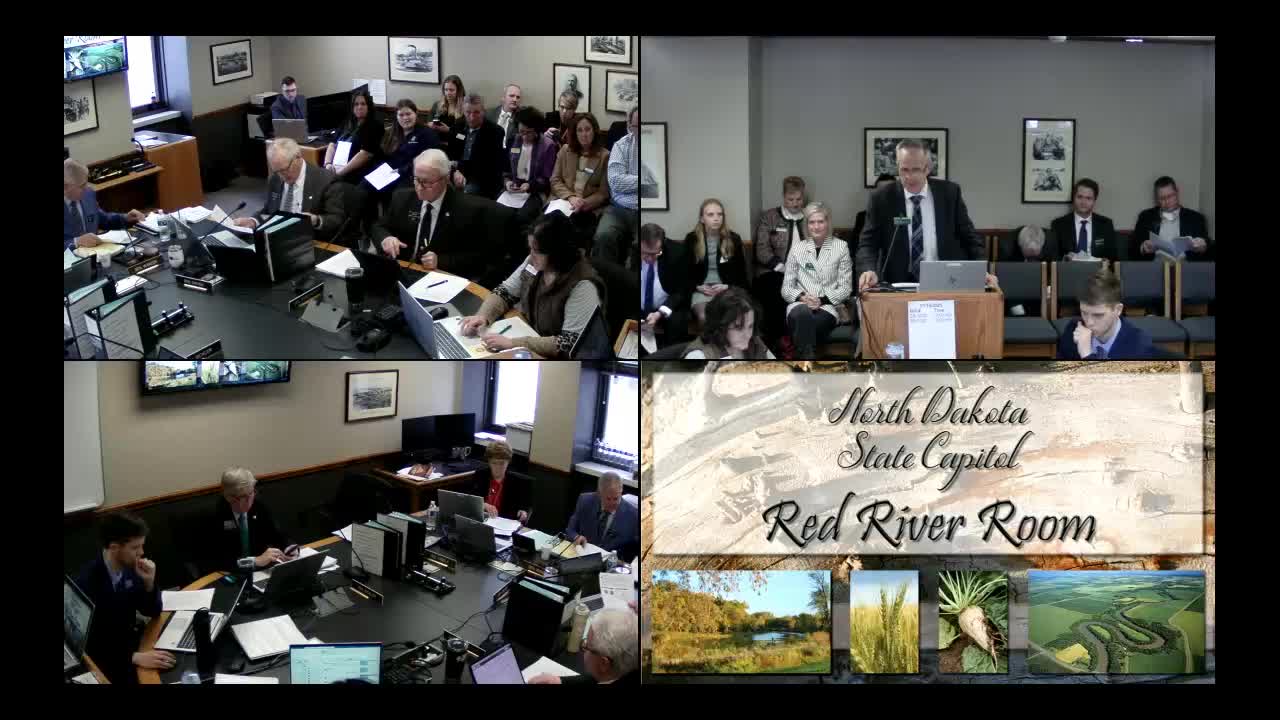
At a hearing of the Senate Appropriations —Government Operations Division, North Dakota State University Extension Director Greg Lardy outlined program requests bundled in Senate Bill 2020, asking for new staff and operating dollars to expand extension services statewide.
"NDSU Extension plays a direct and vital role in the lives of North Dakotans and is 1 of the agencies that help shape the future of North Dakota through our programming efforts in agriculture, community wellness, and youth development," Lardy told the committee.
Lardy laid out four SBARE-ranked initiatives included in SB 2020: a biofuels and carbon specialist (1 FTE, operating support) with a total request of $325,000; additional operating support for NDSU Extension and the State Soil Conservation Committee totaling $750,000 ($600,000 for extension operations and $150,000 for the state soil committee); a livestock precision management and animal health initiative (2 FTE plus operating support) requesting $815,000; and an AgriBiome specialist (1 FTE plus operating support) requesting $325,000. Lardy said Governor Armstrong's executive recommendation included $309,000 toward the biofuels/carbon initiative and $150,000 in special funds for the operating-support request, but did not fund the other ranked initiatives.
The panel also heard stakeholder testimony supporting the bill. Julie Ellingson of the North Dakota Stockmen's Association told senators, "Extension has already been a leader in the precision management space," and said an extension specialist and a veterinary epidemiologist would help livestock producers adopt technology and improve disease surveillance. Drew Courtney of the North Dakota Corn Growers and Peril Grossman of the North Dakota Soybean Growers Association emphasized the need for a carbon/biofuels specialist to help producers navigate carbon markets and to protect access to emerging low-carbon markets for ethanol, biodiesel and sustainable aviation fuel.
Local conservation leaders described the on-the-ground impacts of the requested operating funds. Bob Martin, a Stutsman County Soil Conservation District director, said state committee funds are "a lifeline" for 54 county districts and enable technical assistance and conservation planning that local districts leverage with federal grants. Rhonda Kelch, executive director of the North Dakota Association of Soil Conservation Districts, told the committee that state allocations support administrative capacity, training and growing urban conservation work, and that many districts face staffing and wage pressures.
Lardy and witnesses described program outputs tied to the requests: Extension's 4-H reached over 40,000 youth in 2024; the pesticide safety program trained over 7,200 people; an ag finance program helps stakeholders manage roughly $1.3 billion in annual land rents across 22 million acres; and livestock risk protection outreach supported insurance for nearly 170,000 head of cattle with about $4.5 million in indemnity payments in 2024.
Discussion at the hearing focused on where requested dollars would be spent, the statewide footprint of extension services (local offices in each of North Dakota's 53 counties and 7 research-extension centers), and workforce pressures for county soil conservation offices. No formal votes or committee actions were recorded in the transcript.
The committee will consider these requests alongside executive budget recommendations. Stakeholders urged full funding of the SBARE-ranked items, while staff and legislators asked clarifying questions about which items were included in the governor's budget and what the additional operating dollars would enable.
Less critical details discussed included the swine extension specialist funded in 2023 (now filled), programming delivery methods (webinars, in-person programs, web resources), and the role of local county governments in staffing Extension county offices.
Copies of the Extension budget book pages were referenced repeatedly; the committee was directed to pages 67—————— and 77 for initiative rankings and the governor's executive recommendation.
Lardy concluded by offering to answer committee questions and by noting stakeholder testimony that would follow later in the hearing.