Get Full Government Meeting Transcripts, Videos, & Alerts Forever!
Get email alerts on the Indigent Defense Budget topic
No spam. Unsubscribe anytime.
Indigent defense director warns of constitutional risk as caseloads and turnover climb; commission seeks pay and investigator hires
Summary
Commission on Legal Counsel for Indigence Director Travis Fink told the Senate Appropriations Committee turnover, vacancy rates and rising felony caseloads are pushing the public defender system toward constitutional strain. The commission seeks higher contractor rates, pay adjustments and additional investigators.
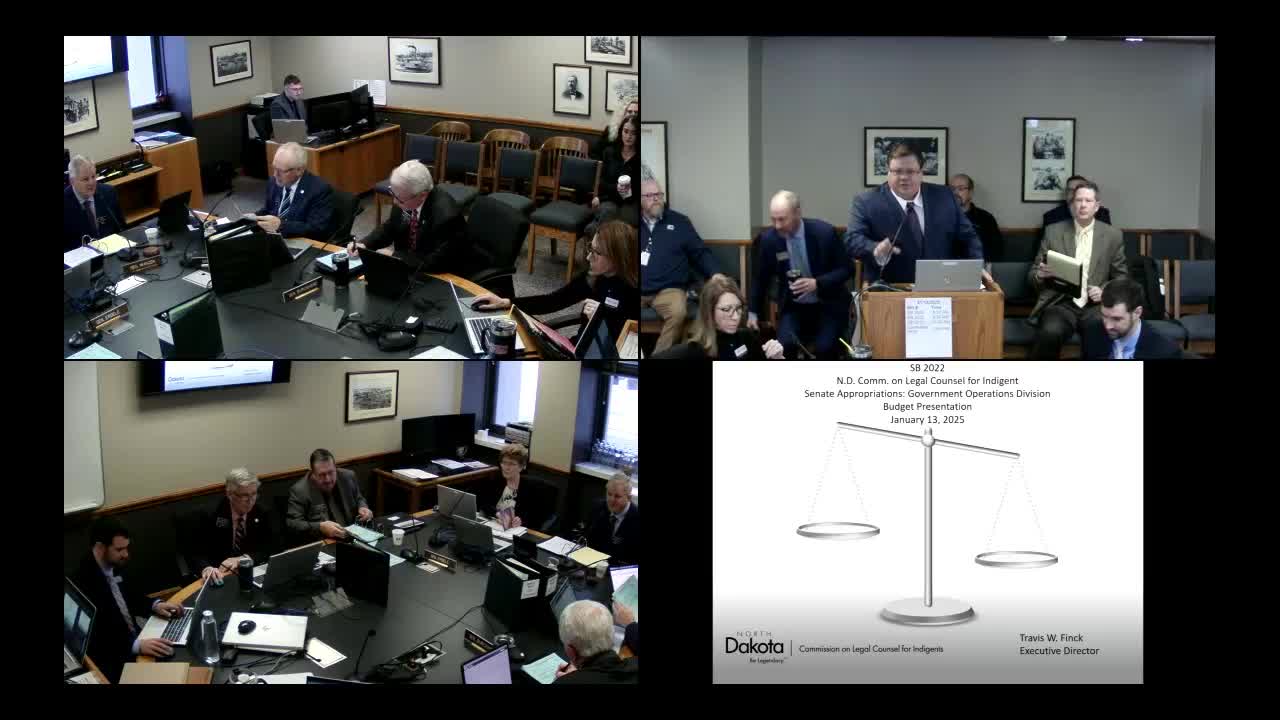
The Senate Appropriations Committee heard a budget request from the Commission on Legal Counsel for Indigence on Tuesday, where Executive Director Travis Fink described rising caseloads, high staff turnover and short-staffed investigative resources that he said risk a constitutional failure in public defense.
Fink told the committee the commission provides counsel whenever “there's a constitutional, statutory or rule-based right to counsel at public expense,” and that most work involves adult criminal cases. He said fiscal year 2024 was the agency’s highest caseload on record and that the mix of cases includes more time-consuming felonies: “If we were to adopt [recent national] workload standards ... we would need four times as many attorneys,” Fink said, summarizing a RAND report on workload standards.
Fink said the commission has 41 FTE positions and reported turnover of 18 full-time positions in the current biennium — roughly 43.9% — with 10 of those being attorneys. He said the agency’s starting salaries lag prosecutors and other government attorney pay and that a prior one-time increase had been matched or exceeded by county salary adjustments, leaving the public defender pay gap intact.
Recruiting and contractor pay: The commission is required by statute to send at least 50% of cases to private contractors; Fink said the agency’s current contractor pay rose last session from $80 an hour to $80 (and the commission is asking to index contractor pay to the federal Criminal Justice Act (CJA) rate). He said the commission proposed setting contractor pay at 60% of the federal CJA benchmark to preserve competitiveness; that benchmark was $172.60 at the time the testimony was prepared and had increased to about $175 on Jan. 1.
Investigators and services: The commission said it had requested three investigator FTEs last session, was granted one and hired a lead investigator placed in Bismarck. Fink and Bismarck public defender Omid Cardoost and lead investigator Jonathan Vanderhoff described investigative work — evidence review, witness interviews and on-site fact-finding — that allows attorneys to vet suppression issues and other defenses early in cases. Vanderhoff said the office’s investigator work has produced case dismissals and helped in major trials; he and Fink urged funding of five additional investigator positions so each public defender office could have one investigator.
Policy and proposals: The commission reported it approved a draft bill at a recent commission meeting that would require counsel at initial appearance and create a presumption of indigence for persons in custody, which the commission said would increase representation at first court appearances and could reduce pretrial detention. Fink also flagged potential fiscal pressure from proposed sentencing changes that would increase trial demand or increase time needed per case.
Support from legal community: Zachary Pelham, commission chair and a private attorney, and Tony Wyler of the State Bar Association urged the panel to support the commission’s budget and the steps to close the pay and retention gap. Jonathan Byers of the State’s Attorneys Association said federal practice provides counsel at initial appearances and noted the federal CJA rate used as an indexing reference had just increased.
Ending: Committee members asked for supporting data and Fink offered to supply salary-comparison details. No committee votes were taken; the commission’s requests will be considered as part of the budget process.