Get Full Government Meeting Transcripts, Videos, & Alerts Forever!
Get email alerts on the Higher Education Capital And Workforce topic
No spam. Unsubscribe anytime.
Williston State reports sharp enrollment gains, advances $36.6 million health training building
Summary
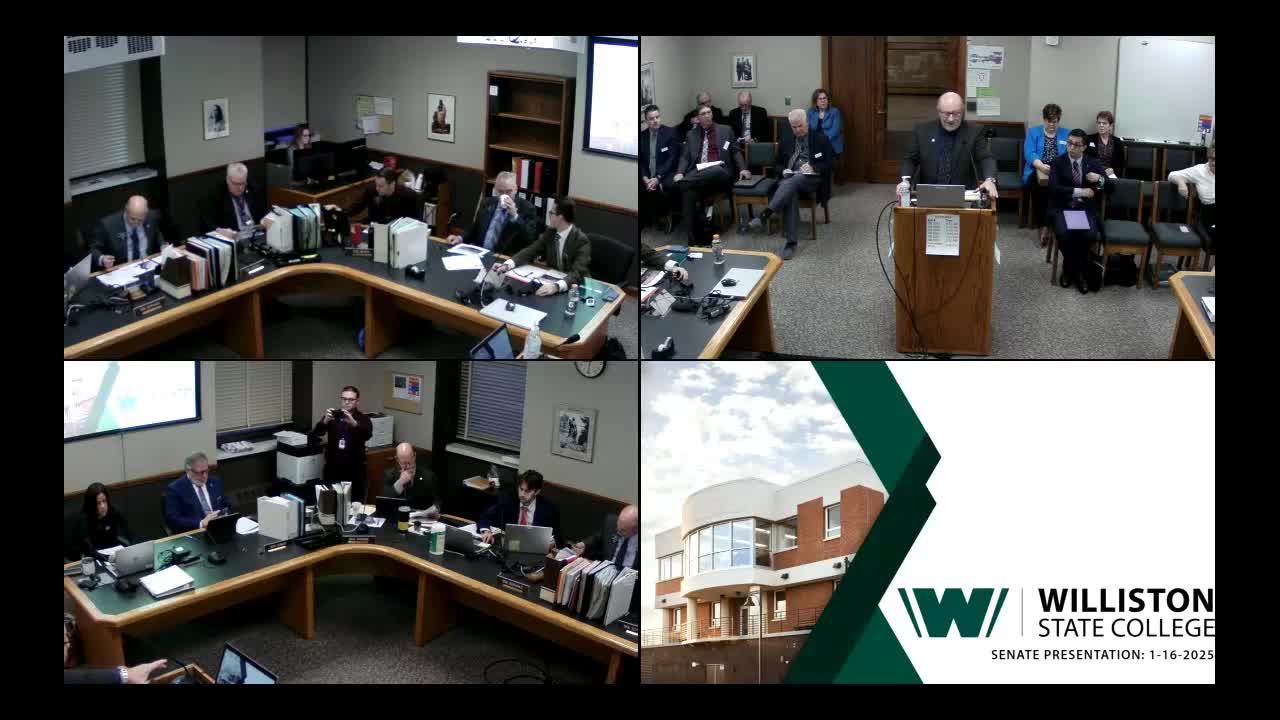
Williston State College told the Appropriations - Education and Environment Division it has rapidly increased enrollment, completed a campus childcare center and turf fields, and is seven months into construction of a $36.6 million healthcare training building slated for November 2025 completion.
Bernal Herning, president of Williston State College, told the Appropriations - Education and Environment Division that the college has reversed multi-year declines and added new capital projects and academic programs to meet regional workforce needs.
Herning said the college had a fall headcount of 1,058 and that full‑time equivalent enrollment and other categories all rose by double digits compared with the prior year. “These numbers here on this slide are from last fall semester. They are the census numbers that we reported to the state and to IPEDS,” he said.
The increases follow an active capital program. Herning described three campus projects: a repurposed childcare center, a turf conversion of baseball and softball fields, and a new healthcare training building. The childcare project cost $2,300,000 and serves 90 children (70 full time, 20 part time); the college reports it hosts Valley City State University early‑childhood students for practicum hours at the center. The turf project was locally funded after the college scaled an earlier $7.8 million approval to a $5.6 million plan; Herning said that work is about 90% complete and will include grandstands, a press box, fencing and lighting before spring play.
The largest project is the healthcare training facility. Herning said the total cost is $36.6 million and that the legislature provided 80 percent of the funding while the college foundation covered the remainder. He told the committee the project is seven months into a 16‑month schedule and is “on schedule, under budget,” with classes planned to begin in spring 2026 and a targeted construction completion in November 2025.
Zahi Atala, vice president for academic affairs, described the planned academic expansion tied to the new facility and other initiatives to retain students locally. Atala said the college will offer more than a dozen new health programs and move nursing and massage programs into the new building. He also described a “2+2 comatriculation” approach with four‑year campuses so students may enroll simultaneously at Williston State and a partnering university and access local classes counted under federal financial‑aid rules (he referenced 34 CFR 668 when explaining home/host institution rules).
Herning and Atala said clinical sites, instructor recruitment and accreditation limits will determine how quickly program capacity grows. Herning said the college currently can serve up to 60 ADN students and is planning to request permission from the Montana State Board to enroll some Montana residents at cross‑border clinical sites; he estimated the college hopes to approach roughly 100 nursing students if they secure instructors and clinical placements.
Finances and fundraising also featured in the presentation. Herning and Hunter Berg, the college foundation director (referenced in the presentation), credited the foundation with awarding $2.3 million in scholarships and supporting capital matches. Herning thanked the legislature for prior support and noted the campus expects to appear before the committee on Senate Bill 2212 (tier capital/building fund) the following week.
Herning closed by asking the committee to consider the college’s enrollment and program expansion when evaluating funding; no formal votes or committee actions were recorded during the presentation.
Ending: Williston State emphasized rapid enrollment gains, completion of local facilities and an on‑schedule health training building intended to expand the regional healthcare workforce. Officials said program capacity will depend on instructor hires and clinical placements and signaled upcoming requests to the legislature for capital and formula funding adjustments.