Get Full Government Meeting Transcripts, Videos, & Alerts Forever!
Get email alerts on the Racing Commission Budget topic
No spam. Unsubscribe anytime.
Racing Commission director outlines budget, warns of wagering threats to ADW revenue
Summary
Bruce Johnson, executive director of the North Dakota Racing Commission, told the Senate Appropriations Education and Environment Division the commission relies on advanced deposit wagering revenue and administers separate breeders, purse and promotion funds that support live racing.
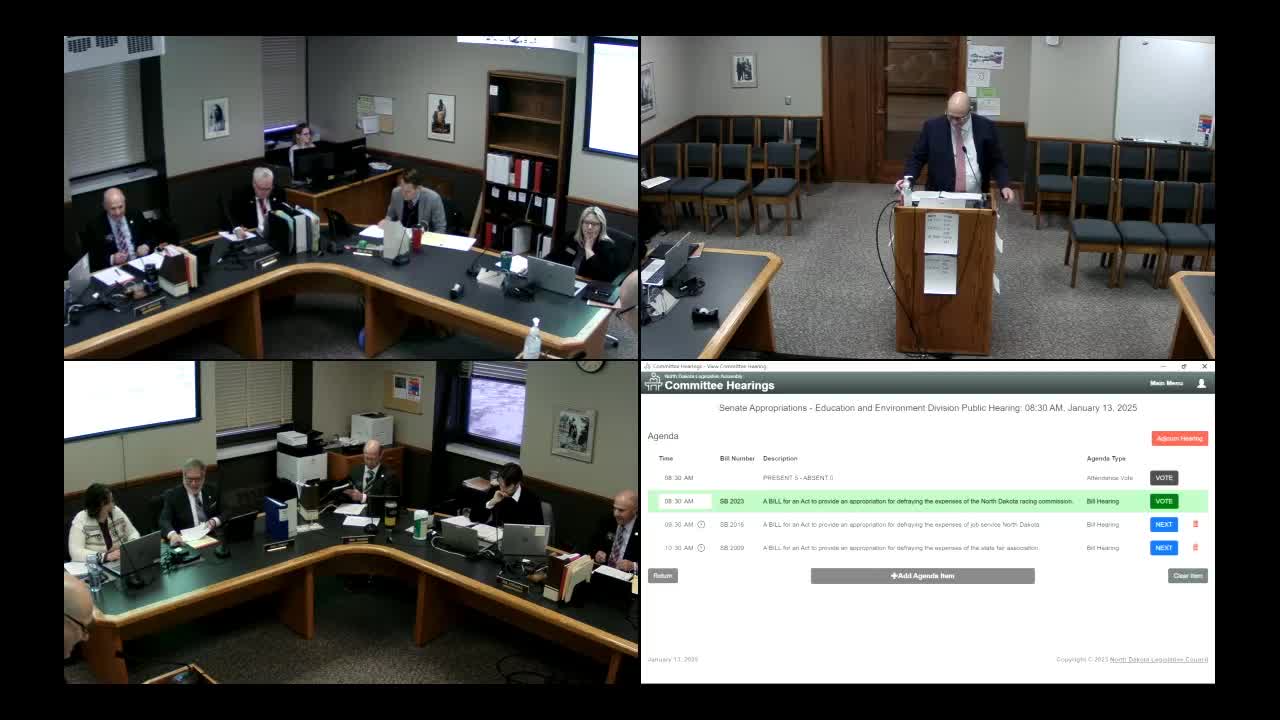
Bruce Johnson, executive director of the North Dakota Racing Commission, testified before the Senate Appropriations Education and Environment Division on the commission’s budget and operations for the 2025–27 biennium.
Johnson said the commission “was established in 1987,” and described three funds the commission administers — a breeders fund, a purse fund and a promotion fund — that supplement live racing purses and support racetrack promotions and facility improvements. He told senators the commission also licenses and oversees licensing for track workers and participants and regulates pari‑mutuel wagering and multiple industry vendors.
Why it matters: Johnson told the committee the commission’s operating model depends in part on multi‑jurisdictional ADW companies that bring large wagering handles into North Dakota racing. He warned that proposals to restrict wagering content, including measures backed by an animal‑rights group he identified as “Grama 2 k,” could reduce ADW participation and lead some ADW operators to stop seeking North Dakota licenses.
Johnson described the commission’s licensing and oversight work: he said the commission currently licenses about 16 ADW companies, “5 tote companies,” and “4 site operators,” and that it contracts veterinarians and stewards for live race meets. He also described the three funds: the breeders fund to incentivize North Dakota‑bred horses, the purse fund to supplement race purses, and the promotion fund to help tracks with security, advertising and special promotions.
On attendance and revenue Johnson said Fargo’s meet drew “just under 10,000 in attendance over 4 weekends” in 2024 and that the commission had recently added two ADW licensees (ExpressBet and AmWager). He said the commission’s advertising campaign last year cost “just short of $50,000” and that the commission’s budget going into the session included a college intern program and a one‑time request for a heavy‑duty office printer.
Questions from senators focused on how the commission could increase self‑generated revenue, the role of simulcasting and whether the ADW model can be expanded without being perceived as gambling expansion. Johnson suggested simulcasting races outside the state and expanding marketing as two possible paths, while warning that change must be balanced against federal and industry rules (he referenced a federal body, HISA). He also said legislation altering ADW rules or historic‑horse or greyhound content could have “a significant change” for Fargo racing and the commission’s revenue stream.
Johnson closed by saying the commission has a “decades long history of returning a little bit more than we have been allocated budget wise,” and that he would stand for questions.
Details and context drawn from testimony: the commission’s testimony included counts and examples mentioned above; Johnson identified the animal‑rights group pushing greyhound restrictions, and repeatedly framed future changes as contingent on bills that had not yet been filed.
Looking ahead: senators indicated they will review budget language and follow up with the Racing Commission for specifics tied to any bills introduced during the session.