Get Full Government Meeting Transcripts, Videos, & Alerts Forever!
Get email alerts on the Sb17 Hearing Timing Changes topic
No spam. Unsubscribe anytime.
Panel reviews SB17 to align child-welfare hearing windows and move show-cause to 21 days
Summary
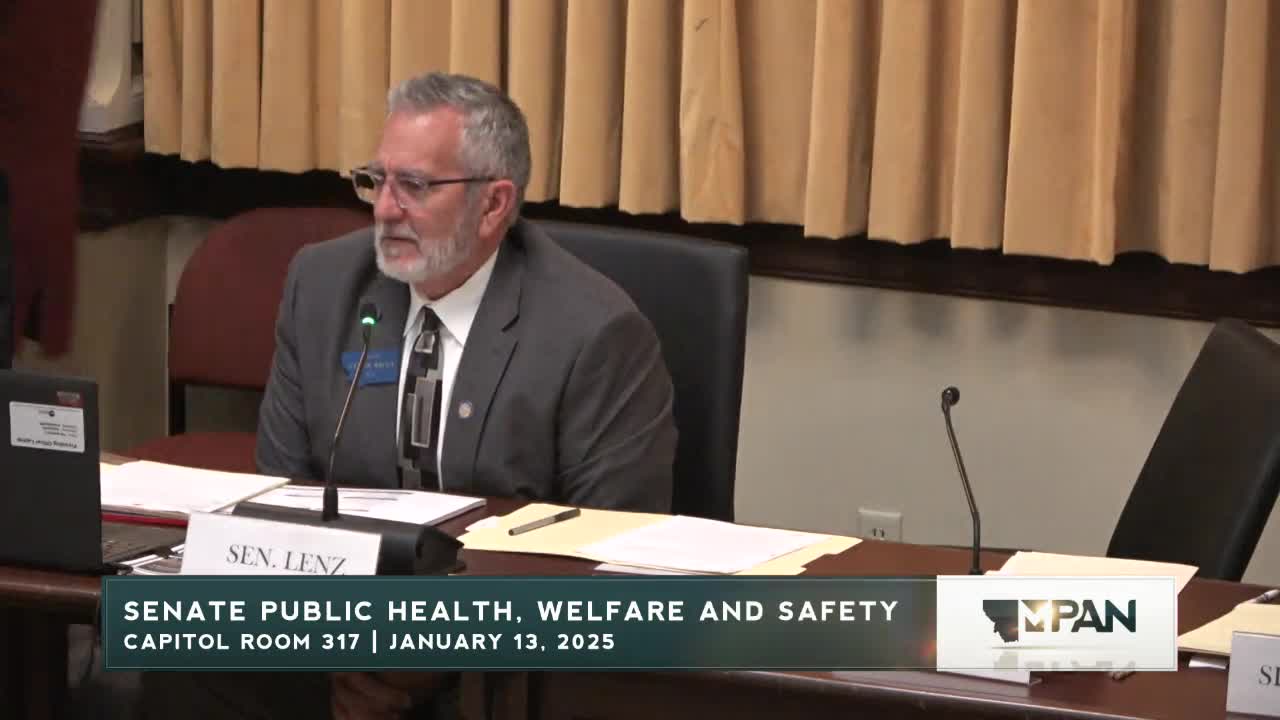
The Senate Public Health, Welfare and Safety Committee on Jan. 13 heard testimony on Senate Bill 17, which would clarify "5 working days" timing for Emergency Protective Services hearings and move the show-cause hearing to 21 days to improve court scheduling efficiency.
HELENA, Mont. — The Senate Public Health, Welfare and Safety Committee on Jan. 13 opened testimony on Senate Bill 17, which proposes to align pre-hearing timelines with Emergency Protective Services (EPS) hearings and to move the show-cause hearing from 20 days to 21 days for scheduling efficiency.
Senator Lehi presented SB 17 as a product of the dependency-neglect task force that reviewed court scheduling and sought small changes to improve efficiency. He described two primary changes: specifying "5 working days" for the EPS timeline so weekend and holiday counting is clarified in practice, and changing the show-cause hearing to 21 days so court scheduling aligns to weekly calendars.
Nikki Grossberg, division administrator for Child and Family Services, testified in support, saying the alignment "creates efficiency not only for the judicial system, but also for parents. They previously would have to take a day off work at 5 days and then come back and take another day off work at 5 working days for the EPS hearing. So by combining that into the same timeline, it does help parents be able to attend both the pre hearing conference and their emergency protective services hearing." Heather Webster, deputy chief county attorney in Yellowstone County, also supported the bill and said local judges favor the 21-day show-cause timing.
Tom Billteen of the Office of Court Administrators clarified administrative mechanics: the Judicial Branch houses the pre-hearing program, which uses a part-time coordinator and contracted facilitators. Committee members pressed for clarity on whether "5 working days" and "5 business days" are interchangeable and which branch’s scheduling the term would affect. Senator Emmerich and others noted that child-protective services staff can operate seven days a week, so the practical impact depends on which entities the statutory term constrains.
Proponents framed SB 17 as a modest, technical fix that would reduce scheduling friction and repeated missed work for families. Tribal representatives also supported the bill, noting the added notice provisions for tribal governments described in the bill’s section 4. No committee vote was recorded at the conclusion of the hearing; Senator Lehi closed by urging passage.