Get Full Government Meeting Transcripts, Videos, & Alerts Forever!
Get email alerts on the Wildfire Finance Models topic
No spam. Unsubscribe anytime.
Legislative Fiscal Division unveils wildfire risk and cost models for Montana lawmakers
Summary
Legislative Fiscal Division staff showed interactive wildfire history, risk and mitigation dashboards to the House Natural Resources Committee, explained recent changes to the state fire suppression fund, and answered lawmakers’ questions about insurance, causes and mapping of mitigation work.
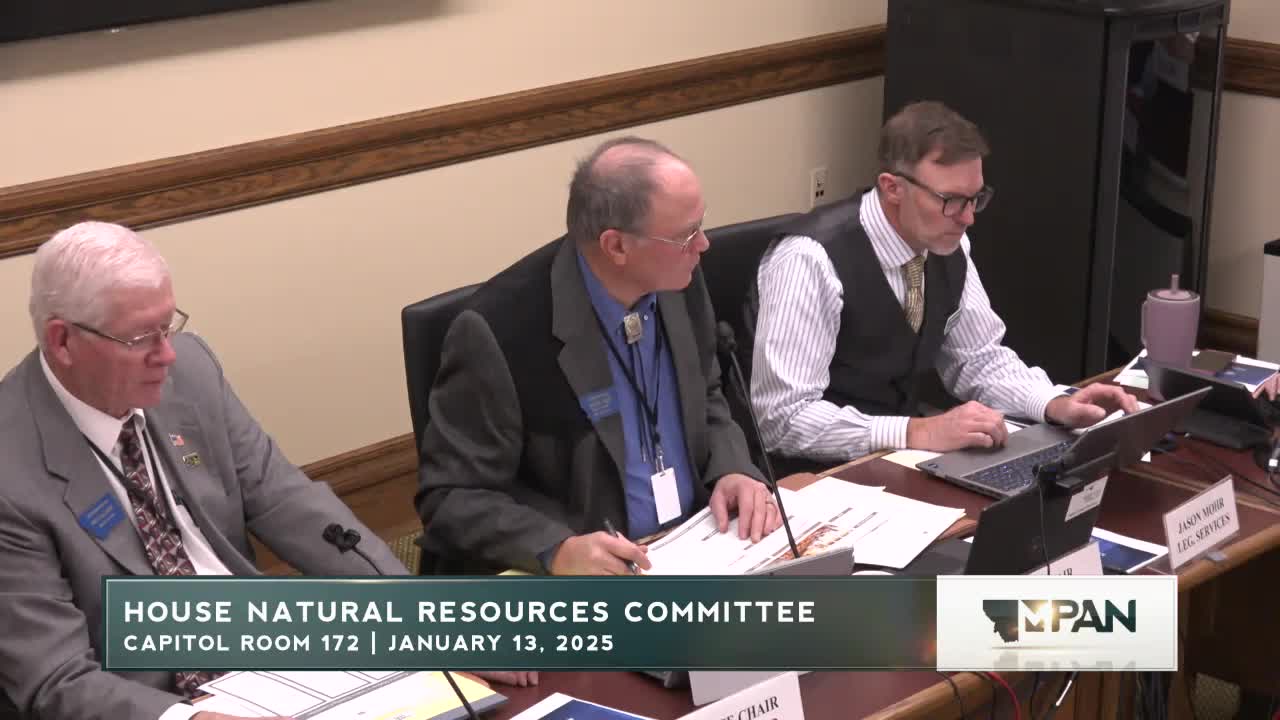
At a meeting of the House Natural Resources Committee, Legislative Fiscal Division staff demonstrated interactive wildfire data tools designed to help lawmakers see historical fires, suppression costs and mitigation activity and to run scenarios for budget and policy questions.
The presentation, led by Legislative Fiscal Division staffers Amy Carlson, Nick Van Brown, Alice Hecht and Robert Miller, showed linked “MARA” modules and a wildfire-specific dashboard that contains more than a century of perimeter data, roughly 20 years of suppression-cost records and 10 years of mitigation project records. "Wildfire is a ... major risk to the state and its partners. It's a very large and unpredictable cost," said Alice Hecht, a legislative fiscal division presenter.
Why it matters: Committee members were shown how the tools can be used to trace where suppression and mitigation dollars have gone, estimate future fiscal exposure, and map which properties sit in the wildland-urban interface. The models are built to be updated live with new data and to accept scenario inputs from lawmakers and staff.
What the tools show: Nick Van Brown, who described the office’s new modular approach, said the models combine many data sources into base models that can be forecasted and run as scenarios. The wildfire model includes a historical “perimeters” page, an account of state and federal suppression spending, maps of mitigation acreage by funder, a wildland-urban interface (WUI) layer based on U.S. Geological Survey methods, and an analysis of residential properties by year built and hazard potential.
Funding history and current law: Robert Miller traced how Montana financed firefighting over time, saying the state originally relied on the general fund and gubernatorial emergency appropriations. After a large 2008 fire year, the legislature created a state special revenue fire suppression account and put an initial $40 million into it. A subsequent law referenced by staff, House Bill 354, added revenue mechanisms in 2014. More recently, staff said, House Bill 883 provided a one-time transfer (about $156 million as described to the committee) and created a formula-driven cap—currently described by staff as about $200 million—that the state will backfill from specified revenues when available. Miller summarized: "We used it up fighting fires... in 2014 the legislature created House Bill 354" and later "House Bill 883 ... transferred about a one-time only transfer of about $156,000,000 into that account."
Key numbers presented (as described in the meeting): staff said the wildfire dataset includes roughly 138 years of perimeter data; roughly $2.3 billion has been spent on fires in the last 20 years (staff estimate); federal agencies reported about $80 million in mitigation spending over the last 10 years; mitigation records in the model include roughly 680,000 acres treated; staff reported that in Montana about 1.5% of land is classified as WUI by the USGS definition while about 63% of homes lie in that WUI layer; and staff said a five-year trend showed average annual state suppression payments around $30 million (all figures reported by Legislative Fiscal Division staff during the presentation).
Insurance and mitigation concerns: Committee members raised concerns about how private insurers or vendor risk scores might use similar data. Representative Konair warned that models could affect homeowners’ access to insurance if mitigation work is not reflected: "It concerns me that models are being used to predict insurance premiums for folks and perhaps them losing their insurance due to being in these areas that have been identified in the model when the mitigation hasn't been taken into consideration." Hecht and other staff said the division’s data sources and methods are transparent and that, if the committee can provide reliable mitigation-location data (for example, addresses of treated properties), staff can map and incorporate that information into the tools.
Causes and reporting: Vice Chair Rob Leonard asked, "What percentage of all these fires are human caused?" Staff said cause data exist for many recent fires and that nationally roughly half of fires have human causes, but that percentages vary by year and location. Robert Miller said the division can provide more exact historical breakdowns if the committee wants them.
Tool access and follow-up: Presenters said most modules are available on the fiscal division web site and are intended to be updated as new data arrive. Nick Van Brown emphasized the office’s readiness to add inputs requested by legislators so scenario analyses reflect committee questions. Staff also said the data include federal and state mitigation records but not every agency’s internal dataset; they offered to incorporate additional, stable mitigation datasets if provided.
No formal committee action was taken during the presentation; the session was a briefing and Q&A rather than a decision or vote. Staff repeatedly framed the materials as tools to inform budget and policy choices the legislature may consider during the session.